
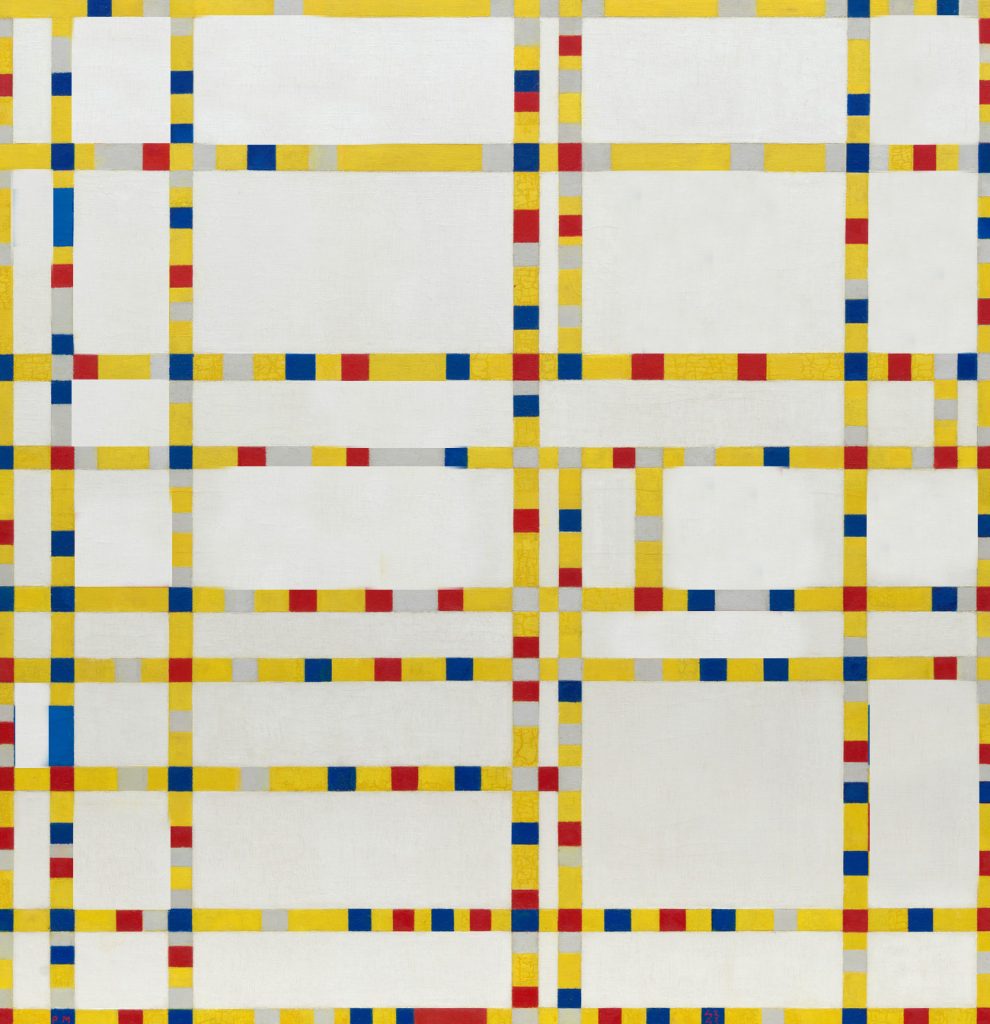
Piet Mondrian's *Composition No. II, with Red and Blue*, created in 1929, is an oil painting on canvas and is now in the collection of the Museum of Modern Art (MoMA) in New York. Although small in size, this work is widely regarded as a highly condensed example of Mondrian's mature Neo-Plasticist language: the canvas is framed by black vertical and horizontal lines, and through asymmetrical division, only red, blue, and white areas are retained, shifting the painting from a representation of nature to a pure structural order. MoMA also considers works of this type to be key examples that propelled the development of modern abstract art.
If we understand this work within the context of a "basic grid module," its most important value lies not merely in the "grid composition," but in establishing a visual system that is both stable and dynamic through a limited number of horizontal and vertical lines and planes. Here, the "grid" is not a mechanically uniform grid, but a meticulously planned organization of proportions: some areas are wide, some narrow; some lines reach the edge of the canvas, while others stop before it; some planes bear strong color weight, while others maintain a sense of breathing space with large areas of white. Therefore, this work is not a static balance, but a balance established through difference.
Formally, the most distinctive feature of the work is the interdependence between black lines and color blocks. Mondrian did not treat the black lines as simple outlines, but rather as visual planes with thickness, direction, and rhythm. In other words, the black lines themselves are part of the composition; they not only separate color blocks but also actively participate in the generation of order. The red areas form the strongest visual focus in the picture, while the blue areas provide a calming ballast. The large areas of white are not "blank," but rather active spaces that allow the structure to unfold. Smarthistory specifically points out that Mondrian's black lines are not passive outlines, but rather, together with the color planes, constitute "opposition within harmony."
This work stands as a representative of the basic grid module because it elevates the "grid" from a measuring tool to an artistic concept. Traditional grids are often used to aid in proportional positioning in realistic painting, but in Mondrian's work, the grid no longer serves the object; it becomes the object itself. Real-world experiences such as trees, buildings, cities, and the horizon are continuously refined into relationships between vertical and horizontal, size and weight, stillness and expansion. Thus, the viewer sees not a specific object, but a world structure purified by reason. Mondrian did not pursue decorative simplification, but a universal order of "de-individualization."
From a visual psychology perspective, this basic grid module has profound training value. It teaches viewers how to discern order in a minimal set of elements: horizontal and vertical lines form a stable framework, asymmetry breaks the monotony, a few primary colors create focal points, and negative space gives the whole a rhythm. Most importantly, the work does not rely on central symmetry for balance, but rather establishes a "dynamic balance" through the subtle manipulation of boundaries, proportions, and positions. This is precisely the most difficult and core ability in geometric abstract art: not to make everything average, but to achieve unity within asymmetry. Mondrian provides almost the most classic example of this.
The significance of this work becomes even clearer when viewed from the perspective of material transformation and contemporary application. It is perfectly suited for extension into architectural facades, interior zoning, textile patterns, modular furniture, digital interfaces, and installation structures because its core is not some unrepeatable brushstroke, but rather a structural logic that can be deconstructed, recombined, amplified, and parametrically configured. Vertical and horizontal lines, thick and thin lines, color blocks and white space, boundaries and interruptions—these can all be translated into rules of cutting, splicing, and production. Therefore, *Composition No. II, with Red and Blue* is not only a classic work in the history of modernist painting, but also an important prototype for geometric abstraction entering real-world material and spatial systems. It transforms the "basic grid module" from merely a visual format into a structural matrix capable of continuously generating new works, new products, and new spatial relationships.
Lesson F2-1: Analysis of Piet Mondrian's "Composition No. II, with Red and Blue" (Click to view and listen to the reading)
Piet Mondrian's *Composition No. II, with Red and Blue*, created in 1929, is an oil painting on canvas and is now in the collection of the Museum of Modern Art (MoMA) in New York. Although small in size, this work is widely regarded as a highly condensed example of Mondrian's mature Neo-Plasticist language: the canvas is framed by black vertical and horizontal lines, and through asymmetrical division, only areas of red, blue, and white are retained, shifting the painting from a representation of nature to a pure structural order. MoMA also considers such works to be key examples in the development of modern abstract art. If this work is understood within the context of a "basic grid module," its most important value is not merely the "square composition," but rather the establishment of a stable yet tense visual system through limited horizontal, vertical, and planar lines. Here, the "grid" is not a mechanically average grid, but a rigorously proportioned organization: some areas are wide, some are narrow; some lines reach the edge of the canvas, while others stop before it; some planes bear a strong color weight, while others maintain a sense of breathing space with large areas of white. Therefore, this work is not a static balance, but a balance built upon difference. Formally, the most striking feature is the interdependence between black lines and color blocks. Mondrian did not treat the black lines as simple outlines, but as visual planes with thickness, direction, and rhythm. That is, the black lines themselves are part of the composition; they not only separate color blocks but also actively participate in the generation of order. The red areas form the strongest visual focus in the picture, while the blue areas provide a calming ballast. Large areas of white are not "blank," but rather active spaces that allow the structure to unfold. Smarthistory specifically points out that Mondrian's black lines are not passive outlines, but rather, together with the color planes, constitute "opposition within harmony." This work becomes a representative of basic grid modules because it elevates the "grid" from a measuring tool to an artistic concept. Traditional grids are often used to assist in proportional positioning in realistic painting, but in Mondrian's work, the grid no longer serves the object; it becomes the object itself. Real-world experiences such as trees, buildings, cities, and the horizon are constantly refined into relationships between vertical and horizontal, size and weight, stillness and expansion. Thus, what the viewer sees is not a specific object, but a world structure purified by reason. Mondrian did not pursue decorative simplification, but a universal order of "de-individualization." From a visual psychology perspective, this basic grid module has a very strong training significance. It teaches viewers how to recognize order in minimal elements: horizontal and vertical lines form a stable skeleton, asymmetry breaks the monotony, a few primary colors form focal points, and white space gives the whole rhythm. Most importantly, the work does not rely on central symmetry to achieve balance, but establishes a "dynamic balance" through the subtle arrangement of boundaries, proportions, and positions. This is precisely the most difficult and core ability in geometric abstract art: not to make everything average, but to achieve unity in asymmetry. Mondrian provides almost the most classic example in this regard. If viewed from the perspective of material transformation and contemporary application, the significance of this work becomes even more apparent. It is perfectly suited for extension into architectural facades, interior zoning, textile patterns, modular furniture, digital interfaces, and installation structures because its core is not some unrepeatable brushstroke, but a structural logic that can be deconstructed, recombined, amplified, and parametrically configured. Vertical and horizontal lines, thick and thin lines, color blocks and white space, boundaries and interruptions—these can all be translated into rules of cutting, splicing, and production. Therefore, *Composition No. II, with Red and Blue* is not only a classic work in the history of modernist painting, but also an important prototype for geometric abstraction entering real material and spatial systems. It transforms the "basic grid module" from a mere pictorial format into a structural matrix capable of continuously generating new works, new products, and new spatial relationships.
 简体中文
简体中文  English
  日本語
日本語  Español
  Français
  हिन्दी
  العربية
  বাংলা
বাংলা  Português do Brasil
  Русский
  اردو
اردو  Bahasa Indonesia
  Deutsch
  Kiswahili
  मराठी
मराठी  తెలుగు
  Tiếng Việt
  Türkçe
  Italiano
  தமிழ்
தமிழ்  한국어
한국어