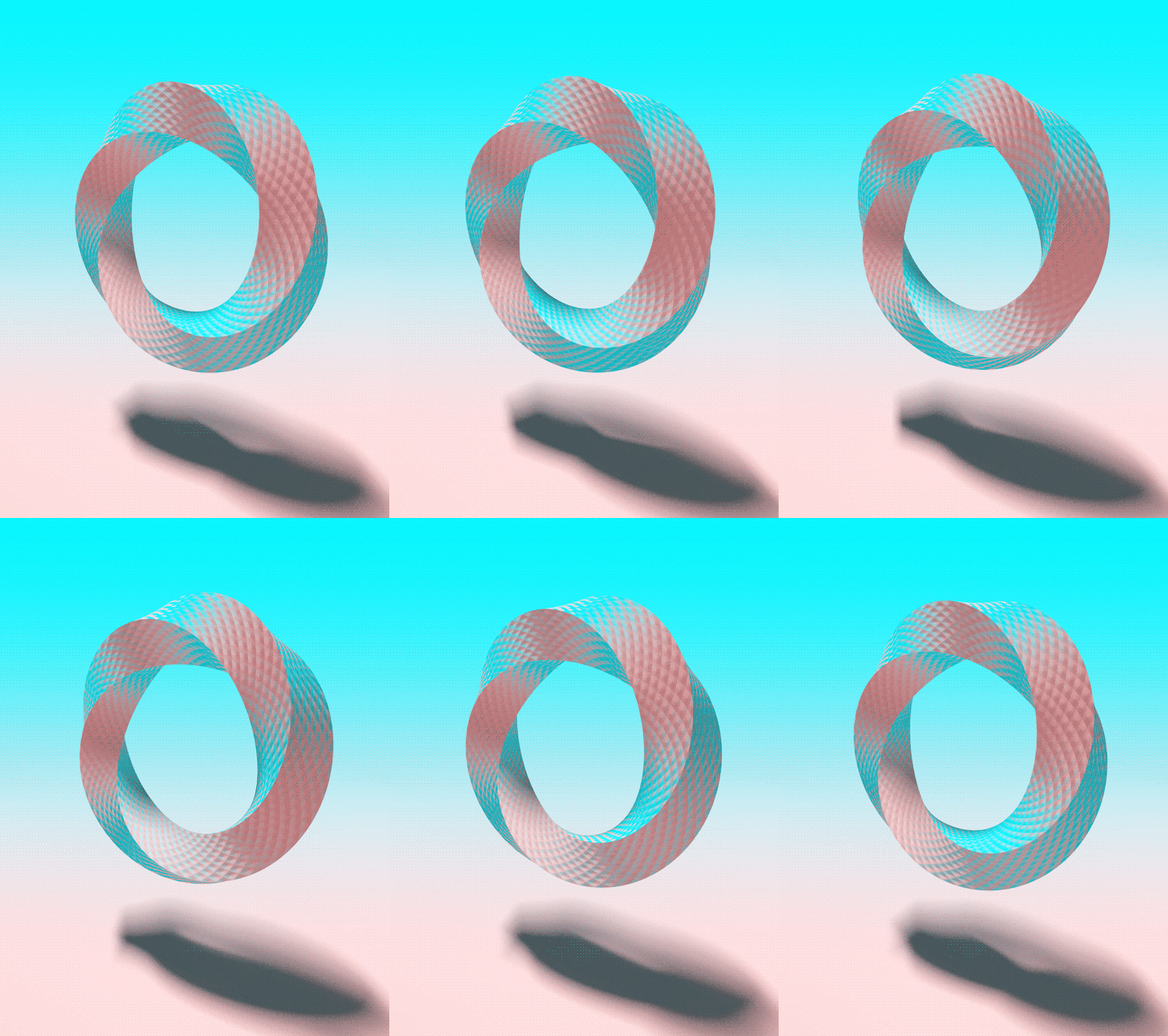
A-1, Core Purpose
If we've explored “how” the brain processes geometric abstract information, we now need to ask a more fundamental question: “Why?” Why did the human mind, at a certain historical moment, suddenly crave this stark form that stripped away all emotion and narrative? What is the ultimate purpose of the cognitive structure of geometric abstract art?
This is not a simple aesthetic choice, but a rescue operation targeting the depths of human consciousness. Its primary and core purpose is...Establishing an "absolute order" to counteract the fluidity and chaos of reality.。
We need to realize that the human cognitive system has long been in a state of overload. The real world is fragmented, accidental, and constantly changing—clouds change, light changes, emotions change, and this impermanence brings us profound existential anxiety. The emergence of geometric abstract art is essentially to construct a cognitive refuge. When Mondrian painted that eternal grid of vertical and horizontal lines, he was actually planting spiritual "anchors" in the chaotic universe. These absolute straight lines and pure blocks of color do not exist in nature; they are products of human rationality. Therefore, the core purpose of geometric abstraction is to provide a kind of "certainty." It promises the viewer that within this frame, everything is balanced, everything is controllable, and everything is eternally unchanging. This cognitive certainty provides an almost religious psychological comfort to the anxious hearts of modern people.
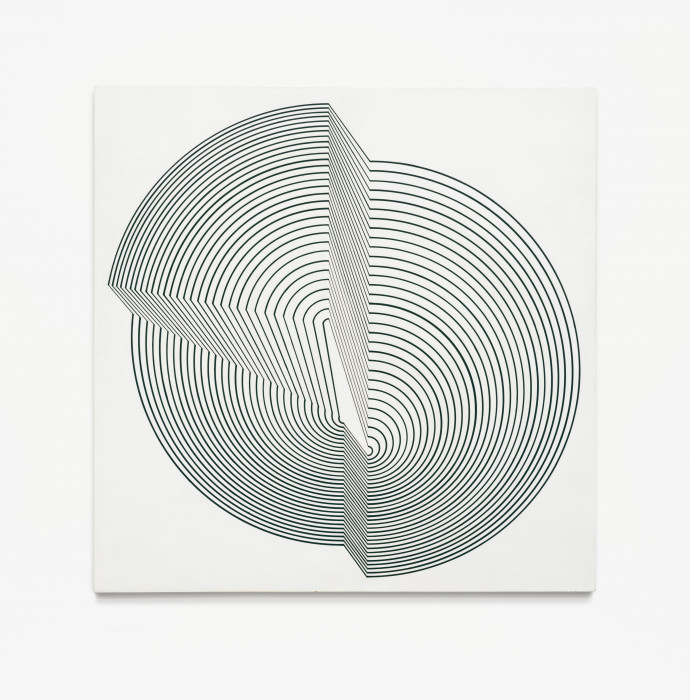
Bridget Riley
Secondly, the cognitive purpose of geometric abstraction is toAchieving spiritual elevation through "visual purification"。
From the perspective of cognitive psychology, representational art often carries too much "worldly impurity." Painting an apple evokes appetite; painting a beautiful woman evokes desire; painting a war evokes fear. These concrete images are always intertwined with our physical experiences and worldly emotions. The purpose of geometric abstract art, however, is precisely to sever this chain of associations. Malevich once said he wanted to take art to the "desert." This desert is not nothingness, but a pure land. By eliminating concrete images, geometric abstraction forces the brain to cease worldly associations and enter a state of "zero emotion." This visual minimalism is, in fact, a cognitive "detoxification" process. Its purpose is to empty our consciousness, freeing us from the confines of concrete objects, thus creating space for purer experiences of cosmic rhythms and inner spirit. Just as one can hear a heartbeat in silence, one can see the essence of the spirit in visual emptiness.
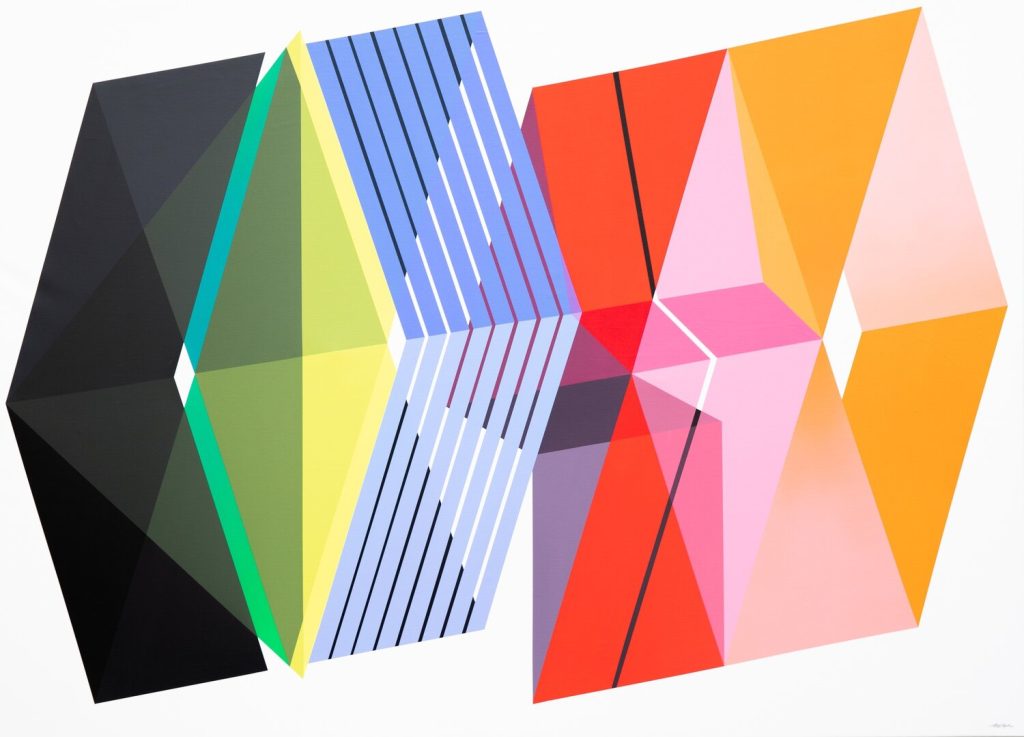
Arthur Dorval
The third core objective isReconstructing the "underlying logic" of our understanding of the world“。
Geometric abstract art is more than just paintings; it's a kind of cognitive "blueprint" or "model." Constructivist artists believed that if we construct perfect structural logic on the canvas, this logic can ultimately be projected onto real society to build more rational cities and more just social relationships. Therefore, viewing geometric abstract art is actually a mental exercise. It trains our brains to see beyond appearances to the essence, to recognize structural relationships rather than being obsessed with surface decoration. Its aim is to cultivate a modern way of thinking with high generalization and logic. It attempts to tell us that although all things in the world have different forms, they all follow a certain mathematical harmony at their core.
In conclusion, the cognitive structure of geometric abstract art transcends mere decoration and aesthetics. It serves as a spiritual defense mechanism against the anxiety of uncertainty; a ritual of purification to transcend worldly emotions; and above all, a declaration of reason, attempting to rewrite our understanding of the world in the language of order. When we gaze upon those silent geometric shapes, we are, in effect, gazing upon the proudest bastion of human reason—a place where chaos ends and order endures.
Lesson A-1: The Cognitive Structure of Geometric Abstract Art: Core Objective—Finding the Ultimate Solace of Order (Click to view and listen to the reading)
If we've explored how the brain processes geometric abstract information, then we now need to ask a more fundamental question: "Why?" Why, at a certain historical moment, did the human mind suddenly yearn for this austere form stripped of all emotion and narrative? What is the core purpose of the cognitive structure of geometric abstract art? This is not a simple aesthetic choice, but a rescue operation targeting the depths of human consciousness. Its primary core purpose is to establish "absolute order" to counteract the fluidity and chaos of reality. We need to realize that the human cognitive system has long been in a state of overload. The real world is fragmented, accidental, and ever-changing—clouds change, light changes, emotions change; this impermanence brings us profound existential anxiety. The emergence of geometric abstract art is essentially to construct a cognitive refuge. When Mondrian painted that eternally vertical and horizontal grid, he was actually planting spiritual "anchors" in the chaotic universe. These absolute straight lines and pure blocks of color do not exist in nature; they are products of human reason. Therefore, the core purpose of geometric abstraction is to provide a kind of "certainty." It promises the viewer that within this frame, everything is balanced, everything is controllable, and everything is eternally unchanging. This certainty of perception provides a near-religious psychological comfort to the anxious hearts of modern people. Secondly, the cognitive purpose of geometric abstraction is to achieve spiritual sublimation through "visual purification." From the perspective of cognitive psychology, representational art often carries too much "worldly impurity." Drawing an apple will evoke appetite; drawing a beautiful woman will evoke desire; drawing a war will evoke fear. These concrete images are always entangled with our physical experiences and worldly emotions. The purpose of geometric abstract art is precisely to sever this chain of association. Malevich once said that he wanted to take art into the "desert." This desert is not nothingness, but a pure land. By eliminating concrete images, geometric abstraction forces the brain to stop worldly associations and enter a state of "zero emotion." This visual minimalism is actually a cognitive "detoxification" process. Its purpose is to empty our consciousness, so that we are no longer occupied by concrete objects, thus creating space to accommodate purer experiences about the rhythm of the universe and the inner spirit. Just as we can only hear a heartbeat in silence, we can only see the essence of the spirit in the emptiness of vision. The third core purpose is to reconstruct the "underlying logic" of our understanding of the world. Geometric abstract art is not merely a painting; it is more like a cognitive "blueprint" or "model." Constructivist artists believed that if we construct a perfect structural logic on the canvas, this logic can ultimately be projected onto real society to build more rational cities and more just social relations. Therefore, viewing geometric abstract art is actually a training of the mind. It trains our brains to see through appearances to the essence, to recognize structural relationships rather than being obsessed with surface decoration. Its purpose is to cultivate a modern way of thinking with high generalization and logic. It attempts to tell us that although all things in the world have different forms, they all follow a certain mathematical harmony at their core. In conclusion, the cognitive structure of geometric abstract art has a core purpose that goes far beyond decoration and aesthetics. It is a spiritual defense mechanism to combat the anxiety of impermanence; it is a purification ritual to transcend worldly emotions; and it is a rational declaration that attempts to rewrite our understanding of the world in the language of order. When we gaze at those silent geometric shapes, we are actually gazing at the proudest fortress of human reason—where chaos ends and order endures.
 简体中文
简体中文  English
  日本語
日本語  Español
  Français
  हिन्दी
  العربية
  বাংলা
বাংলা  Português do Brasil
  Русский
  اردو
اردو  Bahasa Indonesia
  Deutsch
  Kiswahili
  मराठी
मराठी  తెలుగు
  Tiếng Việt
  Türkçe
  Italiano
  தமிழ்
தமிழ்  한국어
한국어