Regarding the artist's methods of creating artwork, we first need to understand their core visual language:Geometric Abstraction with Color Construction。
Arthur Dorval's creative process is a precise experiment in space, shadow, and transparency. His methods can be summarized by the following key dimensions:
1. The Evolution of Geometric Motifs
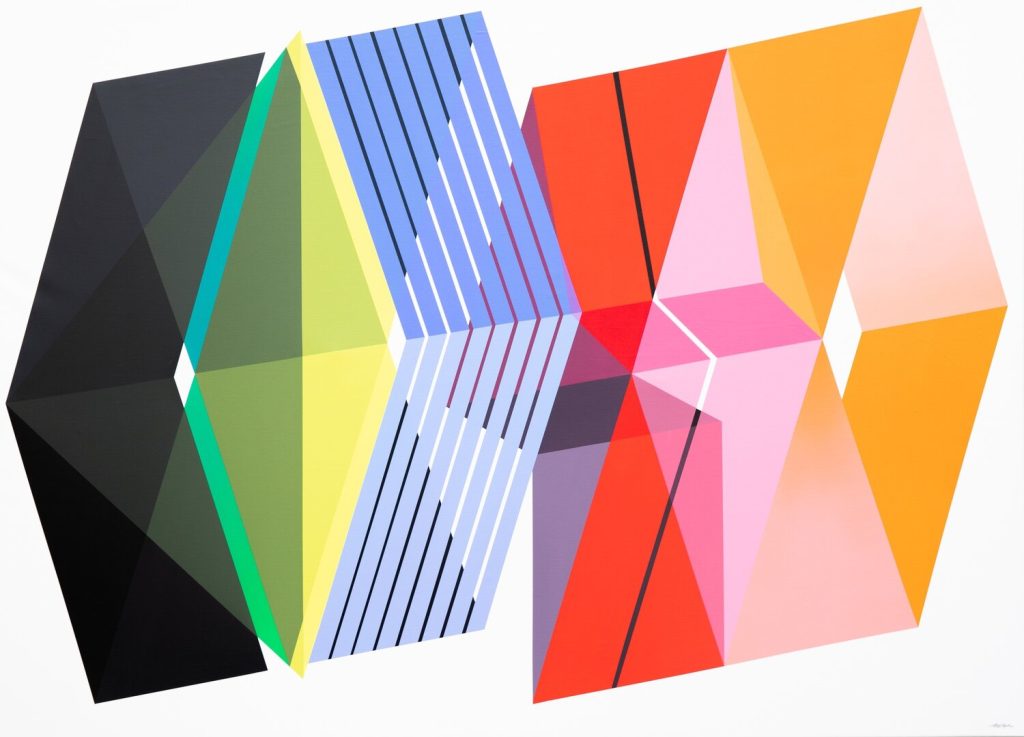
Dorval's work is usually based on simple geometric shapes, such asSquare, rectangle, and circleHe doesn't pursue complex shapes, but rather through the continuous repetition of these basic elements.Overlay and recombinationcreating a three-dimensional feel similar to architectural structures.
- Spatial overlay He used the collision of geometric shapes“ edges to simulate the effect of ”transparent sheets" overlapping each other.
- Oscillating sensation Through subtle shifts in shape, a static image is imbued with a sense of rhythm, as if geometric forms are swaying in space.
2. The Illusion of Color “Transparency”
This is Dorval's most recognizable technique. Although he uses opaque pigments (often acrylics), he achieves the effect of **optical transparency** through extremely masterful color blending.
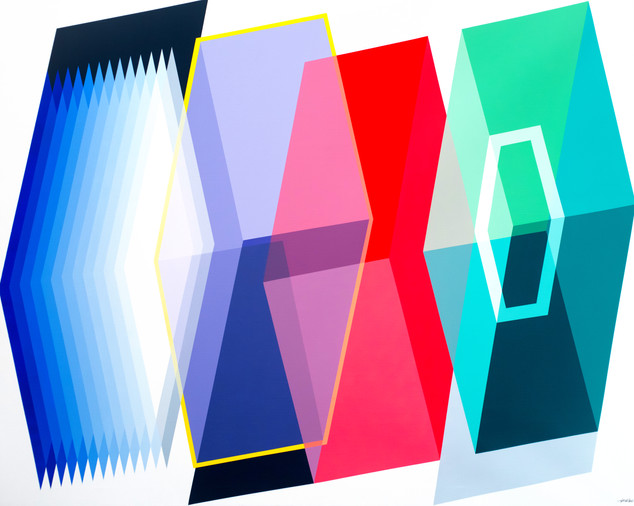
- Midtone Calculation: When two shapes “overlap,” the color of the overlapping area is a blend precisely calculated from both sides. This manually implemented “multiply” effect creates an illusion of depth in the image.
- Color gradient He is skilled at using changes in color brightness to suggest the direction of light, making flat geometric shapes appear like transparent crystals with depth.
3. Precision manufacturing process
Arthur Dorval's work has a strong sense of order, which stems from his rigorous physical production process:
- Masking Tape Method To achieve extremely sharp, clean edges (hard-edge), he uses a lot of high-quality masking tape. After each coat of color is applied, it needs to dry completely before re-taping, which requires extreme patience and precision.
- Applications of Acrylic Paint: He prefers to useAcrylicbecause it dries quickly and has high color saturation, making it suitable for multi-layered thin applications.
- Canvas handling: His canvas surfaces are usually treated very smoothly, with brushstrokes almost invisible. This “de-emphasis of the hand” treatment enhances the work's modern and industrial feel.
4. Shadows and Three-Dimensional Construction
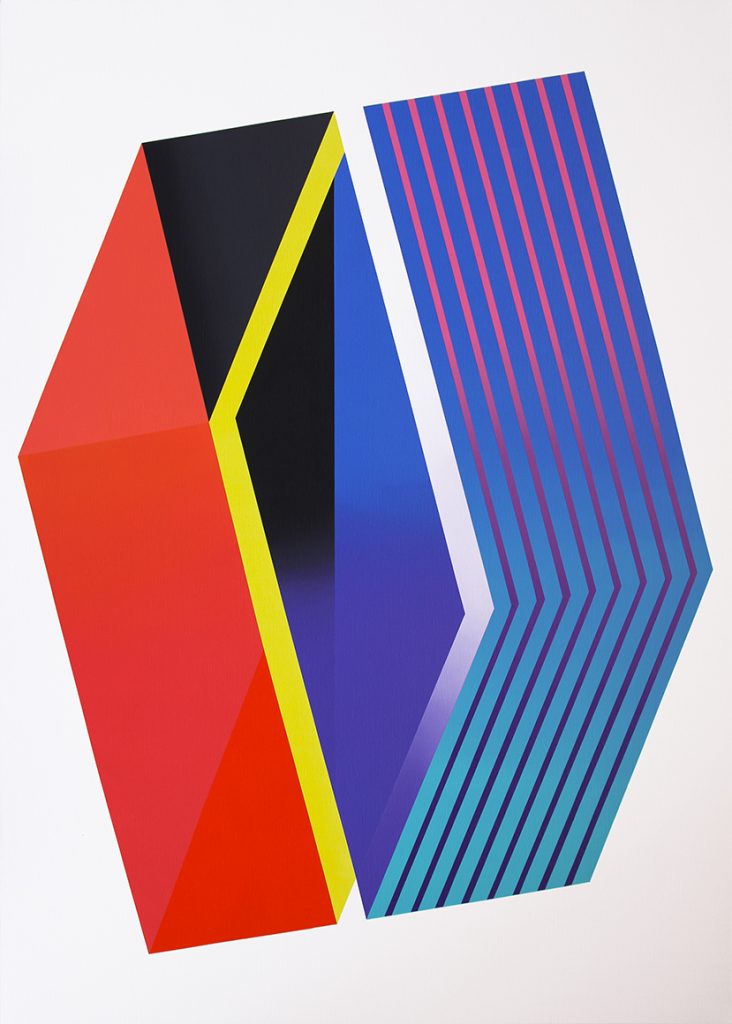
Even though it's a flat painting, Dorval pays close attention to “**imaginary shadows**.” He adds subtle dark tones to the edges of geometric shapes. These “projections” are not real physical projections, but rather visual cues he designed to create the illusion for the viewer that they are looking at a three-dimensional model (Vibrating structures).
Summary
Arthur Dorval's approach is to **“capture the light and shadow of sensibility with mathematical rigor.”** He does this through:
- Minimalist GeometryAs the skeleton.
- Color mixing theorySimulate transparency.
- Precision shielding technologyEnsure a physically perfect edge.
If you are trying to imitate or learn this style, the core lies inColor mixing rulesMastery—you need to plan in advance what color each overlapping area should be, rather than just applying color randomly.
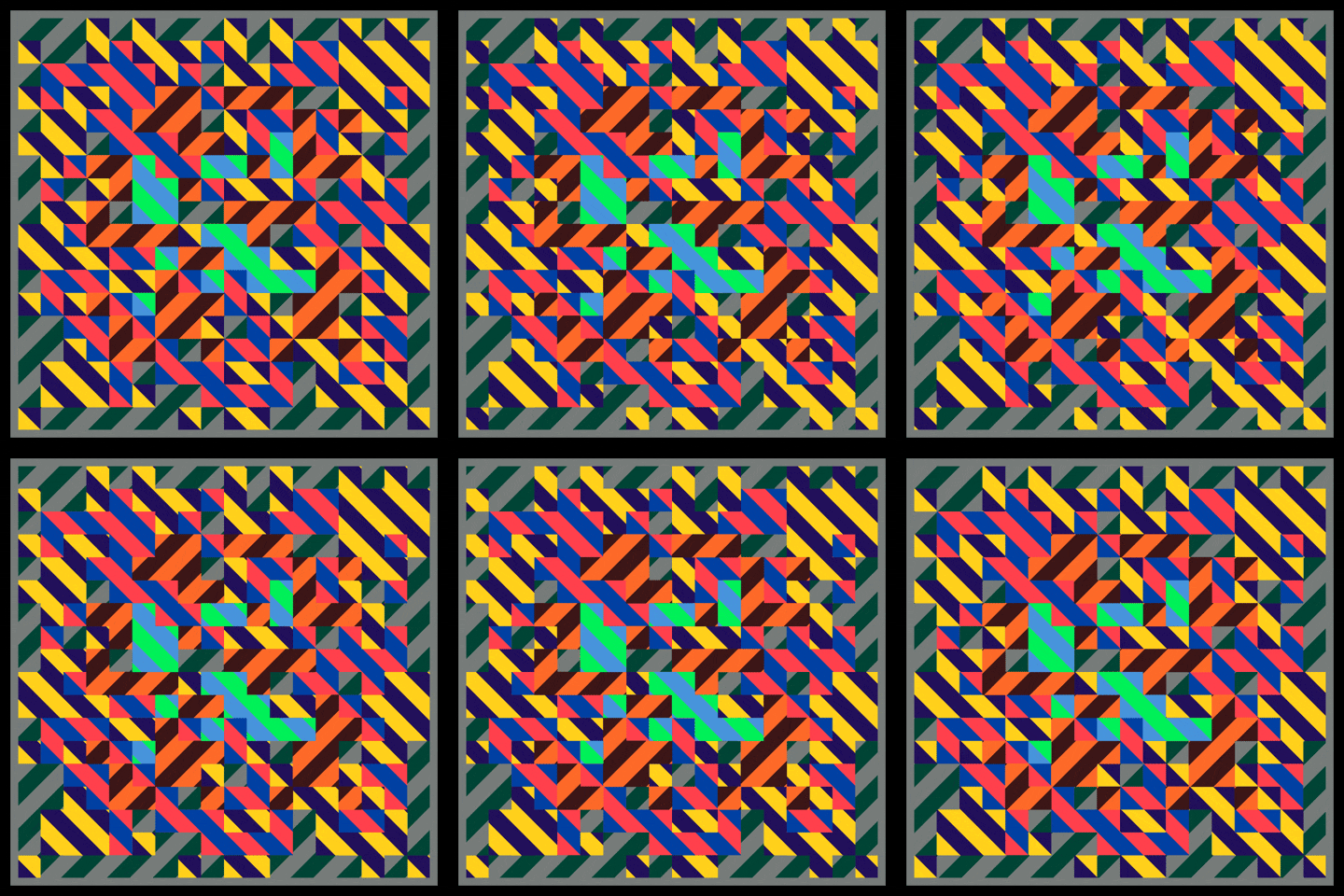
Arthur DorvalColor mixingSimulated transparent device
 简体中文
简体中文  English
  日本語
日本語  Español
  Français
  हिन्दी
  العربية
  বাংলা
বাংলা  Português do Brasil
  Русский
  اردو
اردو  Bahasa Indonesia
  Deutsch
  Kiswahili
  मराठी
मराठी  తెలుగు
  Tiếng Việt
  Türkçe
  Italiano
  தமிழ்
தமிழ்  한국어
한국어