
American artist Erik Gonzales's work, through the combined use of encaustic, mineral pigments, and hard-edge geometry, deconstructs the conflict between modern architectural language and natural weathering processes. His methods, overlapping with Arthur Dorval's geometry, present a profound narrative of transformation from “perceptual transparency” to “material thickness” in the “hatching of structures” and the “reconstruction of layered spaces.” Gonzales treats the canvas as a landscape to be excavated, covering the geometric skeleton with the dust of time.
Creative Methods: The “Addition and Subtraction” of Materials and the Etching Logic of Architecture
Compared to Dorval's pursuit of smooth transparency, Gonzalez's creative method is an archaeological act of “excavation” and “coverage.” His production logic is not a one-time formation but an accumulation process spanning multiple material cycles.
- Layered Masking and Encaustic Burials: González's most core method is to use wax (usually cold wax or melted beeswax) as a spatial medium. He first establishes tight geometric sketches on a wooden panel, then “buries” the originally clear geometric structure deep within the substance through multiple layers of color application and wax coating. This method breaks through the superficiality of two-dimensional painting, and through the increase in physical thickness, the colors appear as residual signals emanating from ancient strata. This is parallel to Dorval's “incubation” logic—Dorval incubates the psychological depth of color, while González incubates the historical depth of matter.
- Physical Engraving and Abrasion (Sgraffito & Abrasion): His production logic involves intense physical intervention. After the wax layer is semi-dry or solidified, he uses sharp tools for sgraffito, rediscovering buried geometric lines. This method breaks from the traditional act of “drawing” lines, adopting a logic of “discovering” them instead. Through localized polishing and erosion, he creates a texture akin to weathered walls or abandoned urban blueprints. This physical destruction of the edges achieves a dynamic balance between rigor and incompleteness in the geometric shapes.
- Structural Grid Embeddings González uses complex diagonal and orthogonal grids to guide the spatial direction. He treats the grid as a “restraining force,” simulating the shadows of architectural facades under different lighting conditions through leaps in color brightness and variations in wax layer thickness. This method compels viewers to search for points of gravity within the geometric maze of the plane, recreating the process of industrial architecture becoming increasingly dematerialized in natural environments.
Style Features: Weathered Modernism, Silent Ruins, and Tactile Rhythms
González's style presents visual qualities of serenity, solemnity, and a sense of geological history, transforming cold geometric shapes into material entities with body temperature.
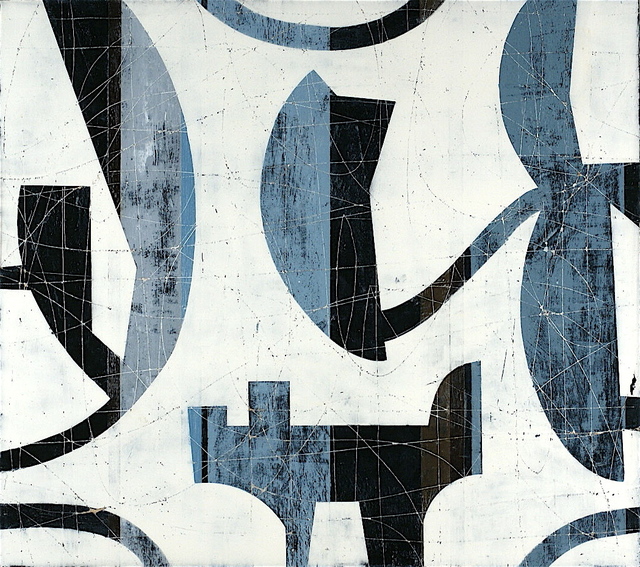
- “Archaeological” Visual Depth: The most striking characteristic of the Gonzales style is the “sense of time” in the artwork. Due to the interpenetration and peeling away of multiple layers of material, the paintings exhibit an effect of being weathered by long ages. This stylistic feature establishes the work's identity as a “carrier of memory,” reflecting the artist's contemplation of vestigial civilizations and spatial degradation. Colors tend to be low-saturation earth tones and off-whites, occasionally punctuated by high-saturation stripes that serve as warnings, mimicking the ever-changing visual signage in urban renewal.
- The collapse of geometry and organic balance: His style is characterized by an obsession with “collapsing edges.” Although the paintings contain a large number of rectangles and straight lines, the edges of these geometric shapes often bear random damage or leakage. This stylistic feature strips away the absolute rationality of minimalism and introduces natural randomness. When viewers look at the work, their gaze repeatedly jumps between “artificial order” and “natural entropy,” creating a philosophical contemplation of “creation” and “destruction.”
- Serene matter-energy field Compared to Pantone's high-frequency flickering, Gonzales“ style leans more towards ”low-frequency resonance.“ He uses large areas of monochromatic blocks (often with subtle textural variations) to create a space that is both subdued yet full of tension. This style pursues a ”silent power," providing viewers with a tactile sanctuary for deep meditation beneath the cumbersome accumulation of material, through precise proportional divisions.
Materials Used: Engineered Integration of Wax Crayon Medium, Marble Powder, and Hardboard
González exhibits an ultimate exploration of “physical stability” and “textural potential” in his material selection, viewing the canvas as a miniature landscape undergoing geological evolution.
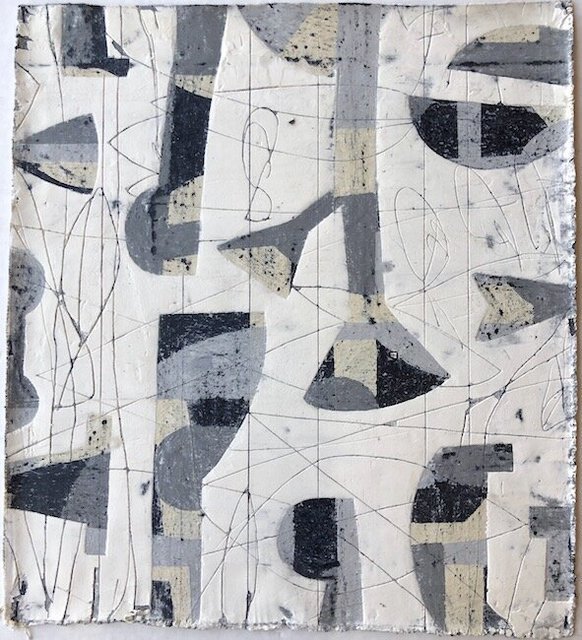
- Cold Wax & Mineral Pigments: Encaustic is his most iconic material. He utilizes the unique plasticity of the cold wax medium, which lies between oil and plaster, by mixing marble dust, graphite, and raw mineral pigments to create a hard, granular surface. This material application transforms “painting” into a “quasi-relief,” ensuring that colors retain a high degree of physical texture after layering.
- Architectural grade primer and wood substrate: To bear the weight of the thick wax layers and the physical pressure of carving, González typically eschews canvas, opting instead for multi-layered, reinforced solid wood panels as his support. He first applies several layers of industrial-grade gesso to the wood panel for leveling and sealing. This method ensures that the physical depth he constructs will not be compromised by the deformation of the support, emphasizing art as an “em-bodied creation” with an undeniable presence.
- Acid-base etching and chemical oxidation: In some works, he introduces mild chemical reagents to artificially oxidize metal powder layers. This material manipulation technique breaks the single source of color, creating a genuine patina or mottled effect. Through this cross-media experimentation, he imbues geometric abstract works with a “self-growing” biological logic, blurring the lines between human engineering and natural oxidation.
 简体中文
简体中文  English
  日本語
日本語  Español
  Français
  हिन्दी
  العربية
  বাংলা
বাংলা  Português do Brasil
  Русский
  اردو
اردو  Bahasa Indonesia
  Deutsch
  Kiswahili
  मराठी
मराठी  తెలుగు
  Tiếng Việt
  Türkçe
  Italiano
  தமிழ்
தமிழ்  한국어
한국어