
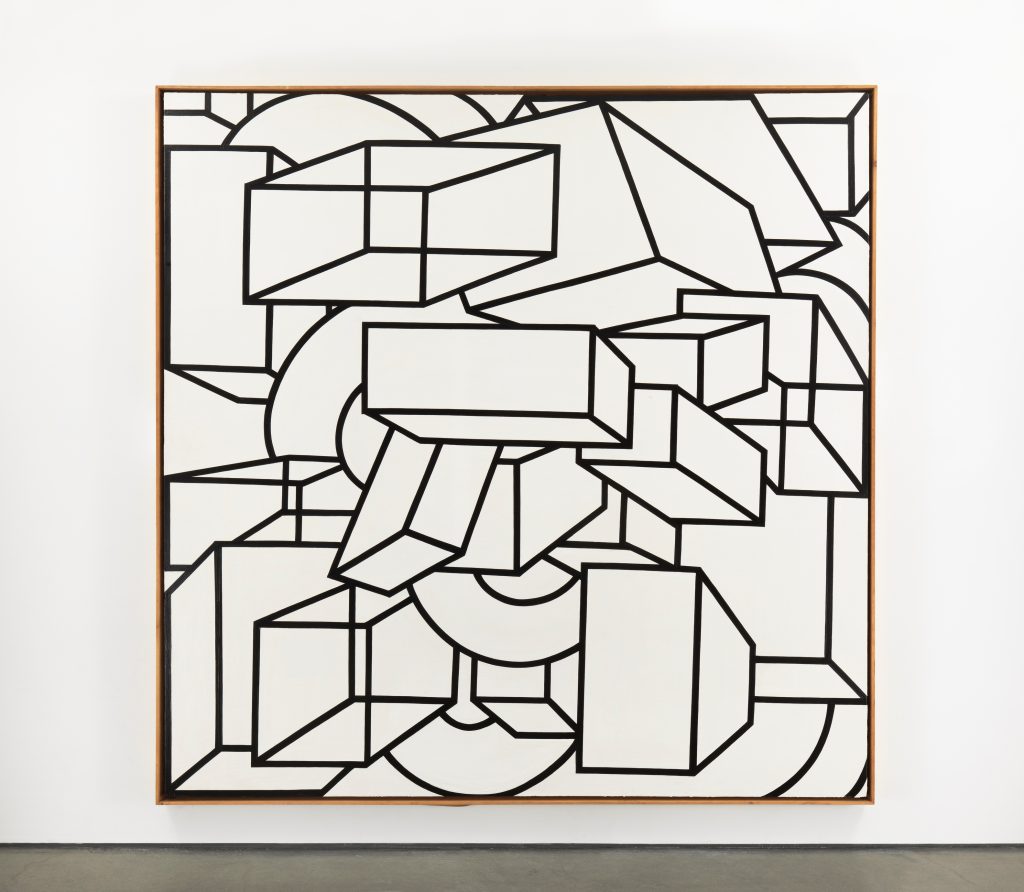
Al Held is a key figure in the "spatial composition" approach of geometric abstract art. His works are highly recognizable not only because they are filled with clear, hard, and defined geometric boundaries, but also because he elevates geometric shapes from planar order to complex spatial construction. In his art, geometry is no longer merely static cubes, arcs, lines, and planes of color, but becomes a structural language capable of creating a sense of volume, direction, interpenetration, pressure, and expansion. Therefore, the analysis of Al Held's work should not be limited to "which geometric shapes he drew," but must examine how he utilizes geometric relationships to organize visual space.
Al Held's early work bordered on hard-edge painting and color field abstraction, but his truly mature and important phase involved shifting from geometric abstraction to large-scale, architectural, and constructive spatial organization. In this phase, he frequently employed thick black lines, defined edges, perspective tendencies, folded planes, overlapping blocks, and unstable directional shifts, creating a spatial field that resembles both architectural drawings and suspended structures, while simultaneously conveying a sense of psychological oppression. Viewers encounter not a single center, but a geometric system that continuously extends inward, clashes outward, and intersects with each other.
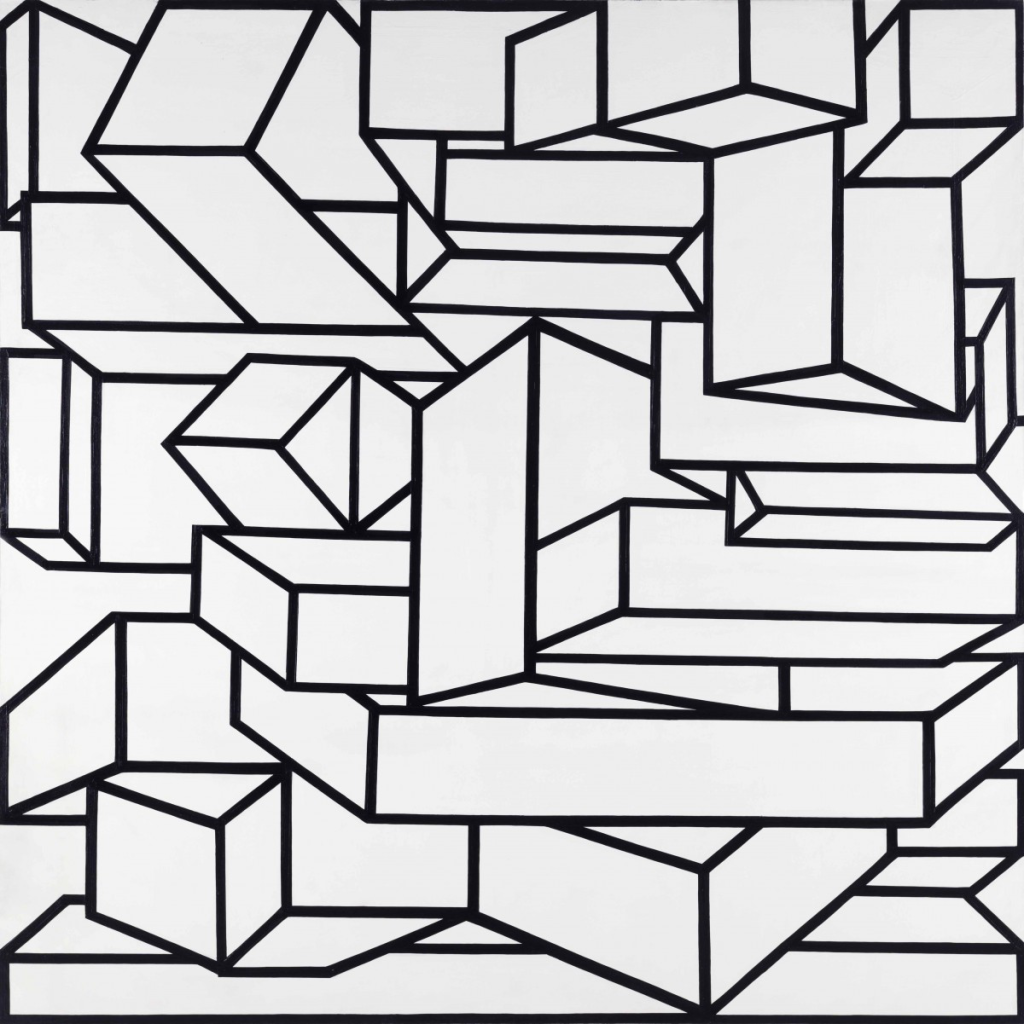
Formally, Al Held's works are characterized by a distinct "block composition." Many shapes resemble cubes, wedges, beams, folded plates, arches, and frame components, interconnected, overlapping, and cutting into each other. It is this interweaving that elevates the painting beyond a two-dimensional plane, creating a space that seems accessible, encircling, and traversable. He doesn't merely arrange geometric shapes neatly; he creates visual conflict: some surge forward, some recede, some seem to press down from above, and some seem to embed themselves from the side. Thus, the pictorial space is no longer stable, but rather a continuously generating and revolving tension structure.
Another key characteristic of Al Held is his use of "outlines." In linear geometric abstraction, lines sometimes merely define boundaries, but in Al Held's work, lines not only delineate forms but also serve to define space. Black outlines grant each surface independence while simultaneously creating transitions, folds, connections, and breaks between them. Lines make the forms appear clear, yet they also complicate spatial relationships, because each line can be both a foreground edge and part of the background structure. This visual duality gives his works a powerful spatial illusion effect.
His space is not real space in the traditional sense of perspective, but a "constructed space." This kind of space does not conform to natural viewing experience, does not rely on the shaping of light and shadow, nor imitate real objects, but is established by geometric logic itself. In other words, Al Held's paintings are not depicting architecture or objects, but creating a world of geometric relationships. In this world, space is not a background, but a result generated by lines, planes, angles, proportions, directions, and occlusions. This is the core of spatial compositional geometric abstraction: space is not reproduced, but constructed.
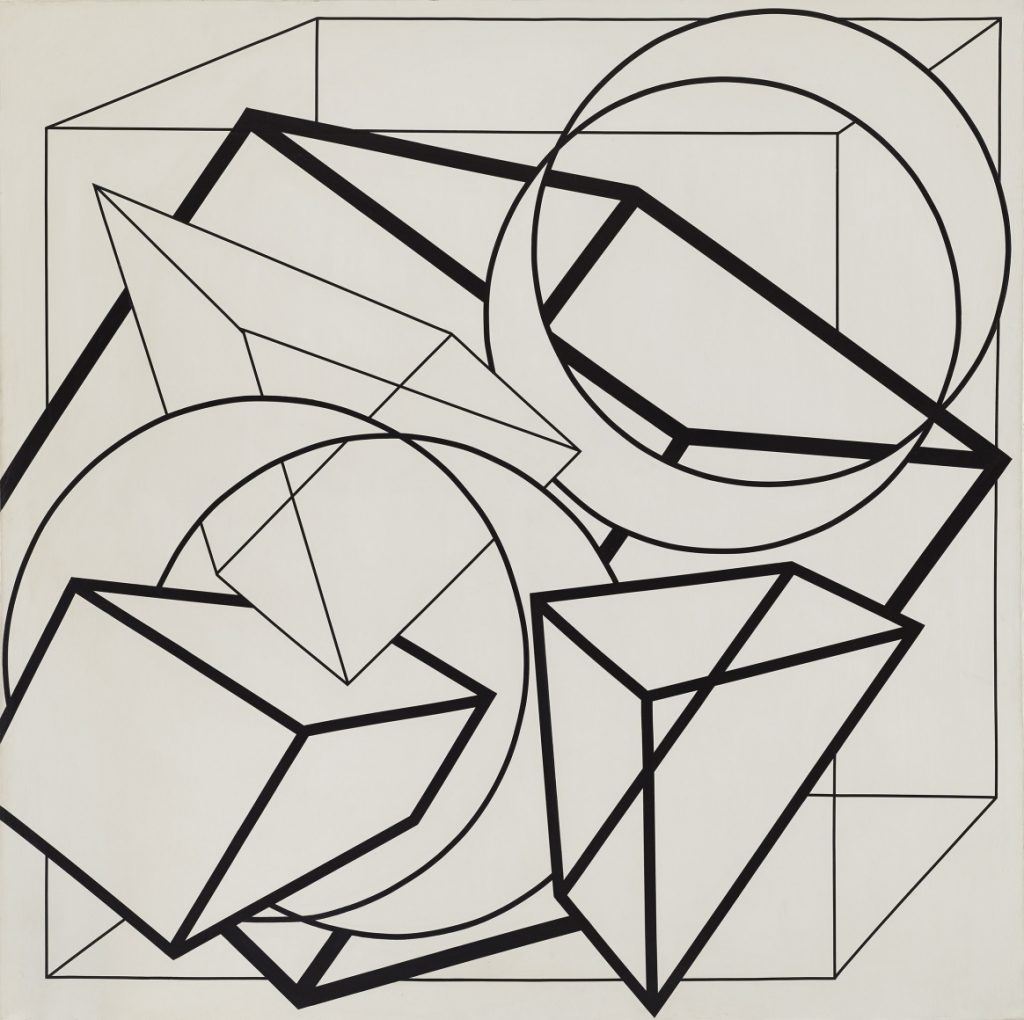
Visually, Al Held's works often possess a grand, rational, austere, and tense quality. The large scale makes the viewer feel as if they are inside the structure, while the collision and compression between forms imbue the image with power. His works are not a quiet balance, but a dynamic one; not a gentle order, but a highly intense structural order. Its charm lies in this: it appears rational, yet it is not rigid; it appears calm, yet it possesses a strong psychological impact. Geometry here is not merely mathematical form, but becomes a visual event capable of creating spatial drama.
From the perspective of the development of geometric abstract art, Al Held's significance lies in his advancement of modernist geometric language from "planar order" to "spatial composition." If Mondrian emphasized the purified relationship between vertical and horizontal, and Malevich emphasized the spiritual independence of geometric forms, then Al Held further endowed geometric forms with architectural weight, direction, and spatial conflict. He made geometric abstraction no longer just a static composition, but a structural field that could be continuously unfolded and reorganized.
Therefore, Al Held is a highly representative artist in the "spatial compositional module" genre. His work demonstrates that geometric abstraction is not merely about simplifying the world into squares, circles, lines, and planes, but rather about constructing a complex, open, and dynamic spatial system using these basic elements. He presents not merely the surface patterns of geometric shapes, but how geometry becomes a sophisticated language for constructing space, organizing order, and creating visual conflict. This is precisely why he remains consistently important in the history of geometric abstract art.
Lessons F2-28: Analysis of Al Held's Works (Click to view and listen to the reading)
Al Held is a key figure in the "spatial composition" approach of geometric abstract art. His works are highly recognizable not only because of the clear, hard, and defined geometric boundaries within the canvas, but also because he elevates geometric shapes from planar order to complex spatial construction. In his art, geometry is no longer merely static cubes, arcs, diagonal lines, and colored surfaces, but becomes a structural language capable of creating a sense of volume, direction, interpenetration, oppression, and expansion. Therefore, the analysis of Al Held's work cannot be limited to "which geometric shapes he drew," but must examine how he utilizes geometric relationships to organize visual space. While Al Held's early work approached hard-edge painting and color field abstraction, his truly mature and significant phase involved shifting geometric abstraction towards large-scale, architectural, and constructive spatial organization. During this phase, he frequently employed thick black lines, defined edges, perspective tendencies, folded planes, overlapping blocks, and unstable directional shifts, creating a spatial field that resembles both architectural drawings and suspended structures, while simultaneously conveying a sense of psychological oppression. When viewers encounter his works, they do not see a single center, but rather a geometric system that continuously extends inward, clashes outward, and intersects with each other. Formally, Al Held's works exhibit a distinct "block composition" characteristic. Many shapes resemble cubes, wedges, beams, folded plates, arches, and frame components, interconnected, overlapping, and cutting into each other. It is this interweaving that elevates the image beyond two-dimensional plane division, creating a spatial state that seems accessible, encircling, and traversable. He is not content with merely arranging geometric shapes neatly; rather, he allows them to visually clash: some surge forward, some recede, some seem to press down from above, and some seem to embed themselves from the side. Thus, the pictorial space is no longer stable, but rather a continuously generating and flipping tension structure. Another important characteristic of Al Held is his use of "outlines." In linear geometric abstraction, lines are sometimes merely boundaries, but in Al Held's work, lines not only divide forms but also serve to define space. The black outlines grant each surface independence while simultaneously creating transitions, folds, connections, and breaks between them. Lines make the forms appear defined, yet complicate spatial relationships, as each line can be both a foreground edge and part of the background structure. This visual duality gives his work a strong spatial illusion effect. His space is not real space in the traditional sense of perspective, but a "constructed space." This type of space does not conform to natural viewing experience, does not rely on light and shadow, and does not imitate real objects, but is established through geometric logic itself. In other words, Al Held's paintings are not depicting architecture or objects, but creating a world of geometric relationships. In this world, space is not a background, but a result generated by lines, planes, angles, proportions, directions, and occlusions. This is the core of spatial compositional geometric abstraction: space is not reproduced, but constructed. Visually, Al Held's works often possess a grand, rational, austere, and tense quality. The large scale makes the viewer feel as if they are inside the structure, while the collision and compression between forms fill the painting with power. His works are not quiet balances, but dynamic ones; not gentle order, but high-intensity structural order. Their charm lies in their apparent rationality, yet not rigidity; seemingly calm, yet possessing a powerful psychological impact. Geometry here is not merely mathematical form, but a visual event capable of creating spatial drama. From the perspective of the development of geometric abstract art, Al Held's significance lies in his advancement of modernist geometric language from "planar order" to "spatial composition." If Mondrian emphasized the purified relationship between vertical and horizontal, and Malevich emphasized the spiritual independence of geometric forms, then Al Held further endowed geometric forms with architectural weight, direction, and spatial conflict. He made geometric abstraction no longer just static composition, but a structural field that can continuously unfold and reorganize. Therefore, Al Held is a highly representative artist in the "spatial compositional module" genre. His works demonstrate that geometric abstraction does not merely simplify the world into squares, circles, lines, and planes, but rather can construct a complex, open, and dynamic spatial system through these basic elements. What he presents is not the surface style of geometric shapes, but how geometry becomes a sophisticated language for constructing space, organizing order, and creating visual conflict. This is precisely why he remains important in the history of geometric abstract art.
 简体中文
简体中文  English
  日本語
日本語  Español
  Français
  हिन्दी
  العربية
  বাংলা
বাংলা  Português do Brasil
  Русский
  اردو
اردو  Bahasa Indonesia
  Deutsch
  Kiswahili
  मराठी
मराठी  తెలుగు
  Tiếng Việt
  Türkçe
  Italiano
  தமிழ்
தமிழ்  한국어
한국어