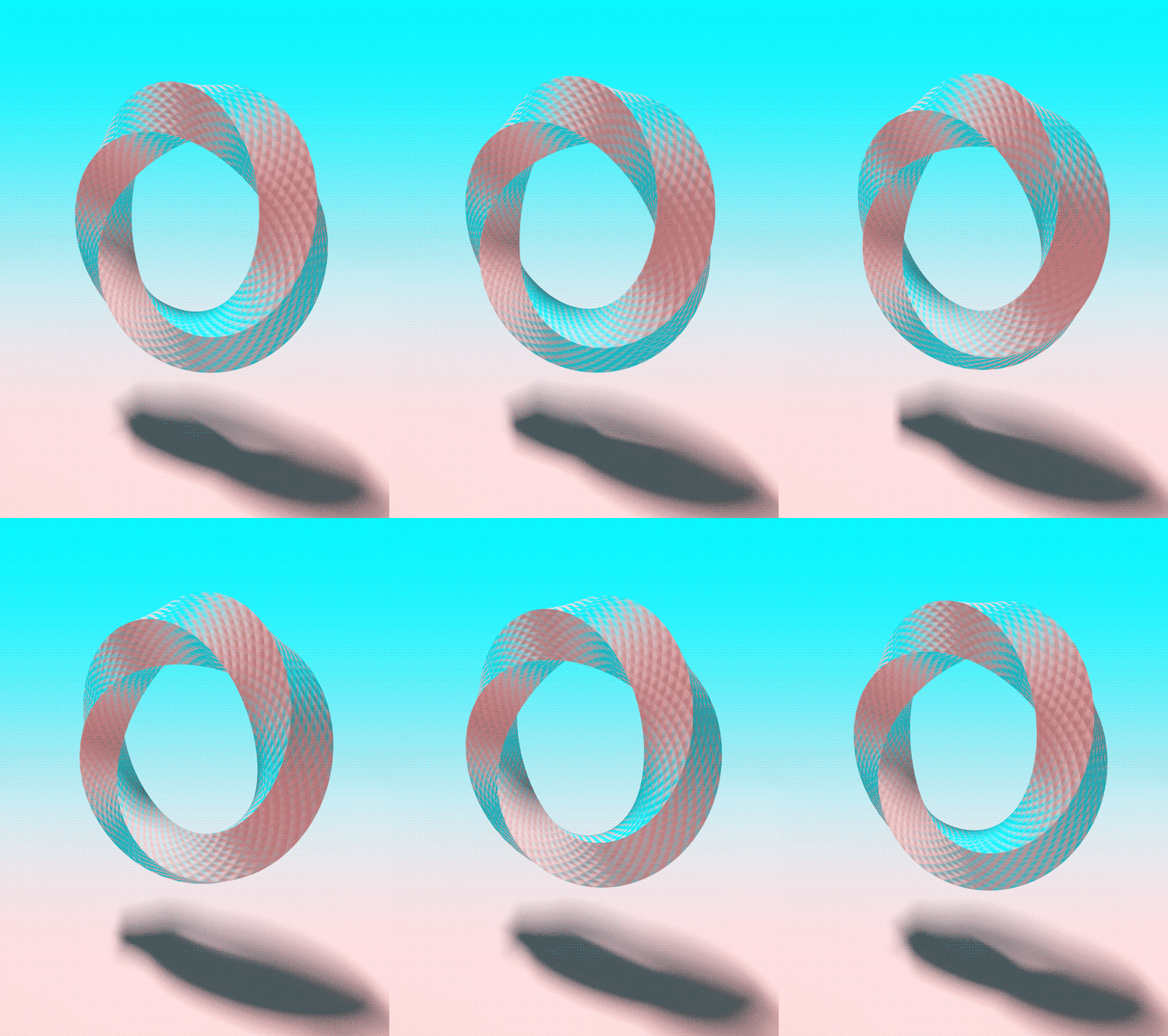
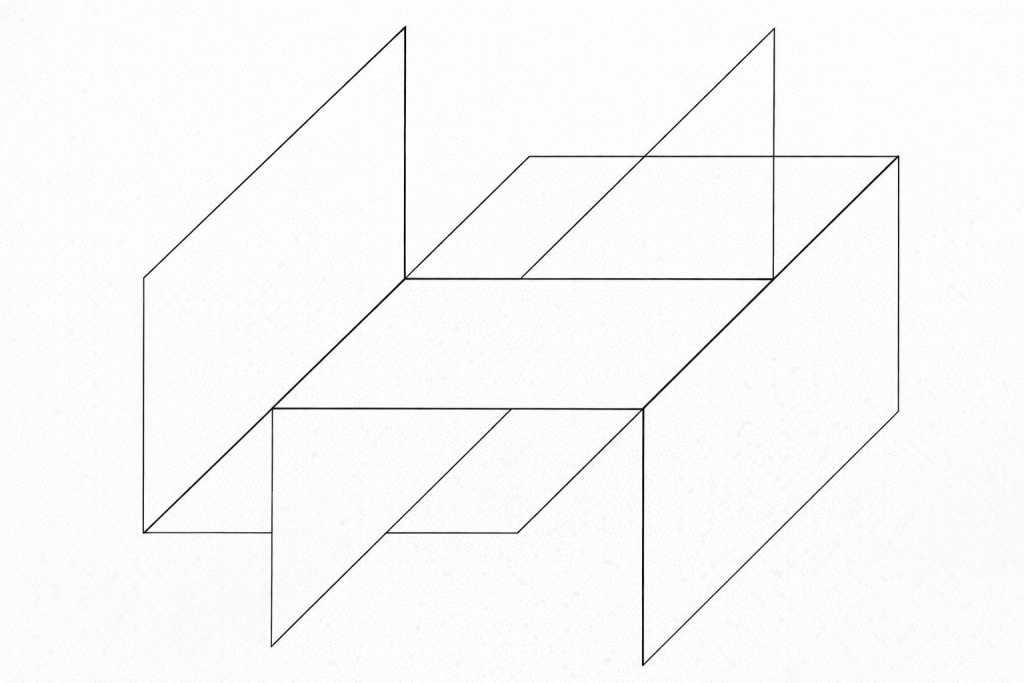
Future geometric abstract art will first move from “static composition” to “dynamic structure.” Traditional geometric abstract art typically views a work as a finished result: lines, planes, proportions, and color relationships are fixed within a stable picture. The viewer is confronted with a kind of order that has been precisely arranged, a solidified visual balance. Whether it's Mondrian's verticals and horizontals, or the Bauhaus emphasis on geometric proportion, formal purification, and color relationships, the core lies in conveying rational, rhythmic, balanced, and structural beauty through a static image. In other words, traditional geometric abstraction more strongly emphasizes “the final appearance.” After the work is completed, its internal relationships tend to no longer change, time is excluded from the picture, and variability is compressed into an implicit part of the creative process, rather than directly entering the work itself.
However, after artificial intelligence becomes involved, the structural logic of geometric abstract art will undergo a fundamental shift. Future works will no longer be just a final picture, but rather a continuously running system. What artists create will no longer be a specific image, but a set of rules and mechanisms capable of continuously generating, adjusting, responding, and evolving. The position of lines, the size of planes, the distribution of colors, the way elements are repeated, the pace of rhythm, changes in density, and even the shift in compositional balance can no longer be permanently fixed, but will constantly change under the drive of programs, algorithms, and data. In this way, the artwork's mode of existence will shift from a “finished product” to an “operating entity,” from a “static structure” to a “living structure.”
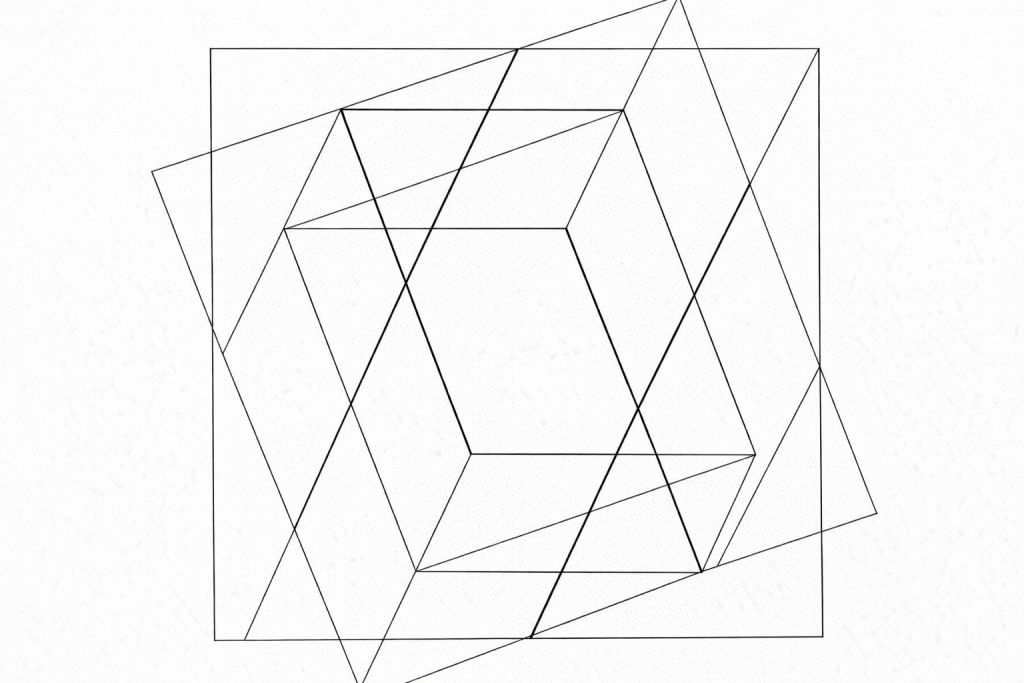
This change first means that geometric relationships begin to have a temporal aspect. In the past, viewing a piece of geometric abstraction was usually completed in an instant, with the viewer perceiving stable, overall relationships. In dynamic structures, however, viewing becomes a process of unfolding. The image may continuously reconfigure over seconds, minutes, or even longer: squares slide slowly, grids deflect according to external input, color areas change brightness and saturation with changes in light, sound, or temperature, and certain geometric units may generate, overlap, disappear, and then reappear in another order. At this point, the work no longer possesses only a “spatial composition” but also a “temporal composition.” Geometric forms are not just arrangements in space, but also events in time. The viewer sees not just a result, but a continuously unfolding structural process.
Secondly, geometric abstract art will increasingly exhibit “responsiveness” in the future. AI enables artworks to receive external information and use that information as a basis for formal changes. Environmental data, weather fluctuations, sound frequencies, audience movement trajectories, touch behaviors, network information streams, and even physiological signals can become input conditions for the operation of geometric structures. In this way, artworks will no longer be closed, self-sufficient objects but will transform into open, sensory systems. Geometric forms will no longer solely stem from the artist's one-way design but will continuously generate new orders through the interplay of “rules” and “feedback.” For example, a group of originally evenly distributed rectangular modules might compress towards a certain area due to audience gathering; a stable system of color blocks might continuously change its layers and contrasts in response to sound rhythms; a previously clear symmetrical structure might gradually shift, fracture, or reorganize due to the intervention of real-time data. Artworks will thus possess the ability to “perceive the external world and change themselves.”
More importantly, this dynamic structure will transform the concept of creating geometric abstract art. In traditional methods, the artist's task was to decide the final image, controlling every line, every color block, and every proportional relationship. In the future, the artist's role will shift more towards being a system designer, a rule maker, and a controller of the boundaries of change. Artists will not need to personally decide every outcome; instead, they will set the logic for the structure's operation: which elements can move, which proportions must be maintained, which colors can be substituted, which changes will trigger new combinations, within what range the system can evolve freely, and within what boundaries it should maintain overall aesthetic consistency. In other words, the focus of creation will shift from “composition completion” to “mechanism establishment.” The value of the work will no longer be solely reflected in a single generated image, but in whether the system possesses the vitality for continuous change, and whether it can maintain formal tension and aesthetic order amidst that change.
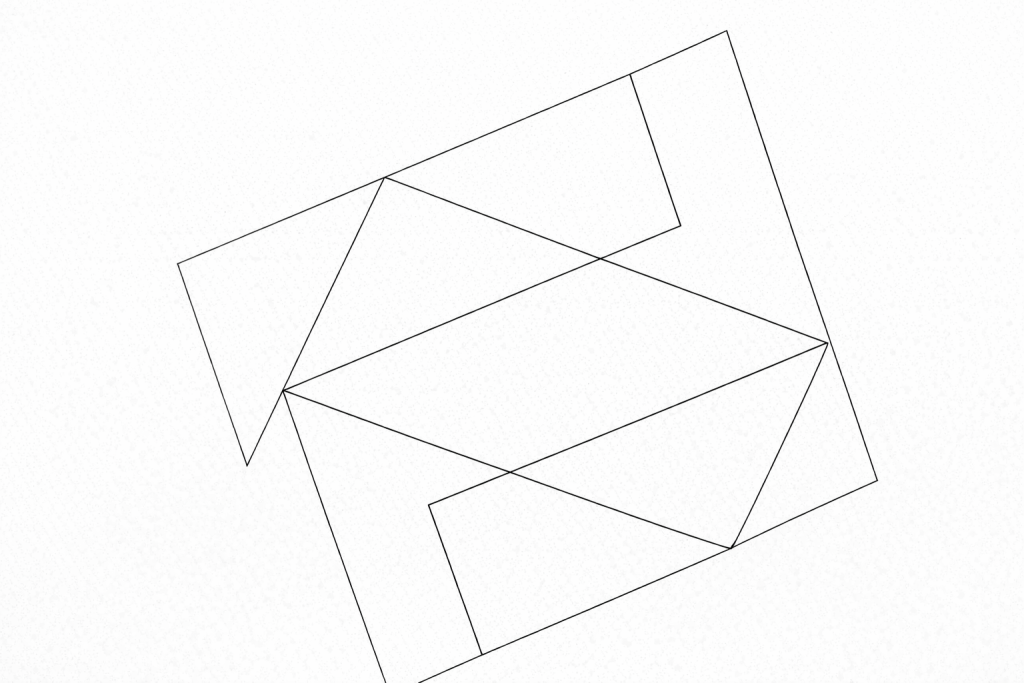
This also means that the aesthetic judgment criteria for geometric abstract art will change in the future. In the past, people primarily evaluated whether the proportions of a work were harmonious, its colors balanced, and its structure stable. However, when facing dynamic structures, people must also evaluate whether their movement is rhythmic, whether the process of change is logical, and whether the evolution can form visual progression, echoes, conflicts, and resolutions. In other words, geometric abstract art is no longer just about “how it looks,” but also about “how it changes,” “why it changes,” and “whether the change is valid.” The beauty of the work no longer exists solely in a static moment but in the continuity of the structure's movement and in the constant attainment of new balances between order and disruption.
Therefore, future geometric abstract art will not simply be the production of static images, but the generation of visual mechanisms; not just the arrangement of forms, but the operation of relationships; not just a viewed result, but a continuously occurring process. Artificial intelligence will not simply replace artists to create more images, but will push geometric abstraction from “completed compositions” towards “continuously evolving structural systems.” In such a transformation, geometric abstract art will gain new vitality: it will no longer remain a solidified order on a plane, but will become a dynamic language capable of unfolding over time, responding to the environment, and changing with interaction. The true importance of future works will not be what they present, but how their structures operate, how they generate, and how they continuously maintain their own order, tension, and aesthetic depth amidst change.
Lesson G2-1: From Static Composition to Dynamic Structure (Click to view and listen to the reading)
The future of geometric abstract art will first move from “static composition” to “dynamic structure”. Traditional geometric abstract art usually regards a piece of work as a finished result: lines, blocks, proportions and color relationships are all fixed in a stable picture, and the viewer is confronted with a precisely arranged order, a kind of frozen visual balance. Whether it is Mondrian's vertical and horizontal, or Bauhaus's emphasis on geometric proportions, purification of forms and color relationships, the core of the work is to convey rationality, rhythm, balance and structural beauty through static images. In other words, traditional geometric abstraction emphasizes more on the “final appearance”, and after the completion of the work, its internal relationship tends to cease to change, time is excluded from the picture, and variability is compressed into a hidden part of the creative process, instead of directly entering the work itself. But after the involvement of artificial intelligence, the structural logic of geometric abstract art will undergo a fundamental shift. The work of the future will no longer just be a final image, but will more likely become a continuously running system. What the artist creates is no longer just a specific image, but a set of rules and mechanisms that can be continuously generated, adjusted, responded to and evolved. The position of lines, the size of blocks, the distribution of colors, the repetition of elements, the speed of rhythm, the change of density, and even the shift of the center of gravity of the composition can no longer be fixed at one time, but can be continuously changed under the drive of procedures, algorithms and data. In this way, the way of existence of a work shifts from a “finished product” to a “running body”, from a “static structure” to a “living structure”. from “static structure” to “living structure”. This change means, first of all, that the geometric relationship begins to have a temporal nature. In the past, the viewing of a geometric abstract work was usually completed in a certain moment, and what the viewer felt was the stable overall relationship. In a dynamic structure, viewing becomes an unfolding process. The image may be reorganized in seconds, minutes, or even longer: squares slowly slide, grids are deflected according to external inputs, areas of color change brightness and saturation in response to light, sound, or temperature, and certain geometric units may be created, superimposed, disappeared, and reappeared in another order. At this point, the work is no longer only “spatial composition”, but also “temporal composition”. Geometric forms are not just arrangements in space, but also happenings in time. What the viewer sees is not only a result, but a continuously unfolding structural process. Secondly, the future of geometric abstraction will be increasingly “responsive”. Artificial intelligence will enable works to receive external information and transform it into a basis for formal change. Environmental data, weather changes, sound frequencies, viewer movement trajectories, touch behaviors, network information streams, and even physiological signals may become input conditions for the operation of geometric structures. In this way, the work is no longer a closed self-contained object, but becomes an open sensory system. The geometric form no longer comes from the artist's one-way setting, but continuously generates a new order between “rules” and “feedback”. For example, a set of rectangular modules originally distributed in a balanced manner may be compressed to a certain area due to the gathering of viewers; a set of stable color block system may constantly change its level and contrast due to the rhythm of the sound; a symmetrical structure that was originally clear may be gradually shifted, cracked or reorganized due to the intervention of real-time data. The work thus possesses the ability to “perceive the outside world and change itself”. More importantly, this dynamic structure changes the concept of geometric abstract art. In the traditional way, the artist's task is to decide on the final image, grasping every line, every color and every proportion. In the future, the role of the artist will shift more to that of a system designer, a rule maker and a controller of the boundaries of change. Instead of deciding every result, the artist will set the logic of the structure's operation: which elements can be moved, which proportions must be maintained, which colors can be replaced, which changes will trigger new combinations, and within what range the system is free to evolve, and within what boundaries to maintain the consistency of the overall aesthetics. In other words, the focus of creation will shift from the “completion of the composition” to the “establishment of the mechanism”. The value of the work is no longer only reflected in the image generated at a certain time, but in whether the system has the vitality of continuous change, and whether it can maintain the formal tension and aesthetic order in the change. This also means that the aesthetic judgment standard of geometric abstract art will change in the future. In the past, people evaluate whether the proportion of a piece of artwork is harmonious, whether the color is balanced, and whether the structure is stable; while facing the dynamic structure, people must also evaluate whether its operation is rhythmic, whether the process of change is logical, and whether the evolution can form visual progression, echo, conflict and recovery. In other words, geometric abstract art is no longer just “how it looks”, but also “how it changes”, “why it changes”, and “whether it is established ”In other words. The beauty of the work no longer exists only in the static moment, but in the continuity of structural movement, in the new balance between order and disturbance. Therefore, the future of geometric abstract art will not just be the production of static images, but the generation of visual mechanisms; not just the arrangement of forms, but the operation of relationships; not just a result of being viewed, but a process that continues to occur. Artificial Intelligence does not simply replace the artist to paint more images, but pushes geometric abstraction from "finished composition" to "evolving structural system". In this transformation, geometric abstraction will gain new vitality: it will no longer remain a solid order on a flat surface, but will become a dynamic language that can unfold over time, respond to the environment, and change with interaction. The real importance of the future work is not just what it presents, but how its structure operates, how it is generated, and how it continues to maintain its own order, tension, and aesthetic depth amidst change.
 简体中文
简体中文  English
  日本語
日本語  Español
  Français
  हिन्दी
  العربية
  বাংলা
বাংলা  Português do Brasil
  Русский
  اردو
اردو  Bahasa Indonesia
  Deutsch
  Kiswahili
  मराठी
मराठी  తెలుగు
  Tiếng Việt
  Türkçe
  Italiano
  தமிழ்
தமிழ்  한국어
한국어