6. The Paradigm Shift from Modernism to the Digital Age: Its Intrinsic Logic
The history of art and design is often misinterpreted as merely a change in visual styles. However, if we look beyond the surface forms, we find that the evolution from modernism to the digital age is actually a profound shift in cognitive paradigms. This is not simply a difference in tools, from paintbrushes to mice, but a fundamental rupture and reconstruction of the inherent logic behind how we understand the world and how we construct order.
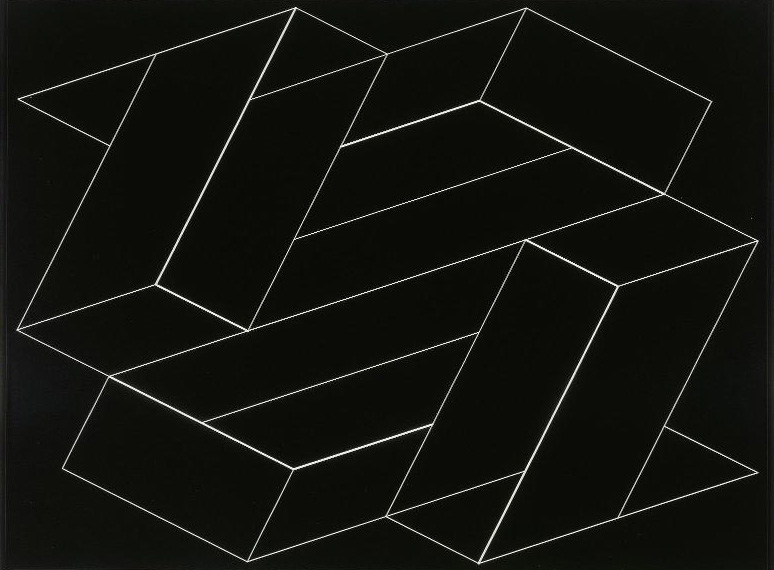
The core logic of modernism is built on "mechanical rationality." It was an echo of the Industrial Revolution, a worship of standardization, universality, and certainty. In that era, artists were like meticulous engineers, pursuing a universal, eternal, ultimate form. Whether it was the Bauhaus's "form follows function" or Mondrian's rigorous red, yellow, and blue grid, the underlying logic was a kind of "subtraction": by eliminating redundant decoration and the interference of individuality, they attempted to find the absolute truth hidden beneath the chaotic appearance. In the logic of modernism, the work was seen as a closed, perfect, static object, which, once completed, would not change. It emphasized "construction," imposing order on material through top-down control.

Frank Stella
However, with the advent of the digital age, this solid logic began to liquefy. Digital technology introduced a completely new core logic—"computability" and "generativeness." In this new paradigm, the world is no longer seen as a mechanical device built from static building blocks, but rather understood as a flowing information network and a complex ecosystem.
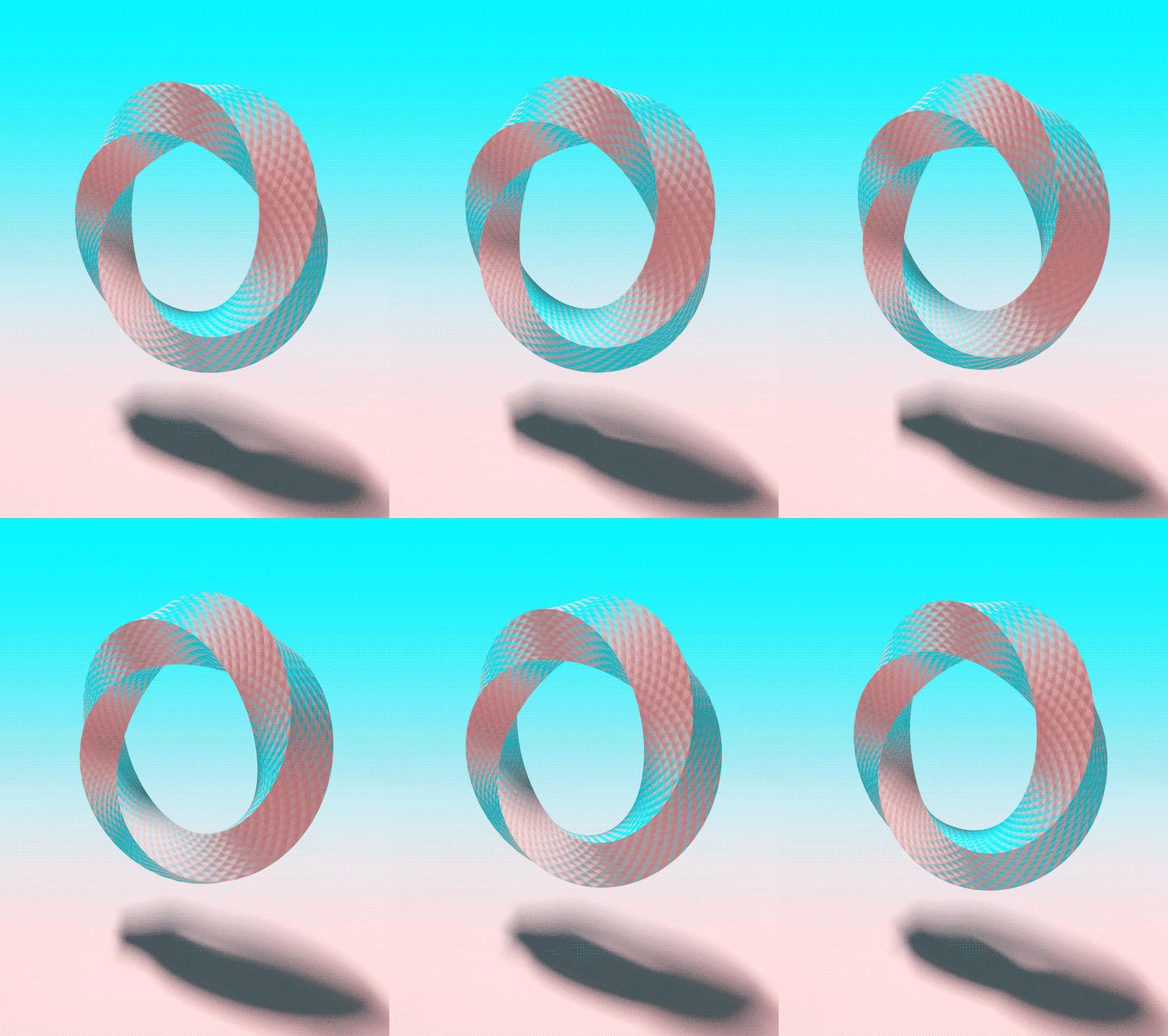
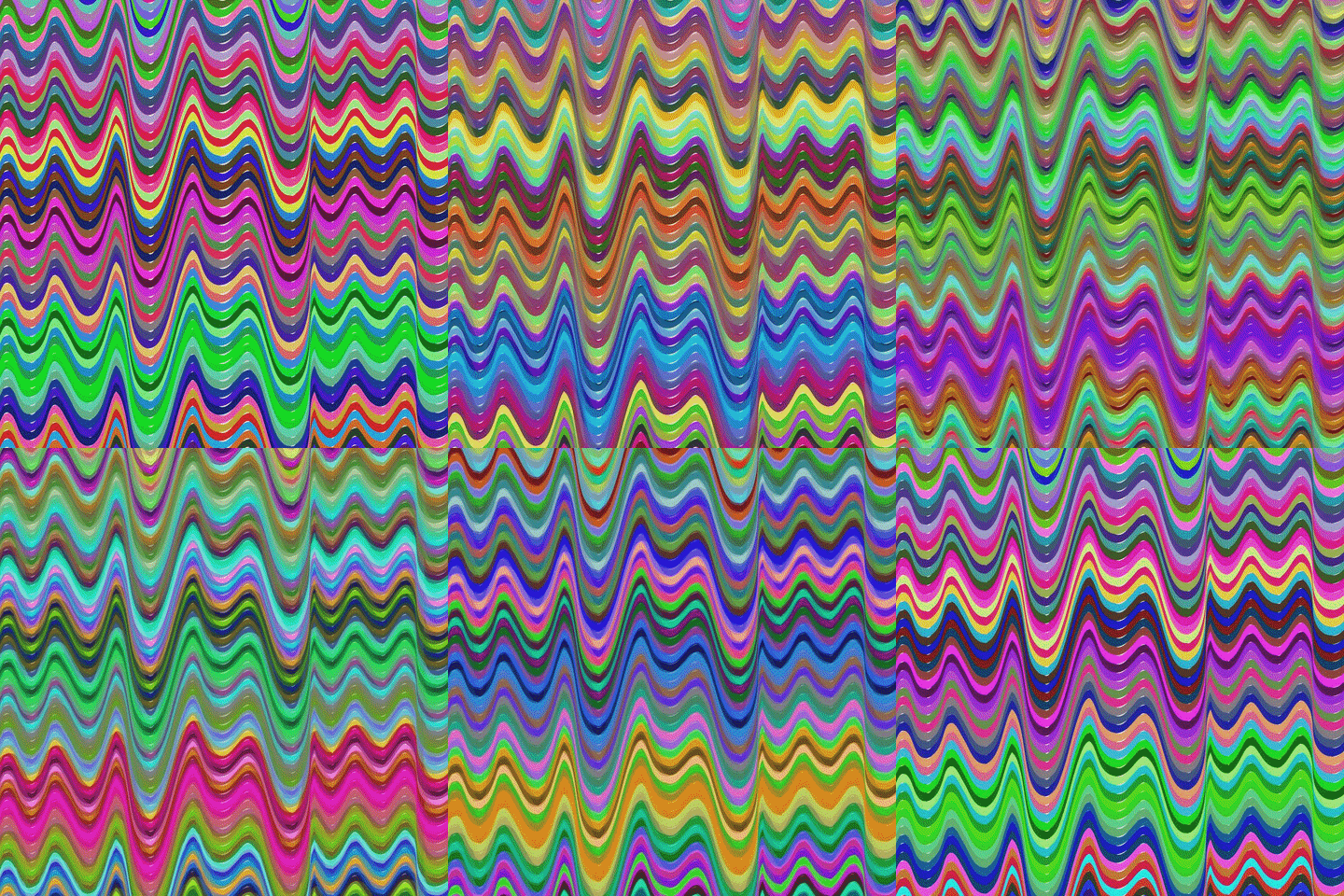
This shift is first reflected in the "methodology of creation." If modernism was about "standards and repetition," then the digital age is about "variables and differences." With the help of algorithms and parametric design, artists no longer directly sculpt the final form, but rather write the rules for generation. The work is no longer a single "original," but a "version" with infinite possibilities for variation. As we see in generative art, the same algorithmic equation can derive thousands of forms, each legitimate yet distinct. This logic fundamentally dismantles modernism's obsession with a "single standard answer," instead embracing complexity and diversity.
Josef Albers
Secondly, this transformation reshapes the "dimensional of time." Modernist works aspire to be eternal monuments, resisting the erosion of time; while digital works are inherently dynamic and evolving. In digital logic, data streams constantly wash over form, interactive installations change with the viewer's actions, and AI-generated images iterate continuously in feedback loops. The artwork transforms from a noun into a verb, from a static "object" into a continuously occurring "event."
Finally, this signifies a relinquishment of "control." Modernist masters were omniscient and omnipotent controllers, while digital-age creators are more like gardeners. They set the initial soil and climate—that is, the boundaries of algorithms and data—and then step back, allowing the results to emerge naturally as the system runs. This logic of "emergence" acknowledges the autonomy of machines and the unpredictability of computation, endowing the unexpected and random with aesthetic value.
In conclusion, the leap from modernism to the digital age represents a shift from "mechanical reproduction" to "algorithmic generation," and from "closed perfection" to "open evolution." We no longer attempt to build a Tower of Babel to exhaustively explore truth, but rather weave an infinitely extending net to capture the ever-changing digital landscape of existence within the flow of bits.
Lesson 6: From Modernism to the Digital Age: A Paradigm Shift Based on Internal Logic (Click to listen to the audio recording)
The history of art and design is often misinterpreted as merely a change in visual styles. However, if we look beyond the surface forms, we find that the evolution from modernism to the digital age is actually a profound shift in cognitive paradigms. This is not simply a difference in tools, from paintbrushes to mice, but a fundamental rupture and reorganization of the inherent logic of how we understand the world and how we construct order. The core logic of modernism is built on "mechanical rationality." It was an echo of the Industrial Revolution, a worship of standardization, universality, and certainty. In that era, artists were like meticulous engineers, pursuing a universal, eternal, ultimate form. Whether it was the Bauhaus's "form follows function" or Mondrian's rigorous red, yellow, and blue grid, the underlying logic was a kind of "subtraction": by eliminating redundant decorations and interference from individuality, they attempted to find the absolute truth hidden beneath the chaotic appearance. In the logic of modernism, the work was seen as a closed, perfect, static object, which, once completed, would not change. It emphasized "construction," imposing order on material through top-down control. However, with the advent of the digital age, this solid logic began to liquefy. Digital technology introduced a completely new core logic—"computation" and "generativeness." In this new paradigm, the world is no longer seen as a mechanical device built from static blocks, but rather understood as a flowing information network and a complex ecosystem. This shift is first reflected in the "methodology of creation." If modernism was about "standards and repetition," then the digital age is about "variables and differences." With the help of algorithms and parametric design, artists no longer directly sculpt the final form, but instead write the rules of generation. The work is no longer a single "original," but a "version" with infinite possibilities of variation. As we see in generative art, the same algorithmic equation can derive thousands of forms, each legitimate yet distinct. This logic fundamentally dismantles modernism's obsession with the "single standard answer," embracing complexity and diversity instead. Secondly, this shift reshapes the "dimensionality of time." Modernist works aspire to be eternal monuments, resisting the erosion of time; while digital works are inherently dynamic and evolving. In digital logic, data flows constantly reshape form, interactive installations change with the viewer's actions, and AI-generated images iterate continuously in feedback loops. Artwork transforms from a noun into a verb, from a static "object" into a continuously occurring "event." Ultimately, this signifies a relinquishment of "control." Modernist masters were omniscient and omnipotent controllers, while digital-age creators are more like gardeners. They set the initial soil and climate—the boundaries of algorithms and data—and then step back, allowing the results to emerge naturally within the system's operation. This logic of "emergence" acknowledges the autonomy of machines and the unpredictability of computation, endowing the unexpected and random with aesthetic value. In conclusion, the leap from modernism to the digital age is a leap from "mechanical reproduction" to "algorithmic generation," from "closed perfection" to "open evolution." We no longer attempt to build a Tower of Babel to exhaust all truth, but rather weave an infinitely extending net, capturing the ever-changing digital landscape of existence within the flow of bits.
 简体中文
简体中文  English
  日本語
日本語  Español
  Français
  हिन्दी
  العربية
  বাংলা
বাংলা  Português do Brasil
  Русский
  اردو
اردو  Bahasa Indonesia
  Deutsch
  Kiswahili
  मराठी
मराठी  తెలుగు
  Tiếng Việt
  Türkçe
  Italiano
  தமிழ்
தமிழ்  한국어
한국어