
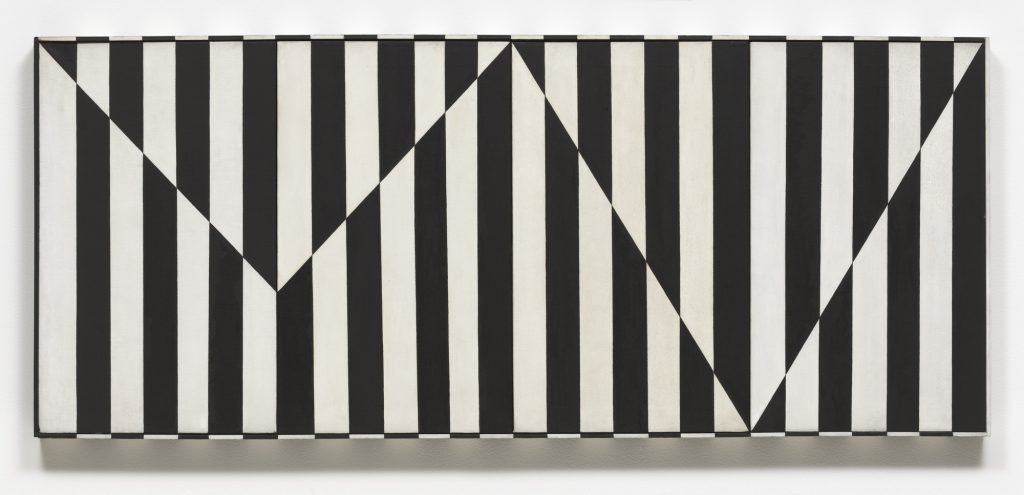
Carmen Herrera's *Untitled*, painted in 1952 and now in the collection of the Museum of Modern Art, New York, is an acrylic painting on canvas measuring approximately 63.5 × 152.4 cm. Whitney's guided tour notes that it belongs to a series of black and white paintings Herrera completed in Paris in 1952, representing a key breakthrough in her artistic language: she compressed the composition to only black and white, and established a highly tense pictorial order through extremely simple geometric relationships.
If we understand this work within the framework of "block-based composition," its representativeness becomes very clear. This painting isn't established by continuous brushstrokes or a single central image, but rather by the interplay of several geometric blocks to form a cohesive whole. Whitney's explanation specifically mentions a near-W-shaped, jagged diagonal structure within the painting, but this isn't achieved by outlining contours; rather, it's revealed through the "reversal" of black and white stripes at the boundaries. In other words, Herrera didn't simply juxtapose the blocks; instead, she created a patchwork effect at their intersections through color interchange, resulting in boundaries that are both clear and full of tension.
This is precisely where the most worthy aspect of analysis lies: the so-called "block splicing" here is not a jigsaw puzzle-like filling, but an active method of structural generation. Black and white occupy different areas, but what truly matters is not the large areas of color themselves, but the diagonal folds formed where they meet. The viewer does not initially perceive the image as a series of isolated blocks, but first senses a geometric, folded force running through the entire canvas, and then gradually realizes that this force actually emerges from the precise splicing of multiple blocks. In other words, the blocks are not passively piled on the canvas, but collectively create a larger structural whole through their interweaving.
Formally, the brilliance of this work lies in its powerful structural compression achieved with minimal elements. The black and white palette is already restrained enough, but Herrera goes further, abandoning obvious outlines, volumetric shaping, and background layers, retaining only direction, boundaries, and the relationships between planes. Thus, every transition in the composition becomes exceptionally sensitive: the interaction between vertical stripes and diagonal joinery maintains vertical stability while constantly creating a rhythm of inward cutting and outward expansion. This treatment makes *Untitled* neither a mere calm division like traditional geometric abstraction nor reliant on emotional traces like expressionism, but rather achieves an almost architectural tension within its cool control. Whitney's guided tour cites it as an example of Herrera's "leap" in 1952, demonstrating that this simplification is not a reduction in content, but rather an increase in structural density.
Therefore, from the perspective of "block splicing modules," the core value of *Untitled* lies in its demonstration that splicing does not necessarily rely on rich colors or complex units. The fewest black and white colors, the simplest geometric divisions, can also form a very strong block logic. The splicing here is not about piecing together different fragments into a single image, but rather about giving each block a directional function: some blocks are responsible for stabilizing vertical order, some for driving diagonal turns, and some for reinforcing boundaries through the interplay of black and white. Ultimately, the entire image is a structure precisely interlocked by a few geometric components, rather than an abstract pattern established through decoration.
This work also reminds us that when block-based mosaic modules truly mature, the focus is often not on the quantity of "blocks," but on how the "mosaic lines" organize the viewer's perception. Herrera doesn't hide the seams here; instead, she makes them the engine of the image. The W-shaped folds are powerful precisely because the boundaries of the black and white blocks constantly exchange hierarchy, allowing the viewer's eye to slide along the seams. Thus, the blocks are both color units and path units; the mosaic is both connection and division. This treatment gives "Untitled" a rare dual nature: on the one hand, it is extremely flat and extremely simple; on the other hand, it allows the viewer to feel a structural movement that almost lifts the surface.
From the perspective of Carmen Herrera's creative development, this 1952 work is particularly crucial. Whitney's materials place it within the context of her breakthrough in black and white painting during her Paris period, and the relevant exhibition page shows that this stage was the starting point for her gradual formation of her later signature hard-edged geometric language. In other words, although "Untitled" is not yet the extremely condensed single-slanted structure of her later famous "Blanco y Verde" series, it has already established the most important methods: reducing colors, compressing elements, making boundaries the protagonist, and generating the picture by piecing together blocks rather than depicting objects.
Therefore, if we summarize *Untitled* as a representative work of "block-based modularity," its most significant meaning lies in elevating modularity from a mere surface combination to a structural method. Herrera doesn't arrange geometric blocks as decorative fragments, but rather allows them to generate rhythm, direction, and tension through precise interlocking. This method remains highly inspiring for contemporary creation, as it is particularly suitable for translation into architectural facades, exhibition zoning, interface layouts, panel structures, and modular installation design. It proves that truly advanced block-based modularity doesn't rely on an increasing number of elements, but on increasingly precise boundaries and increasingly close relationships. The reason *Untitled* is a classic is precisely because it achieves the strongest structural organization with the fewest blocks.
Lessons F2-23: Analysis of Carmen Herrera's Works (Click to view and listen to the reading)
Carmen Herrera's *Untitled*, painted in 1952 and now in the collection of the Museum of Modern Art, New York, is an acrylic painting on canvas measuring approximately 63.5 × 152.4 cm. Whitney's guided tour of the work notes that it belongs to a series of black and white paintings Herrera completed in Paris in 1952, representing a key breakthrough in her artistic language: she compressed the composition to only black and white, establishing a highly tense pictorial order through extremely simple geometric relationships. If this work is understood within the context of "block-based modularity," its representativeness becomes very clear. This is because the painting is not established by continuous brushstrokes or a single central image, but rather by the interplay of several geometric blocks to form a whole. Whitney's explanation specifically mentions the presence of a near-W-shaped, jagged diagonal structure in the painting, which is not achieved by outlining contours, but rather revealed through the "reversal" of black and white stripes at the boundaries. In other words, Herrera didn't simply juxtapose the planes; instead, she created a patchwork effect at their boundaries through color interchange, resulting in clear yet dynamic borders. This is precisely the most worthy aspect of analysis: the so-called "plane patchwork" here isn't a jigsaw puzzle, but an active method of structural generation. Black and white occupy different areas, but what truly matters isn't the large blocks of color themselves, but the diagonal folds formed where they meet. The viewer doesn't initially perceive the image as a series of isolated planes, but first senses a geometric, folded force running throughout the entire canvas, gradually realizing that this force emerges from the precise combination of multiple planes. That is, the planes aren't passively piled on the canvas, but collectively create a larger structural whole through their interweaving. Formally, the brilliance of this work lies in its use of minimal elements to achieve extremely strong structural compression. Black and white are already sufficiently restrained, but Herrera further abandons obvious outlines, volumetric shaping, and background layers, retaining only direction, boundaries, and the relationships between planes. Thus, every transition in the image becomes exceptionally sensitive: the interaction between vertical stripes and diagonal juxtapositions maintains vertical stability while continuously creating a rhythm of inward cutting and outward expansion. This treatment makes *Untitled* neither a mere calm division like traditional geometric abstraction nor reliant on emotional traces like expressionism, but rather achieves an almost architectural tension through cool control. Whitney's guided tour cites it as an example of Herrera's "leap" in 1952, demonstrating that this simplification is not about reducing content, but rather increasing structural density. Therefore, from the perspective of "block-based juxtaposition modules," the core value of *Untitled* lies in its proof that juxtaposition does not necessarily rely on rich colors or complex units. The fewest black and white colors and the simplest geometric divisions can also form a very strong block logic. The juxtaposition here is not about piecing together different fragments into a single image, but about giving each block a directional function: some blocks are responsible for stabilizing the vertical order, some for driving diagonal transitions, and some for reinforcing boundaries through the interplay of black and white. Ultimately, the entire painting is a structure meticulously crafted from a few geometric components, rather than an abstract pattern built on decorative elements. This work also suggests that when block-based composition truly matures, the focus is often not on the number of "blocks," but on how the "joints" organize the viewer's perception. Herrera doesn't hide the seams here; instead, she makes them the engine of the image. The W-shaped folds are powerful precisely because the boundaries of the black and white blocks constantly exchange hierarchy, allowing the viewer's eye to slide along the joints. Thus, the blocks are both color units and path units; the joints are both connections and cuts. This treatment gives *Untitled* a rare duality: on the one hand, it is extremely flat and simple; on the other hand, it evokes a structural movement that almost lifts the surface. From the perspective of Carmen Herrera's creative development, this 1952 work is particularly crucial. Whitney's materials place it within the context of her breakthrough in black and white painting during her Paris period, while related exhibition pages indicate that this stage was the starting point for her gradual formation of her later signature hard-edged geometric language. In other words, while *Untitled* doesn't yet possess the highly condensed, single-slanted structure of her later famous "Blanco y Verde" series, it has already established the most important methods: reducing colors, compressing elements, making boundaries the protagonist, and generating the image through the interweaving of blocks rather than depicting objects. Therefore, if we summarize *Untitled* as a representative work of "block-based modularity," its most typical significance lies in elevating patchwork from a surface combination to a structural method. Herrera doesn't arrange geometric blocks as decorative fragments, but rather allows them to generate rhythm, direction, and tension through precise interlocking. This method remains highly inspiring for contemporary creation, as it is particularly suitable for translation into architectural facades, exhibition zoning, interface layouts, panel structures, and modular installation design. It proves that truly advanced block-based patchwork doesn't rely on increasing the number of elements, but on increasingly precise boundaries and increasingly close relationships. The reason *Untitled* is a classic is precisely because it achieves the strongest structural organization with the fewest blocks.
 简体中文
简体中文  English
  日本語
日本語  Español
  Français
  हिन्दी
  العربية
  বাংলা
বাংলা  Português do Brasil
  Русский
  اردو
اردو  Bahasa Indonesia
  Deutsch
  Kiswahili
  मराठी
मराठी  తెలుగు
  Tiếng Việt
  Türkçe
  Italiano
  தமிழ்
தமிழ்  한국어
한국어