
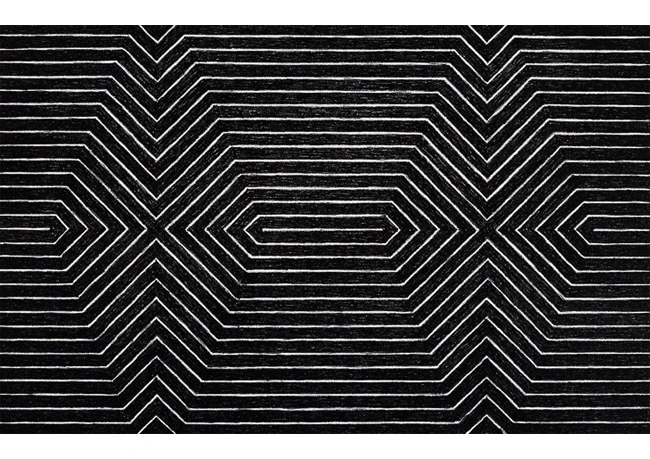
Frank Stella's *The Marriage of Reason and Squalor, II*, created in 1959, is an industrial enamel painting on canvas, measuring approximately 230.5 × 337.2 cm, and is currently housed in the Museum of Modern Art (MoMA) in New York. It belongs to Stella's renowned "Black Paintings" series and is one of his most pivotal works when he entered MoMA's field of vision at a very young age in 1959. MoMA's catalogue notes that the work consists of two sets of almost symmetrical, inverted U-shaped black stripes; Smarthistory also considers it the most representative example of this series of black paintings.
If this work is analyzed within the framework of "strip division," its typicality becomes very strong. The entire painting relies almost entirely on repetitive, progressive stripes, rather than on a central figure, foreground, background, or narrative element found in traditional compositions. Thick black stripes alternate with the narrow strips of the original canvas that remain between them, making the "stripes" both the units that fill the canvas and the mechanism that divides it. Smarthistory explicitly points out that the repeated alternation between the wide black stripes and the thin strips of exposed canvas leaves no room for expressive brushstrokes; the MoMA audio also emphasizes that Stella used house paintbrushes to create parallel lines and patterns, making the stripes the true structural foundation of the work.
The most important aspect of this work lies in its transformation of "division" into an absolute order. Generally, division often serves only the purpose of composition, but in *The Marriage of Reason and Squalor, II*, division itself is the theme. The black stripes continuously retrace, converge, and advance inward until the entire image is dominated by this striped logic. What the viewer sees is not a series of individual stripes, but a holistic system formed by the continuous folding of the stripes. The MoMA artwork page mentions that the image is composed of two sets of identical vertical concentric inverted U-shapes, indicating that Stella did not treat the stripes as decoration, but rather organized them into an almost architectural structure of order.
Formally, the brilliance of this work lies in its "sense of oppression within repetition." The width of the stripes remains relatively stable, and their direction is extremely uniform, giving the viewer the feeling that the image is constantly being bound by some strict rule. The black resembles both a solid wall and a repeatedly pushed path; the thin white stripes are both gaps and breathing points. It is precisely because these white stripes are extremely narrow that the weight of the black stripes is further amplified. Smarthistory points out that this structure almost eliminates the traditional sense of gesture, but upon closer inspection, details such as dripping, blurred edges, and subtle differences in the width of the white space can still be found; in other words, this is not a cold, mechanical pattern, but rather a work that retains the subtle disturbances of materials and handcraft within a highly rational framework.
Therefore, this work is not simply a "striped painting," but rather a modern extreme form of striped segmentation modules. It proves that stripes can establish a strong visual order without relying on color richness or curve variations, solely through repetition, reflection, symmetry, and boundaries. The MoMA 2024 retrospective article refers to Stella's early stripes as "paths of a brush on canvas," indicating that they are both the trajectory of the brush's movement and the trajectory that generates the structure of the image. Here, the stripes both cut through the image and simultaneously stitch the entire plane back together into a unified whole.
From today's perspective, *The Marriage of Reason and Squalor, II* remains highly inspiring in its use of striped modules. It shows us that stripes are not merely decorative elements, but a fundamental method that can be applied to architectural facades, exhibition walls, interface partitions, and modular design: repetition establishes order, boundaries create tension, and division forms a whole. For this reason, this 1959 work is not only a groundbreaking masterpiece by Stella, but also a significant example of how "striped division" in geometric abstraction has evolved from a surface pattern into a structural language.
Lessons F2-7: Analysis of Frank Stella's Works (Click to listen to the reading)
Frank Stella's *The Marriage of Reason and Squalor, II*, created in 1959, is an industrial enamel painting on canvas, measuring approximately 230.5 × 337.2 cm, and is currently housed in the Museum of Modern Art (MoMA) in New York. It belongs to Stella's renowned "Black Paintings" series and is one of his most pivotal works when he entered MoMA's field of vision at a very young age in 1959. MoMA's catalogue notes that the work consists of two sets of almost symmetrical, inverted U-shaped black stripes; Smarthistory also considers it the most typical example of this series of black paintings. If analyzed within the context of "strip division modules," its typicality is extremely strong. The entire painting relies almost entirely on repetitive, progressive stripes, rather than on a central figure, foreground, background, or narrative element in traditional composition. The alternation between thick black stripes and the remaining narrow strips of the original canvas makes the "stripes" both the filling units and the dividing mechanism of the painting. Smarthistory explicitly points out that the alternating wide black bands and thin stripes of exposed canvas leave no room for expressive brushstrokes; the MoMA audio also emphasizes that Stella used house paintbrushes to create parallel lines and patterns, making the stripes the true structural foundation of the work. The most important aspect of this work is that it transforms "division" into an absolute order. Generally, division often serves only the composition, but in *The Marriage of Reason and Squalor, II*, division itself is the theme. The black stripes continuously turn inward, approach, and advance until the entire picture is occupied by this striped logic. The viewer does not see a few local stripes, but a holistic system formed by the continuous folding of the stripes. The MoMA artwork page mentions that the picture is composed of two sets of identical vertical concentric inverted U-shapes, indicating that Stella did not use the stripes as decoration, but rather organized them into an almost architectural structure of order. Formally, the brilliance of this work lies in the "oppressive feeling within repetition." The stripes maintain a relatively stable width and a highly uniform direction, giving the viewer the feeling that the image is constantly being bound by some strict rule. The black lines resemble both a solid wall and a repeatedly pushed path; the thin white lines are both gaps and breathing points. Because these white lines are extremely narrow, the weight of the black stripes is amplified. Smarthistory points out that this structure almost eliminates traditional gestural expression, but close inspection still reveals details such as dripping, blurred edges, and subtle differences in the width of the white space; that is, this is not a cold, mechanical pattern, but rather a work that retains the subtle disturbances of materials and handcraft within a highly rational framework. Therefore, this work is not simply a "striped painting," but a modern extreme form of striped segmentation modules. It proves that stripes can establish a strong visual order without relying on color richness or curve variations, solely through repetition, reflection, symmetry, and boundaries. The MoMA 2024 retrospective article refers to Stella's early stripes as "paths of a brush on canvas," indicating that they are both the trajectory of the brush's movement and the trajectory of the image's structure. Here, the stripes both cleave the canvas and simultaneously reassemble the entire plane into a unified whole. From today's perspective, *The Marriage of Reason and Squalor, II* remains highly inspiring in its use of striped modules. It shows us that stripes are not merely decorative elements, but a fundamental method that can be applied to architectural facades, exhibition walls, interface partitions, and modular design: repetition establishes order, boundaries create tension, and division forms a whole. Therefore, this 1959 work is not only a groundbreaking masterpiece by Stella, but also a significant example of how "striped division" in geometric abstraction has evolved from a surface pattern into a structural language.
 简体中文
简体中文  English
  日本語
日本語  Español
  Français
  हिन्दी
  العربية
  বাংলা
বাংলা  Português do Brasil
  Русский
  اردو
اردو  Bahasa Indonesia
  Deutsch
  Kiswahili
  मराठी
मराठी  తెలుగు
  Tiếng Việt
  Türkçe
  Italiano
  தமிழ்
தமிழ்  한국어
한국어