
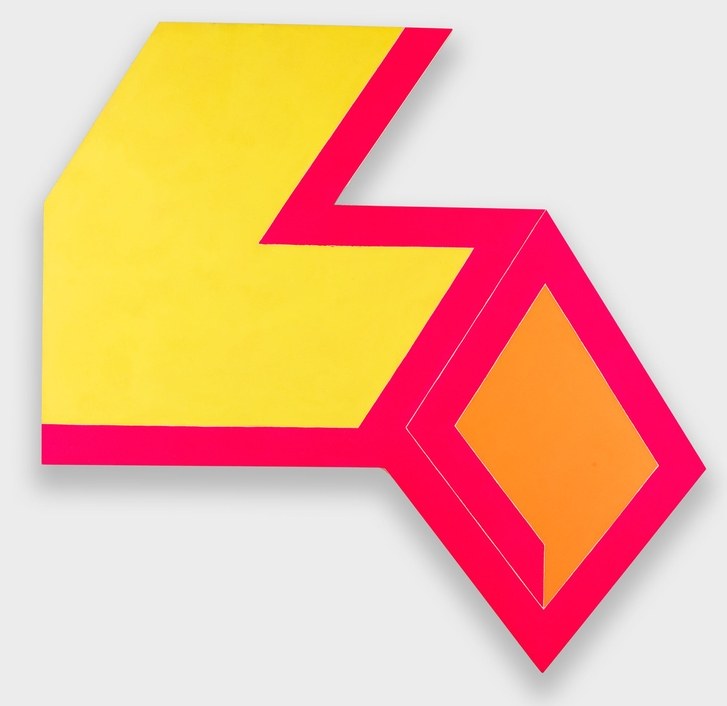
Frank Stella is a pivotal artist in geometric abstract art. His importance lies not only in his pioneering work in updating the language of abstract painting, but also in his continuous breakthroughs in overcoming the limitation that "painting can only remain on a two-dimensional plane," gradually imbuing geometric forms with structural, material, and spatial qualities. Therefore, Frank Stella's work is highly representative of "spatial compositional modules." His creations demonstrate that geometric abstraction is not merely the arrangement of lines, blocks of color, and order, but can develop into a spatial construction language that expands outward, protrudes forward, and transforms into structural generation.
Frank Stella's early works are known for their strict, simple, and repetitive linear structures. Those black-striped paintings often give an impression of calm, rationality, and restraint; the paintings do not pursue narrative or emphasize emotional catharsis, but rather establish order through lines and boundaries themselves. While the geometric forms of this period are still relatively flat, they already reveal his high sensitivity to structure. He did not use geometry as decorative patterns, but rather viewed it as a self-organizing system: how lines repeat, how boundaries are defined, how the composition is generated by internal rules—these questions form the foundation of his art.
However, Frank Stella truly brought geometric abstraction into the realm of "spatial composition" after he gradually broke free from the constraints of the rectangular canvas. With the emergence of irregularly shaped canvases, layered structures, curved divisions, and relief-like surfaces, his works were no longer merely flat surfaces to be viewed, but rather like constructs with a sense of volume, direction, and extensional tension. The edges of the canvas were no longer passive containers, but became part of the composition; the works were no longer just images painted on a plane, but entered space as a whole. In other words, he changed the way people viewed painting: painting was no longer just "composing on a surface," but "constructing visual existence in a holistic form."
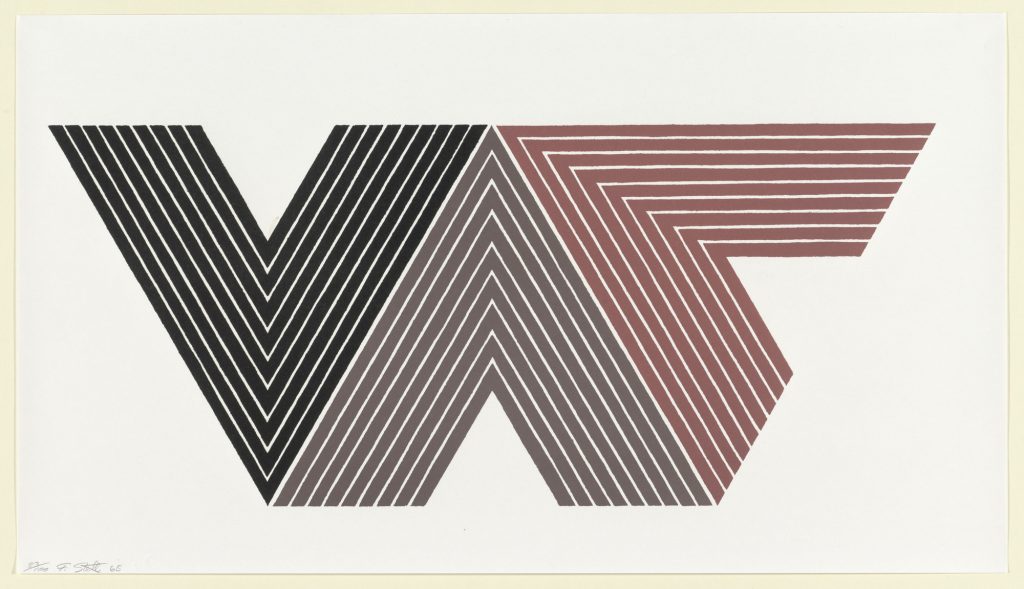
Formally, Frank Stella's spatial composition is primarily manifested in the "unity of form and internal structure." Traditional paintings often arrange content within a defined rectangle, while Stella allows the outer contours of the canvas to directly participate in structural generation. Curves, broken lines, polygons, and irregular edges make the work itself a spatial unit. The internal bands, color planes, and swirling paths echo the external shapes, forming a holistic order from the inside out. This approach is crucial because it extends geometric abstraction beyond mere internal relationships to encompass the relationship between the work as a whole and its surrounding space.
Secondly, Frank Stella's spatiality does not rely on traditional perspective, nor on naturalistic chiaroscuro. His space is a "constructed space" generated by geometric movement, layering, and visual rhythm. In many works, color bands advance, rotate, and unfold like tracks, while forms overlap, stretch, and suspend like components. When viewers face these works, they do not feel a simple planar order, but a force that continuously grows outward. Geometry here is no longer static, but has direction, speed, and an expanding tendency. It is not closed, but open; not static, but generative.
Another key characteristic of Frank Stella is his blurring of the boundaries between painting, sculpture, and architecture. Particularly in his later works, curved metal components, protruding panels, swirling paths, and complex layering give his pieces an increasingly relief-like, installation-like, and architectural quality. While still belonging to abstract art, they are no longer simply "paintings." They resemble structures growing from a flat surface, possessing clear spatial relationships, depth relationships, and spatial intervention. It is in this respect that Frank Stella's development of spatial compositional geometric abstraction is profoundly significant: he demonstrated that geometric abstraction can completely transcend planar boundaries and enter into more complex spatial organizations.
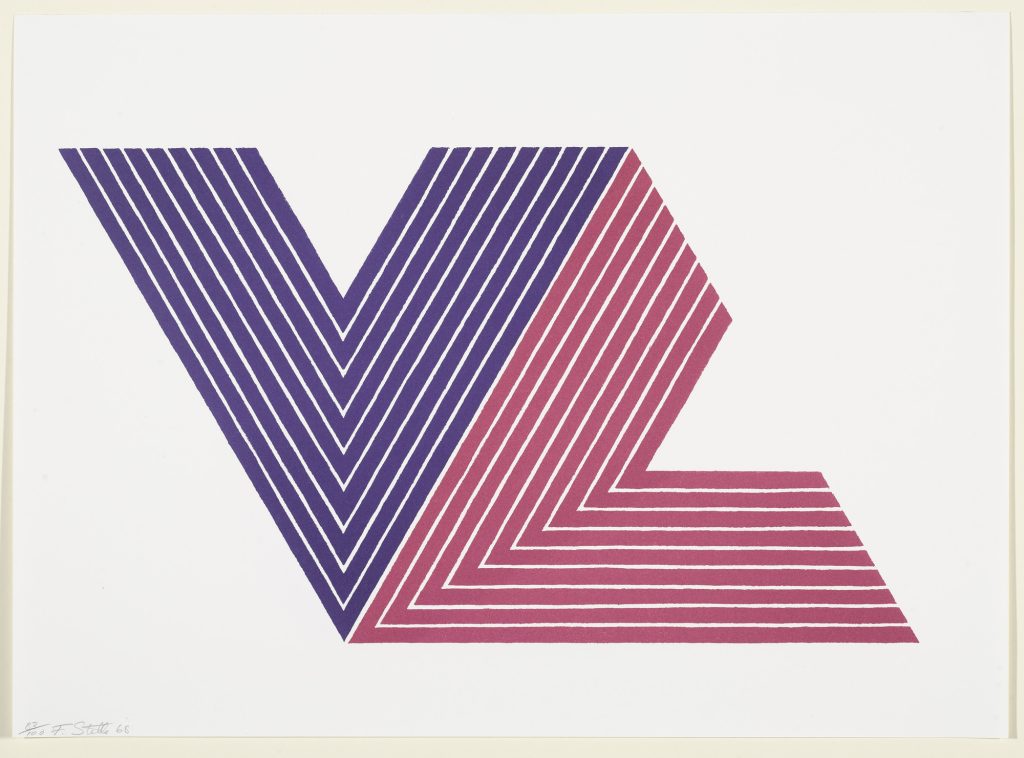
Visually, Frank Stella's works are both rational and full of tension. They possess a strict sense of order, yet are not rigid; they have a distinct systematicity, yet are not monotonous. This is because he consistently combines "repetition" and "variation." Repetition brings rhythm and order, while variation brings transition and vitality; geometry provides clarity, and spatial expansion provides impact. Thus, his works contain a strong sense of movement and visual energy within a calm structure. Viewers feel as if they are not looking at a static image, but rather facing an ever-evolving geometric system.
In the context of geometric abstract art, Frank Stella's significance lies in his advancement of geometric language from the two-dimensional plane to a stage of objectification, structuration, and spatialization. He made people realize that geometric abstraction is not merely a simplification of form, nor is it simply a decorative order, but a constructive method capable of shaping spatial relationships, organizing visual movement, and changing the way we see. His works unify lines, planes, boundaries, contours, and materials into a dynamic system, giving geometric abstraction greater material power and spatial depth.
Therefore, as a representative artist of "spatial compositional modules," Frank Stella's value lies in his continuous advancement of geometric forms. He did not remain at the level of neatness and purification in planar abstraction, but constantly allowed geometry to grow towards structure, towards objects, and towards space. His works clearly demonstrate that geometric abstract art can not only establish order, but also construct space; it can not only organize planes, but also form a visual compositional system that unfolds towards real space. This is precisely Frank Stella's most crucial contribution to modern geometric abstract art.
Lessons F2-29: Analysis of Frank Stella's Works (Click to view and listen to the reading)
Frank Stella is a pivotal artist in geometric abstract art. His importance lies not only in his pioneering work in updating the language of abstract painting, but also in his continuous breakthroughs in overcoming the limitation that "painting can only remain on a two-dimensional plane," gradually imbuing geometric forms with structural, material, and spatial qualities. Therefore, Frank Stella's work is highly representative of "spatial compositional modules." His creations demonstrate that geometric abstraction is not merely an arrangement of lines, blocks of color, and order, but can develop into a spatial construction language that expands outward, protrudes forward, and transforms into structural generation. Frank Stella's early works are known for their strict, concise, and repetitive linear structures. Those black-striped paintings often evoke a sense of calm, rationality, and restraint; the paintings do not pursue narrative or emphasize emotional expression, but rather establish order through lines and boundaries themselves. While the geometric forms of this period remain relatively flat, they already reveal his high sensitivity to structure. He did not use geometry as decorative patterns, but rather viewed it as a self-organizing system: how lines repeat, how boundaries are defined, how the image is generated by internal laws—these questions form the foundation of his art. However, Frank Stella truly brought geometric abstraction into the realm of "spatial composition" after he gradually broke free from the constraints of the rectangular canvas. With the emergence of irregularly shaped canvases, layered structures, curved divisions, and relief surfaces, his works were no longer merely flat surfaces to be viewed, but rather like constructs with a sense of volume, direction, and extensional tension. The edges of the canvas were no longer passive containers, but became part of the composition; the work was no longer just an image painted on a plane, but entered space as a whole. In other words, he changed the way people viewed painting: painting was no longer just "composing on a surface," but "constructing visual existence in a holistic form." Formally, Frank Stella's spatial composition is first reflected in the "unity of form and internal structure." Traditional painting often arranges content within a fixed rectangle, while Stella allows the outer contour of the painting to directly participate in structural generation. Curves, broken lines, polygons, and irregular edges make the work itself a spatial unit. The internal stripes, color planes, and swirling paths echo the external shapes, forming a holistic order from the inside out. This approach is crucial because it expands geometric abstraction beyond mere internal relationships within the image to encompass the relationship between the work as a whole and its surrounding space. Secondly, Frank Stella's spatiality doesn't rely on traditional perspective or naturalistic chiaroscuro. His space is a "constructive space" generated by geometric movement, layering, and visual rhythm. In many works, color bands advance, rotate, and unfold like tracks, while forms overlap, stretch, and suspend like components. Viewers encounter not a simple planar order, but a continuously outward-growing force. Geometry here is no longer static but possesses direction, speed, and an expanding tendency. It is not closed but open; not static but generative. Another important characteristic of Frank Stella is his constant blurring of the boundaries between painting, sculpture, and architecture. Especially in his later works, curved metal components, protruding panels, rotating paths, and complex layering relationships increasingly imbue the works with a relief-like, installation-like, and architectural quality. Although they still belong to abstract art, they are no longer simply "paintings." They resemble structures growing from a plane, possessing clear spatial relationships, thickness relationships, and spatial intervention. It is precisely at this point that Frank Stella's contributions to the development of spatial compositional geometric abstraction are profound: he proved that geometric abstraction can transcend planar boundaries and enter into more complex spatial organizations. Visually, Frank Stella's works are both rational and full of tension. They possess a strict sense of order, yet are not rigid; they have a distinct systematicity, yet are not monotonous. This is because he consistently combines "repetition" and "variation." Repetition brings rhythm and order, while variation brings transition and vitality; geometry provides clarity, while spatial expansion provides impact. Thus, the works contain a strong sense of movement and visual energy within their calm structure. Viewers feel they are not looking at a static image, but rather facing an ever-evolving geometric system. In the context of geometric abstract art, Frank Stella's significance lies in advancing geometric language from a two-dimensional plane to a stage of objectification, structuration, and spatialization. He made people realize that geometric abstraction is not merely a simplification of form, nor simply decorative order, but a constructive method capable of shaping spatial relationships, organizing visual movement, and changing the way we see. His work unifies lines, planes, boundaries, contours, and materials into a dynamic system, giving geometric abstraction greater material power and spatial depth. Therefore, as a representative artist of "spatial compositional modules," Frank Stella's value lies in his continuous advancement of geometric forms. He doesn't remain at the level of neatness and purification in planar abstraction, but constantly allows geometry to grow towards structure, towards objects, and towards space. His work clearly demonstrates that geometric abstract art can not only establish order but also construct space; it can not only organize planes but also form a visual compositional system unfolding towards real space. This is Frank Stella's most crucial contribution to modern geometric abstract art.
 简体中文
简体中文  English
  日本語
日本語  Español
  Français
  हिन्दी
  العربية
  বাংলা
বাংলা  Português do Brasil
  Русский
  اردو
اردو  Bahasa Indonesia
  Deutsch
  Kiswahili
  मराठी
मराठी  తెలుగు
  Tiếng Việt
  Türkçe
  Italiano
  தமிழ்
தமிழ்  한국어
한국어