
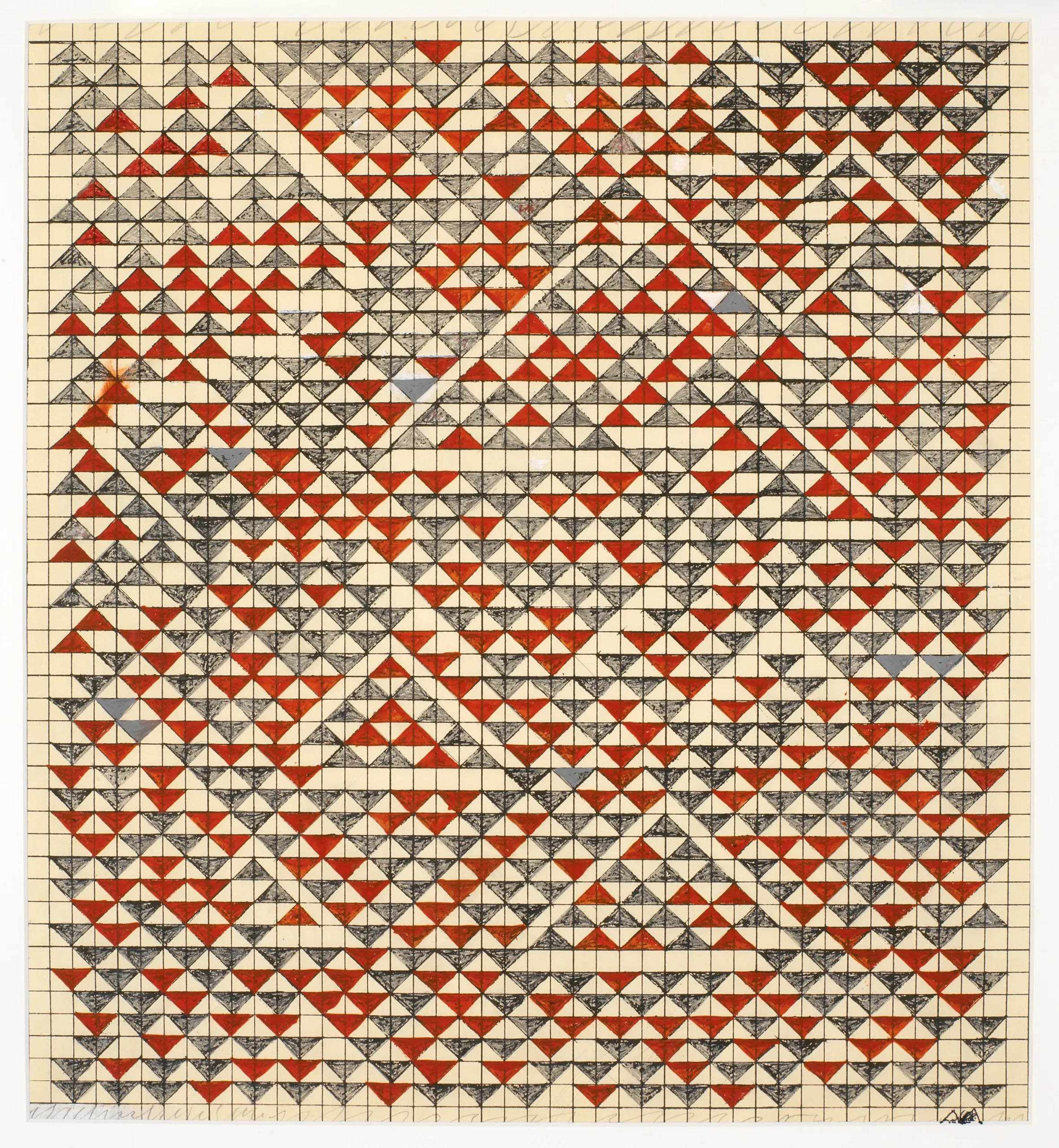
Anni Albers is a highly representative artist within the "Basic Grid Module" because in her work, the grid is not an added compositional tool, but rather the starting point of weaving itself. The warp and weft threads intersect vertically and horizontally, naturally forming the most basic grid structure; geometric order, repetitive rhythm, density variations, and pattern generation all emerge from this structure. As the Metropolitan Museum of Art and MoMA have pointed out in their summary of the history of textiles, the "constructivism" of weaving comes from the grid formed by the vertical and horizontal elements on the loom. This structure makes geometric design not merely surface decoration, but an inseparable unity of structure and pattern. The most accurate reason to place Anni Albers within the "Basic Grid" is precisely this: she transforms the grid from an implicit technical framework into a core element of modern abstract art that can be viewed, contemplated, and elevated to the level of artistic language.
Albers entered the Bauhaus in 1922, initially intending to study visual arts. However, the school's gender segregation at the time restricted many women from entering the weaving workshops. This seemingly passive starting point, ironically, led her down a path that changed the status of modern fiber art. She not only completed her weaving diploma at the Bauhaus but also taught at Black Mountain College in the United States after the school closed, bringing Bauhaus structural concepts, material experimentation, and design methods to a new teaching environment. Black Mountain College records explicitly state that she transformed the principles she learned at the Bauhaus into her own workshop teaching, emphasizing materiality and a deep connection to pre-Columbian textile traditions. In other words, Albers's "grid consciousness" was not merely a graphic preference from the beginning, but rather shaped by training, craftsmanship, teaching, and cross-cultural research.
Anni Albers's importance lies in her revolutionizing the way people understand fabrics. A 1990 MoMA document points out that she, along with Gunta Stölzl, reversed the 19th-century tradition of fabric making that emphasized pictorial representation, instead revealing the most fundamental structure of fabric—warp and weft—and allowing these interwoven relationships to "speak" anew through plain weaves and contrasting fibers. This means she didn't treat the fabric surface as a plane to which images could be arbitrarily drawn, but rather as the structure itself as the site where form occurs. In the relationships between lines, planes, rhythms, and color blocks, the basic grid is no longer hidden, but becomes the true source of visual order. For geometric abstract art, this is a crucial step: from then on, geometry is not drawn on, but organized; not a generalization of real objects, but a form naturally generated from within the material and structure.
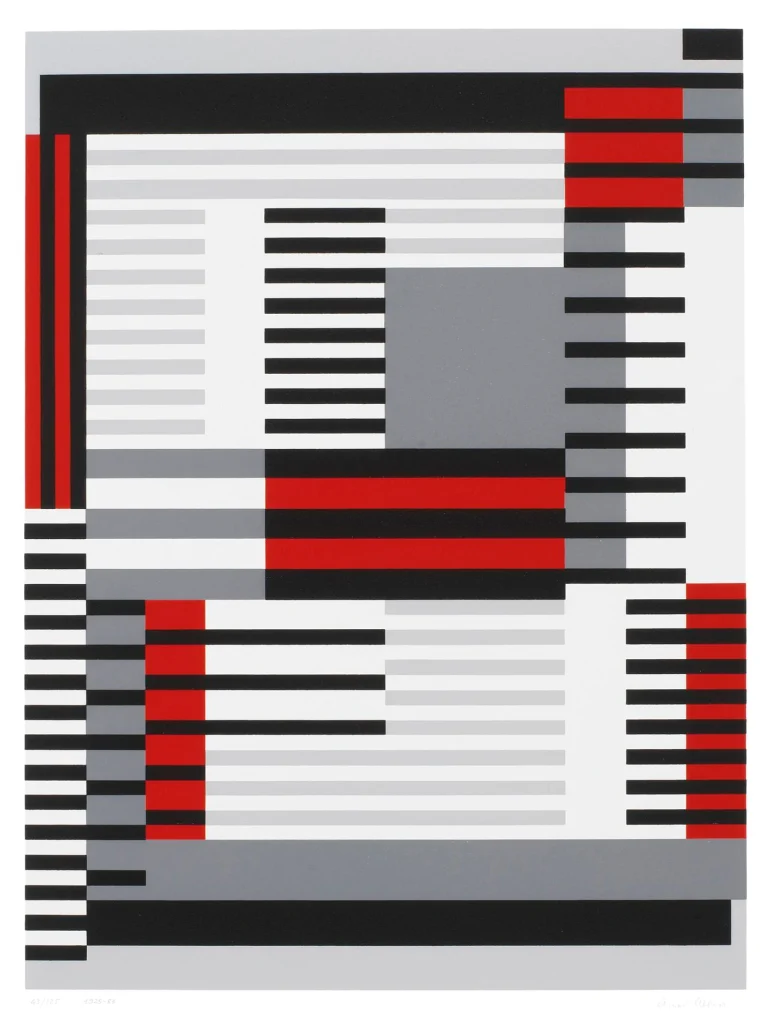
Further analysis of her work reveals that her "basic grid" is not rigid. While the interweaving of warp and weft establishes a stable vertical-horizontal order, she creates subtle and complex visual layers through variations in fiber thickness, material texture, density, and the contrast between transparency and opacity. During her Bauhaus period, she experimented with different materials such as rayon, cellophane, metallic wire, jute, and cotton, using them in fabric designs with specific functions, such as sound absorption, reflection, partitioning, or adaptation to modern architectural spaces. Materials from the Black Mountain Institute and MoMA emphasize that she used both natural fibers and experimental synthetic materials to establish a new language of modern textiles. Therefore, Albers' grid is not a cold, mechanical chessboard, but a living structure that is both orderly and tactile, serving function while also allowing for pure formal contemplation.
She is particularly suited to the "basic grid module" because she consistently connects basic structure with visual abstraction. *On Weaving*, described by the foundation as her reflection on the history, tools, techniques, and relationship of weaving to 20th-century design, includes structural diagrams of plain weave, twill, and interlocking twill, demonstrating how she understood weaving as a way of thinking, not merely a craft. In her 1941 work, *Handweaving Today*, she further clarified that weaving is a "constructive" and "compositional" process, requiring aesthetic judgment of surface, form, color, and function. In other words, for Albers, the basic grid is not merely a technical chart, but also a modern formal logic; it concerns not only "how to weave," but also "how to organize the world."
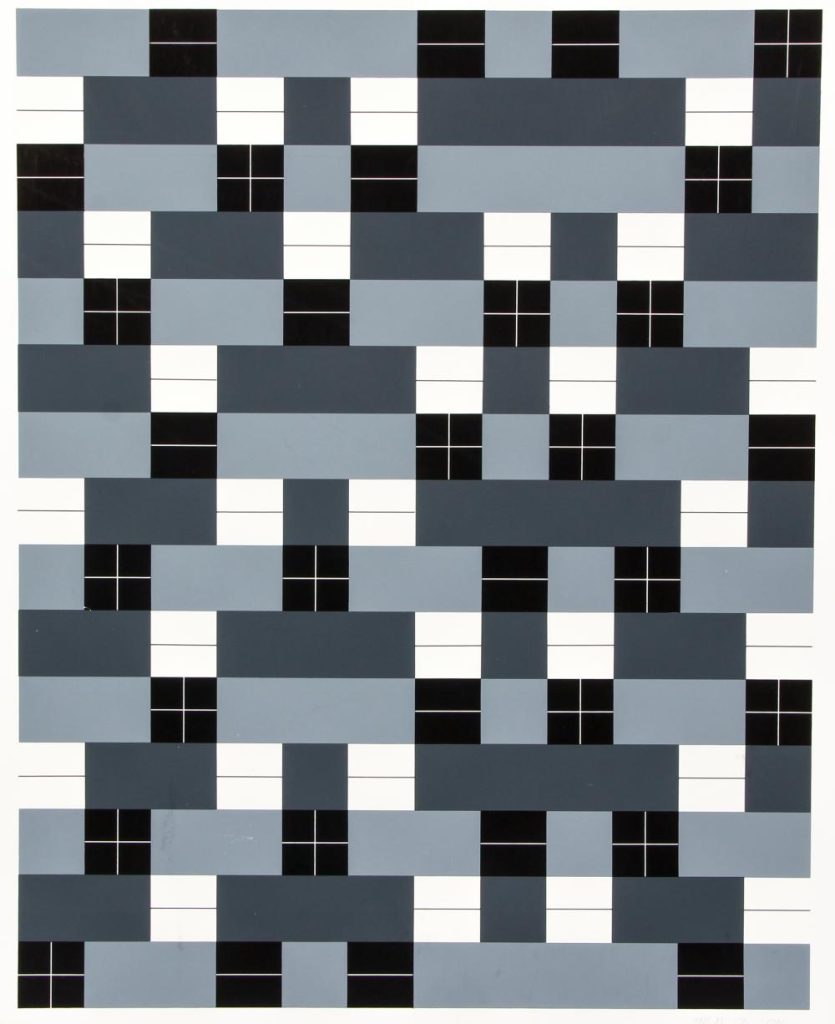
The pre-Columbian textile tradition was also crucial to her. The foundation's chronology and the Metropolitan Museum of Art's exhibitions both indicate that she collected pre-Columbian and contemporary textiles during her travels in Mexico and developed her own modern approach through in-depth research into Andean techniques. The Metropolitan Museum of Art also emphasizes that the connection between ancient Andes and 20th-century artists is built upon the geometric exploration facilitated by woven grids. What Anni Albers saw in these ancient fabrics was not merely surface patterns in the sense of "folkloric motifs," but an inseparable whole of structure, pattern, rhythm, and thought. This makes her foundational grid not only a rational product of European modernism, but also imbued with a broader historical depth and cross-cultural dimension.
In 1949, MoMA held an exhibition for her, *Anni Albers Textiles*, the museum's first exhibition dedicated to a single textile artist and one of its first solo exhibitions featuring a female artist. The exhibition included material studies, experimental samples, yardage, graphic fabrics, and hanging screens. This demonstrated that she had successfully propelled textiles, long categorized as "craft," into the core discourse of modern art. The basic grid was thus no longer merely a technical starting point on the loom, but became a fundamental method in modern abstract art: establishing order, rhythm, space, function, and visual thought from the simplest crisscrossing patterns. Anni Albers' value lies precisely in her demonstration that the most basic grid is not basic at all; it can become a profound modern language.
Lesson F2-2: Analysis of Joaquín Torres-García's "Color Structure" (Click to view and listen to the reading)
Anni Albers is a highly representative artist within the "Basic Grid Module" because in her work, the grid is not an added compositional tool, but rather the starting point of weaving itself. The warp and weft threads intersect vertically and horizontally, naturally forming the most basic grid structure; geometric order, repetitive rhythm, density variations, and pattern generation all emerge from this structure. As the Metropolitan Museum of Art and MoMA have pointed out in their summaries of the history of textiles, the "constructivism" of weaving comes from the grid formed by the vertical and horizontal elements on the loom. This structure makes geometric design not merely surface decoration, but an inseparable unity of structure and pattern. The most accurate reason to place Anni Albers within the "Basic Grid" is precisely this: she transformed the grid from an implicit technical framework into a core element of modern abstract art that can be viewed, contemplated, and elevated to the level of artistic language. Albers entered the Bauhaus in 1922, initially intending to study visual arts, but the school's gender division at the time restricted many women from entering the weaving workshops. This seemingly passive starting point, however, led her down a path that changed the status of modern fiber art. She not only completed her weaving diploma at the Bauhaus but also taught at Black Mountain College in the United States after the school closed, bringing Bauhaus structural concepts, material experimentation, and design methods to a new teaching environment. Black Mountain College materials explicitly state that she transformed the principles she learned at the Bauhaus into her own workshop teaching, emphasizing materiality and a deep connection to pre-Columbian textile traditions. In other words, Albers's "grid consciousness" was not simply a preference for graphic representation from the beginning, but rather shaped by training, craftsmanship, teaching, and cross-cultural research. Anni Albers's importance lies in how she changed the way people understand fabrics. A 1990 MoMA document points out that she, along with Gunta Stölzl, reversed the 19th-century tradition of pictorial representation in fabric making, instead revealing the most fundamental structure of fabric—warp and weft—and allowing these interwoven relationships to "speak" anew through plain weaves and contrasting fibers. This means she did not treat the fabric surface as a plane where images could be arbitrarily drawn, but rather the structure itself as the site where form occurs. In the relationship between lines, planes, rhythms, and color blocks, the basic grid is no longer hidden but becomes the true source of visual order. For geometric abstract art, this is a crucial step: from then on, geometry is not drawn, but organized; not a generalization of real objects, but a form naturally generated from within materials and structures. Further analysis of her work reveals that her "basic grid" is not rigid. While the interweaving of warp and weft establishes a stable vertical-horizontal order, she uses variations in fiber thickness, material differences, density changes, and the contrast between transparency and opacity to create subtle and complex visual layers within the same grid. During her Bauhaus period, she experimented with different materials such as rayon, cellophane, metal wire, jute, and cotton thread, using them in fabric designs with specific functions, such as sound absorption, reflection, partitioning, or fabrics adapted to modern architectural spaces. Materials from the Black Mountain Institute and MoMA emphasize that she used both natural fibers and experimental synthetic materials to establish a new language of modern textiles. Therefore, Albers' grid is not a cold, mechanical chessboard, but a living structure that is both orderly and tactile, serving function while also allowing for pure formal contemplation. She is particularly suited to the "basic grid module" because she consistently connects the basic structure with visual abstraction. The Foundation describes *On Weaving* as her reflection on the history, tools, techniques, and relationship of weaving to 20th-century design. The book includes structural diagrams of plain weave, twill, and interlocking twill, demonstrating how she understood weaving as a way of thinking, not merely a craft. In her 1941 book, *Handweaving Today*, she further clarified that weaving is a "constructive" and "compositional" process, requiring aesthetic judgments of surface, form, color, and function. In other words, for Albers, the basic grid is not only a technical chart but also a logic of modern form; it concerns not only "how to weave" but also "how to organize the world." Pre-Columbian textile traditions were also crucial to her. The Foundation's chronology and the Metropolitan Museum of Art's exhibitions both indicate that she collected pre-Columbian and contemporary textiles during her travels in Mexico and developed her own modern approach through in-depth research into Andean techniques. The Metropolitan Museum of Art also emphasizes that the connection between ancient Andean culture and 20th-century artists is built upon the geometric exploration facilitated by the weaving grid. What Anni Albers saw in these ancient fabrics was not merely surface patterns in the sense of "folk art," but an inseparable whole of structure, design, rhythm, and thought. This made her basic grid not just a rational product of European modernism, but also imbued it with a broader historical depth and cross-cultural dimension. In 1949, MoMA held an exhibition for her, *Anni Albers Textiles*, the museum's first exhibition dedicated to a single textile artist and one of its first solo exhibitions featuring a female artist. The exhibition included material studies, experimental samples, yardage, graphic fabrics, and hanging screens. This demonstrated that she had successfully propelled fabric, long categorized as "craft," into the core discussion of modern art. The basic grid was thus no longer just a technical starting point on the loom, but became a fundamental method in modern abstract art: establishing order, rhythm, space, function, and visual thought from the simplest crisscrossing. Anni Albers' value lies precisely in proving that the most basic grid is not basic at all; it can become a profound modern language.
 简体中文
简体中文  English
  日本語
日本語  Español
  Français
  हिन्दी
  العربية
  বাংলা
বাংলা  Português do Brasil
  Русский
  اردو
اردو  Bahasa Indonesia
  Deutsch
  Kiswahili
  मराठी
मराठी  తెలుగు
  Tiếng Việt
  Türkçe
  Italiano
  தமிழ்
தமிழ்  한국어
한국어