
Hilma af Klint

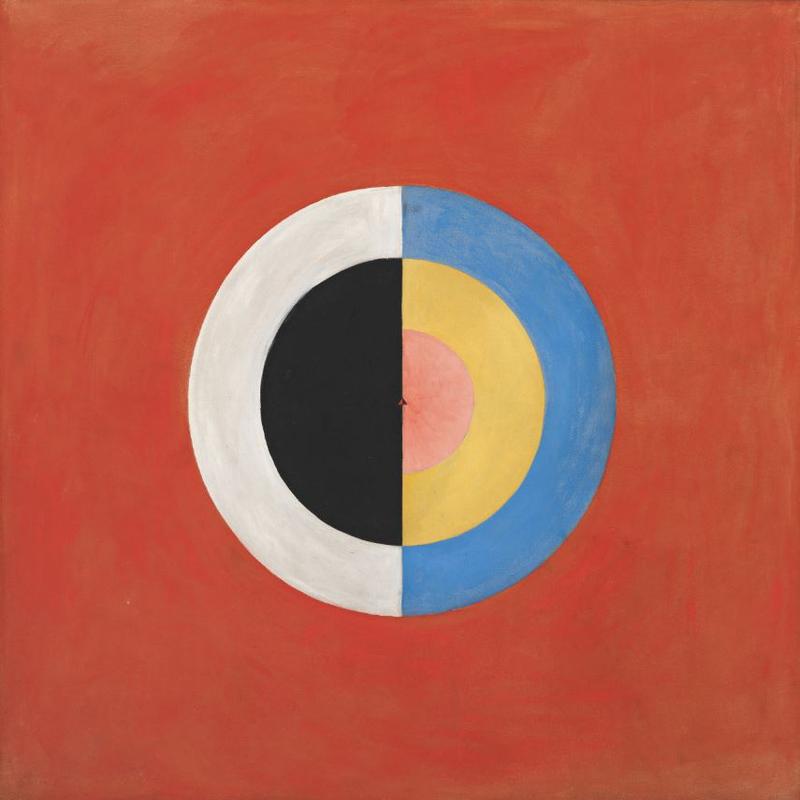
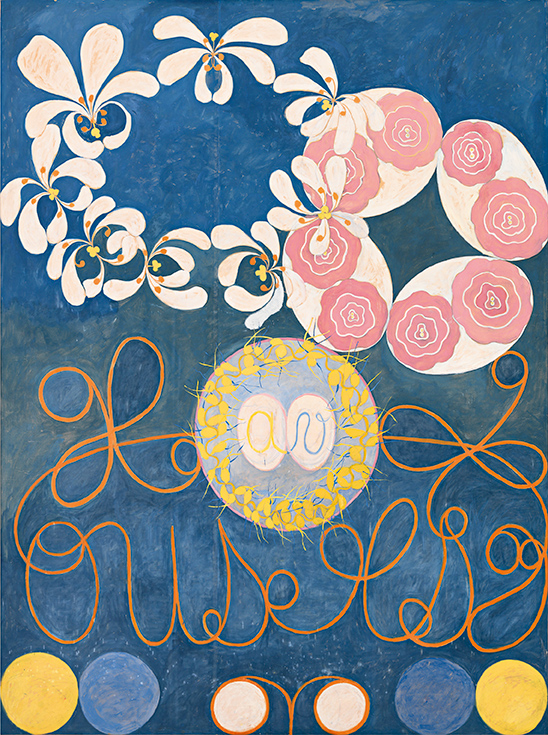
Hilma af Klint(1862–1944) is one of the most unique, and latest recognized, founders of abstract art in the early 20th century. In her system of geometric abstraction, the circle holds a central position. The circle is not a decorative choice of form, but rather a structural archetype concerning the whole, cycles, generation, and spiritual order. Through the circle, Åkintz pushed geometric abstraction from formal experimentation into a visual modeling of the universe, life, and consciousness.
Born into a family with a background in science and engineering in Stockholm, Sweden, Åkrent was exposed to mathematics, drafting, and nature observation from an early age. She received rigorous academic training at the Royal Swedish Academy of Arts, mastering the prevailing styles of realistic painting, botanical illustration, and precise depiction. It was this rational training that allowed her to retain structure and order when she later turned to abstraction, simply transferring it to the non-representational realm. At the end of the 19th century, discussions in European intellectual circles about evolution, theosophy, and spiritual science provided her with an intellectual framework that transcended the visible world.
In her creative process, Arntzen did not work in a manner of “bursts of inspiration.” Her abstract paintings were built upon long-term documentation, systematic planning, and serial development. After 1906, she entered a highly focused creative phase, beginning to extensively use circles, spirals, concentric structures, and symmetrical compositions. In her works, circles often served as the organizing core of the composition, integrating opposing elements and multiple levels. She incorporated color, line, and symbols into the structure of circles, imbuing the paintings with an overall sense of both stability and fluidity.
For Arcklinit, the circle is primarily a “non-directional” structure. Unlike a cross, rectangle, or triangle, a circle has no beginning or end, nor does it emphasize a hierarchy of up, down, left, or right. This characteristic makes it an ideal vehicle for expressing totality and continuity. In her creative process, the circle is often combined with binary oppositional systems, such as spirit and matter, feminine and masculine, or overt and covert. Through the inclusive structure of the circle, these oppositions are placed within the same system rather than being mutually exclusive.
Aaklinte's important series "Paintings for the Temple" prominently showcases the systematic application of circular structures. Among these, "The Ten Largest Works" presents the generative process of different life stages on a monumental scale, with circles and spirals running throughout, symbolizing growth, cycles, and the unfolding of consciousness. The seemingly free-form color blocks and lines in the paintings strictly adhere to the inherent order of the circular structure, granting abstract forms a clear organizational logic.
In works such as the “Swan Series” and “Dove Series,” the circle further takes on the functions of harmony and transformation. Black and white, positive and negative, division and unity are often visually represented through the juxtaposition, overlapping, and rotation of circles. These works do not tell stories, nor do they rely on symbolic narratives, but rather translate complex philosophical and spiritual issues into geometric relationships. The circle here is no longer a simplification of natural objects but a cognitive model.
In the history of geometric abstract art, Åkrent's contribution is fundamentally significant. Prior to Kandinsky, Mondrian, and others, she had already completed a highly mature abstract system and explicitly used geometric forms for the expression of spiritual and cognitive structures. In her work, the circle is not a stylistic element, but a methodological tool. Through the circle, she demonstrated that geometric abstraction could carry the expression of an entire worldview, not just the exploration of formal order.
Unlike later geometric abstraction that emphasized formal autonomy, Acklin's circles were always connected to a structure of meaning. However, this meaning was not an external symbol but the result of internal relationships. She did not present the circle as a direct religious symbol, but rather as a geometric foundation for an integrated system that revealed generative logic. This makes her work resonate across eras with systemic art, cognitive mapping, and even data visualization when viewed today.
Historically, Acklint's works were long absent from modern art narratives due to their suppression during his lifetime. However, as these works have been re-examined, people have gradually realized that geometric abstraction was not the result of a single line of development, but rather a parallel unfolding of multiple thought paths. Acklint's abstract system, centered around the circle, constitutes one of the earliest and most complete paths.
From a contemporary perspective, Hilma af Klint's circular abstractions are no longer just “discovered precursors,” but a paradigm that redefines the possibilities of geometric abstraction. She elevated the circle beyond mere aesthetic beauty, transforming it into a structural language for understanding wholeness, cycles, and generation. Within the history of geometric abstract art, her contribution lies not only in her temporal precedence but also in the expansion of intellectual depth, making geometry a true bridge connecting the visible world with invisible order.
 简体中文
简体中文  English
  日本語
日本語  Español
  Français
  हिन्दी
  العربية
  বাংলা
বাংলা  Português do Brasil
  Русский
  اردو
اردو  Bahasa Indonesia
  Deutsch
  Kiswahili
  मराठी
मराठी  తెలుగు
  Tiếng Việt
  Türkçe
  Italiano
  தமிழ்
தமிழ்  한국어
한국어