
Square: Emma Kunz
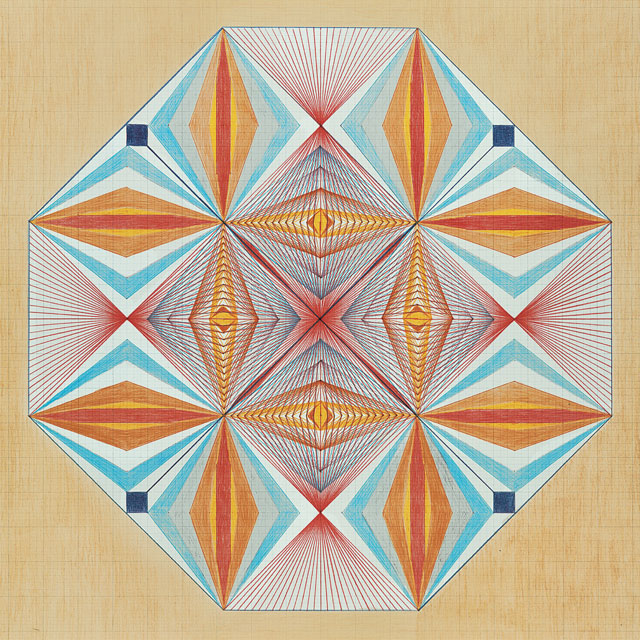
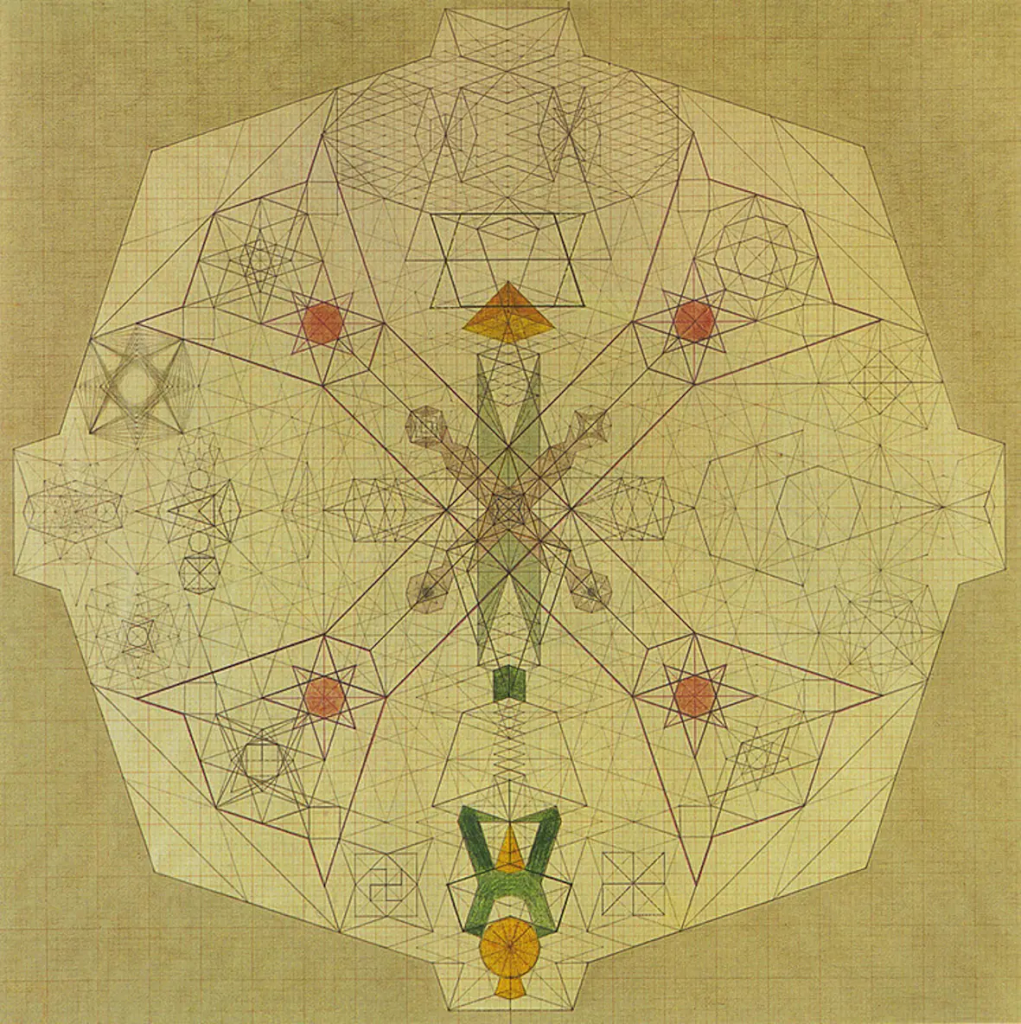
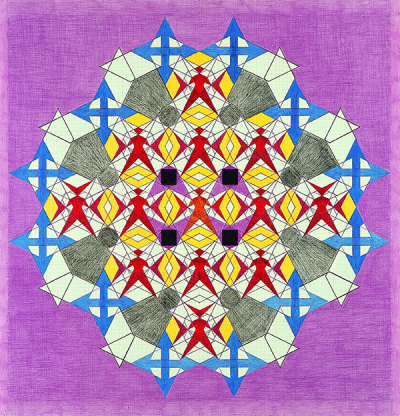
Emma Kuntz(1892-1963) is a truly unique figure in 20th-century geometric abstract art. She belonged neither to the academic system nor entered the modernist art world, yet she developed a highly self-consistent, rigorous, and restrained system of geometric imagery, using the square as its core structure. She never considered herself an artist, but rather viewed painting as a tool for studying the structure, energy relationships, and inner order of the world. It is precisely from this non-art-historical stance that her square abstractions reveal a depth of thought that transcends style and era.
Born into an ordinary family near Zurich, Switzerland, Kuntz did not receive formal art training in her early years, instead working as a secretary and tutor. She spent most of her life far from the art centers, a position that shielded her from stylistic trends and imbued her work with a rare independence. The discussions about energy, vibration, proportion, and overall order within the European intellectual climate of the early 20th century provided her with an alternative framework for understanding the world. Instead of responding to these questions through words or theories, she chose to use geometric shapes as a means of thinking and recording.
In her creative process, the square is not Kuntz's choice of composition, but rather a prerequisite for all her work. Almost all of her works are drawn on graph paper, with the square grid forming an absolute coordinate system. This system is not for decoration, but to establish a "research field" that can be measured, calibrated, and reused. Here, the square signifies stability, equidism, and neutrality; it eliminates hierarchical differences in direction, making the picture a balanced structure capable of supporting complex relationships.
Kuntz's drawing process is highly focused and slow. She uses colored pencils, rulers, compasses, and pendulums, drawing under strictly controlled conditions. In her practice, the pendulum is not a mystical symbol, but a tool for determining direction, proportion, and relationships. Each work involves extensive calculations, note-taking, and revisions, its completion resembling more of an experiment than an intuitive act of creation. A square grid provides a constant reference throughout the process, ensuring all changes remain within a controlled framework.
In the image, the square does not appear in a single form, but is constantly activated through axes of symmetry, diagonals, concentric structures, and proportional divisions. Straight lines unfold within the square, forming radial, intersecting, or overlapping structural relationships. The use of color is extremely restrained, not for emotional rendering, but for distinguishing different levels, tensions, or states. The square is therefore no longer a static frame, but a field capable of accommodating vibrations and changes in relationships.
Kuntz created approximately four hundred geometric drawings throughout her life, almost all labeled with numbers rather than titles. This numbering system indicates that her work was not an independently completed "artwork," but rather a continuously evolving research system. The most central group is known as the "AION" series. This series does not constitute a linear narrative, but rather a graphic deduction revolving around the structure of the universe, the order of life, and the relationship of energy. In these works, squares serve as stable outer frames, within which complex and precise geometric relationships unfold, creating a visual state that is both calm and highly focused.
These works reject any figurative references and offer no interpretable symbolic narratives. Viewers cannot "read" them, yet they can clearly sense an exceptionally rigorous sense of order. The square here does not serve a formal aesthetic purpose, but rather a cognitive function, compelling viewers to engage in relational thinking rather than image association. This makes Kuntz's works visually resemble charts, models, or structural diagrams, yet they cannot be simplified into scientific illustrations.
Emma Kunz holds a unique position in the history of geometric abstract art. While she did not participate in Constructivism, Neo-Plasticism, or Concrete Art movements, her structural rigor rivals that of the most rational geometric abstractions. One of her significant contributions was transforming the square from a "compositional form" into a "methodological foundation." In her practice, the square is not a form to be used, but a trusted structure, a prerequisite for the manifestation of all relationships.
Secondly, she expanded the functional boundaries of geometric abstraction. Kuntz's square paintings are not for visual pleasure, but for understanding, reconciliation, and calibration. This gives her geometric abstraction a strong non-decorative quality, and also makes her work resonate unexpectedly with systems art, generative art, data visualization, and even cognitive science today.
Furthermore, through extreme restraint, she diminished the central role of the artist's subjectivity. The continued presence of the square grid made it difficult for personal style to emerge, replacing it with the logical unfolding of the structure itself. This stance constitutes an almost overlooked yet extremely important path in the history of modern art, which emphasizes personal expression.
Historically, Emma Kunz's works were virtually unknown during her lifetime, only gradually being rediscovered at the end of the 20th century. Her practice forced people to rethink the origins and definition of geometric abstraction: Does abstract art necessarily stem from art historical self-awareness? Must it be for aesthetic purposes? Emma Kunz's square system offers another answer.
From a contemporary perspective, her square abstraction is no longer a marginal case, but a highly forward-looking cognitive model. In her work, the square is not a cold formal tool, but the most stable and honest structural language in humanity's attempt to understand the world order. Within the overall spectrum of geometric abstract art, Emma Kunz, with the square at its core, silently but firmly expands the intellectual depth of abstract art, making geometry a true way of understanding the world, rather than just a visual style.
 简体中文
简体中文  English
  日本語
日本語  Español
  Français
  हिन्दी
  العربية
  বাংলা
বাংলা  Português do Brasil
  Русский
  اردو
اردو  Bahasa Indonesia
  Deutsch
  Kiswahili
  मराठी
मराठी  తెలుగు
  Tiếng Việt
  Türkçe
  Italiano
  தமிழ்
தமிழ்  한국어
한국어