
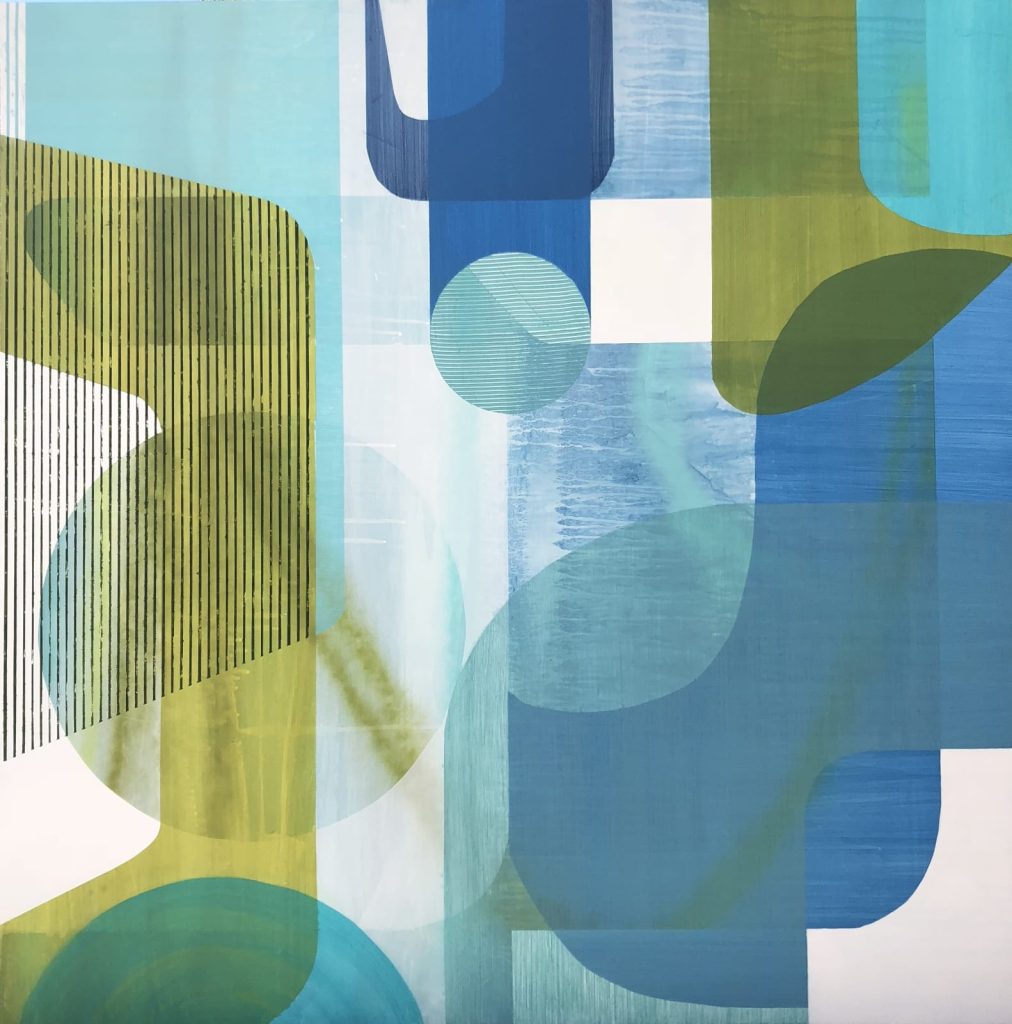
American artist Tricia Strickfaden's work breaks down the boundaries between natural landscapes and abstract expression through her intuitive capture of light and shadow on the seashore and the physical layering of multiple colors. Her methods, along with Arthur Dorval's geometric overlap, present a fascinating dialogue on the theme of "color as a carrier of depth," evolving from "rational construction" to "sensual flow."
Creative techniques: organic layering and "archaeological" scraping
Strickland's creative approach is a visual experiment about "time and coverage." Her production logic is not a pre-set blueprint, but a dynamic process of constantly discovering, burying, and revealing.
- Wet-on-Wet and Glazing: Strickland's core technique is the "atmospheric layering" of color. She often rapidly applies large areas of color to the canvas, using the interpenetration of the paint while it is still wet to simulate the blurred boundaries of fog, water vapor, or the sea level. She then applies diluted, transparent layers (glaze) over the dried paint. This technique breaks down the monotony of a two-dimensional plane, allowing light to penetrate the top layer of color and reach the underlying texture, creating a translucent visual depth similar to Dorval's "color incubation."
- Physical Scraping and Texture Revealing (Mark-making & Scraping): Her creative process involves a great deal of "subtraction." Using palette knives, rubber scrapers, and even sandpaper, she randomly cuts and scrapes through thick layers of paint. This method breaks down the "integrity" of traditional painting, instead pursuing a tactile depth akin to archaeological excavation. By scraping away the top layer to reveal buried complementary colors or original drafts, she infuses the painting with a sense of history. This method of "burying and searching" imbues the edges of each geometric color block with a natural, incomplete beauty.
- Abstract Reconstruction of Horizon Logic: Despite the highly abstract nature of her works, the compositions often follow an invisible "horizon." She uses large areas of horizontal color blocks to divide the image, simulating the spatial tension at the boundary between the ocean and the sky by controlling the "visual weight" of each area. This technique forcibly guides the viewer's breathing rhythm, allowing the work to exhibit an infinite sense of landscape extension within a limited framework.
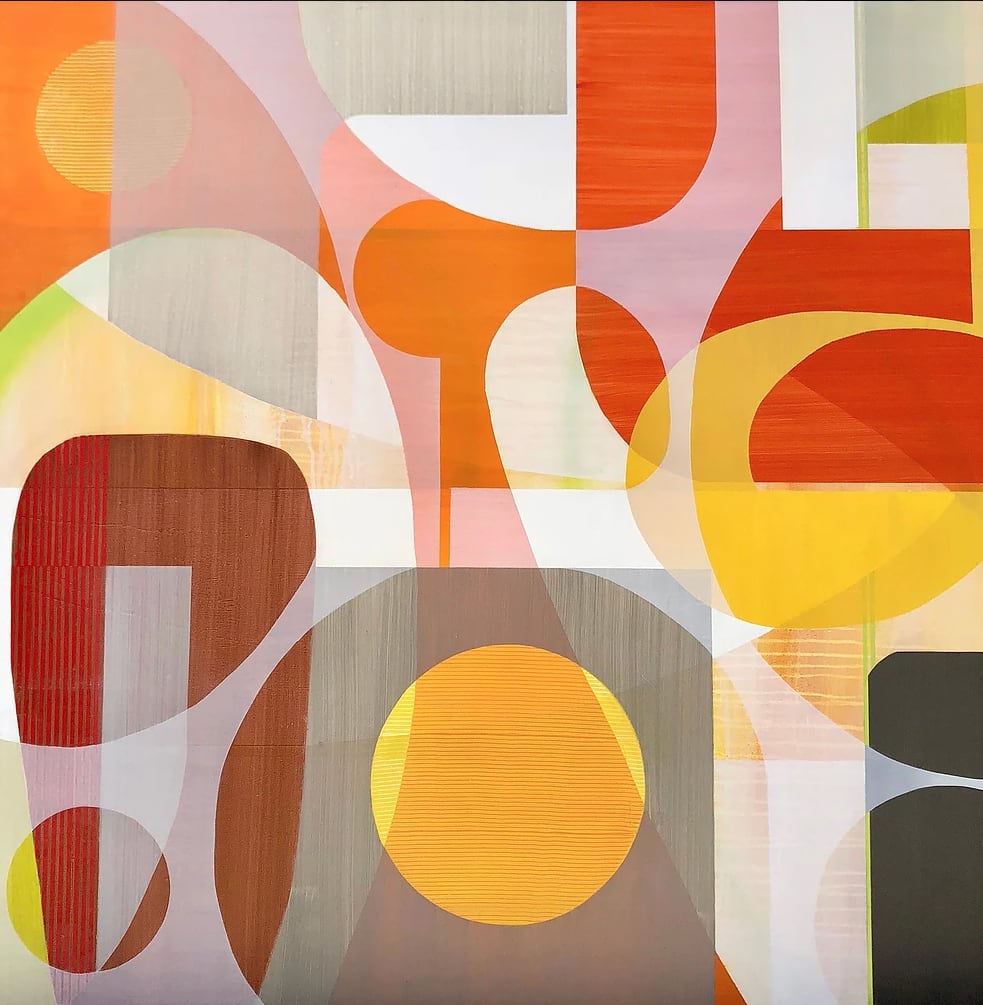
Stylistic characteristics: Contemporary seaside abstraction, tranquility of light, and emotional color balance.
Strick Faden's style presents a light, ethereal, and highly therapeutic visual quality, transforming natural phenomena into pure geometric colors.
- Coastal Atmospheric Abstraction: Her style is a direct translation of the light of Southern California. Stylistic features manifest in subtle shifts in tone—such as the silent transitions between turquoise, gray-blue, sand gold, and misty gray. This stylistic characteristic establishes the work as a “breathing window” to space, reflecting the artist’s profound perception of the natural environment.
- Intuitive dynamic equilibrium: Strickland's work is characterized by a strong sense of "balance." She doesn't rely on mathematical symmetry, but rather achieves stability through the proportions of color brightness and area. For example, in a deep blue-green field, she might add a tiny, bright white or coral patch. This stylistic feature imbues cold, abstract figures with a sense of life, making the image appear both stable and brimming with pent-up energy.
- The Poetics of Organic Geometry: Compared to Dorval's rigorous, hard-edged geometry, Strickland's shapes are softer and more "anthropomorphic." Her style is characterized by blurring the boundaries of rectangles or squares, making them resemble melting ice or dissipating clouds. This style pursues an "imperfect order," preserving emotional brushstrokes within a rational compositional framework.
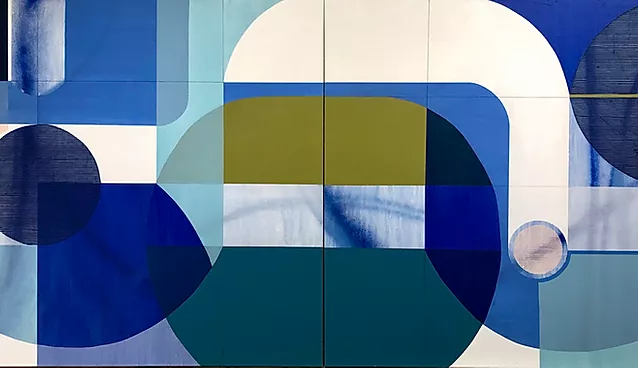
Materials used: Integration of professional-grade acrylic, large-format canvas, and industrial tools
Strickland demonstrated an extreme understanding of the properties of "fast-drying media" in her choice of materials, regarding the canvas as a physical container that carries the ever-changing light and shadow.
- Highly flexible acrylic pigments and additives: She makes extensive use of acrylic paints known for their exceptional transparency and self-leveling properties. By mixing retarders and rheology modifiers, she can control the drying speed of the paints, thus achieving large-area gradient blending. This method of applying materials transforms "industrial chemicals" into a "medium of light," ensuring that the colors retain a high degree of purity even after layering.
- Large canvas and heavy-duty tripod: Strickland prefers to create on large-format canvases (48 x 48 inches or even larger). This use of material enhances the "enveloping" feel of her work. To support the physical weight of the multiple layers of paint, she typically uses thick cotton canvas and heavy wooden backing. This pursuit of a stable base allows for unlimited layering of the canvas, resulting in a dual texture that is either as heavy as rock or as light as feathers.
- Experiments with cross-domain tools: In addition to brushes, she frequently uses large scrapers and sponges from construction work. This use of materials breaks the limitations of detailed depiction and encourages the creation of accidental textures. The marks left by these industrial tools—such as smooth smears and rough flyaways—constitute a unique “tactile vocabulary” in her geometric abstract language.
 简体中文
简体中文  English
  日本語
日本語  Español
  Français
  हिन्दी
  العربية
  বাংলা
বাংলা  Português do Brasil
  Русский
  اردو
اردو  Bahasa Indonesia
  Deutsch
  Kiswahili
  मराठी
मराठी  తెలుగు
  Tiếng Việt
  Türkçe
  Italiano
  தமிழ்
தமிழ்  한국어
한국어