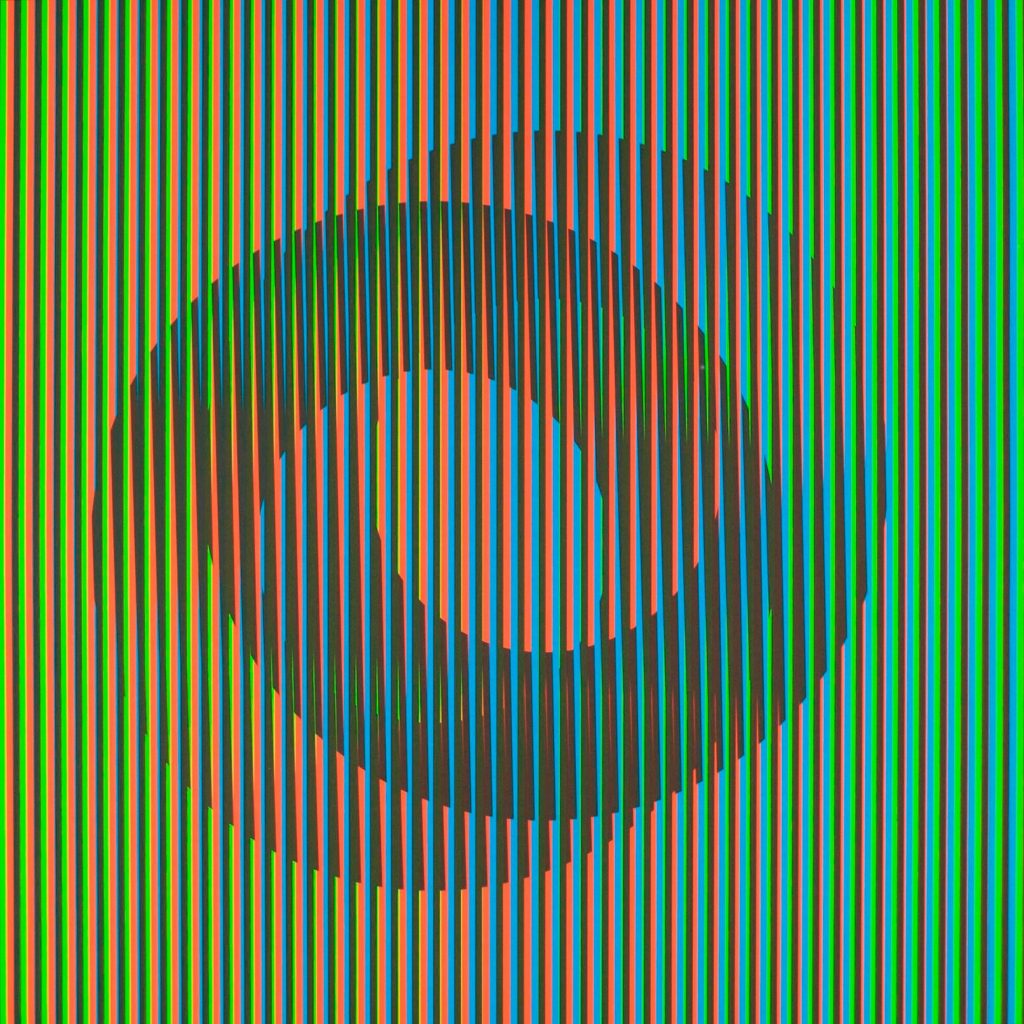
As a leading figure in kinetic art, Carlos Cruz-Diez liberated color from its material form, making it an unstable physiological experience that is constantly generated in space.
Creative methods: optical experiments and the generation of physiological colors
Cruz-Diez's creative methods are essentially based on scientific experiments on the "evolution of color over time." He opposes viewing color as some kind of rigid pigment applied to the surface of an object.
- Physichromie logic: This is his core production technique. He arranges extremely thin colored lines (usually red, green, blue, black, and white) vertically on a background plane, and then adds vertical transparent or semi-transparent sheets above them. When light shines in or the viewer moves, the sheets intercept the light and reflect the colors of adjacent lines, creating a "third color" in the air. This technique breaks through the limitations of the color palette, achieving a dynamic additive color through physical reflection and retinal mixing.
- Color perception and interaction (Chromatic Induction): He utilizes the physiological principle of "afterimage" produced when two colors are adjacent. For example, in areas where yellow and blue lines alternate, the human eye automatically perceives a phantom orange or purple. This technique, through mathematically precise arrangement, allows colors to "incubate" autonomously on the viewer's retina, which aligns closely with Arthur Dorval's geometric superposition logic on a psychological level.
- Spatial "color events": His methods often involve the reconstruction of the entire space. He uses light projection or chromosaturation to allow color to transcend the edges of the canvas, becoming a volumetric gas that envelops the viewer. This approach transforms painting into an immersive phenomenological event.
Stylistic characteristics: dynamic, unstable, and perceptually interactive
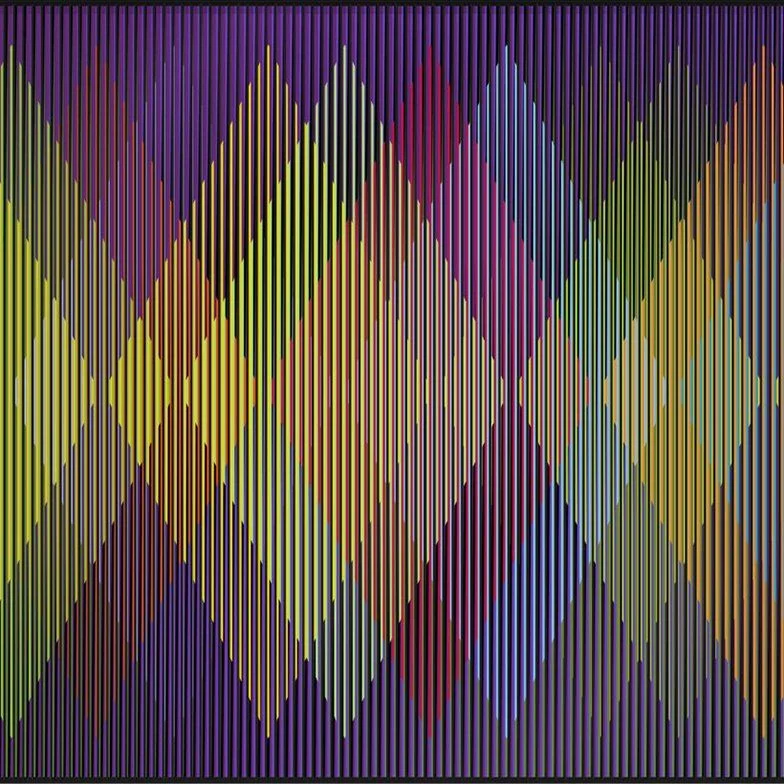
Cruz-Diez's style is characterized by a high degree of rationality and emotional visual high-frequency vibration.
- Retinal Vibration: The most striking feature of his style is the "flickering" quality of his images. Due to the arrangement of high-frequency parallel lines, the human eye cannot find a static point on the canvas, causing the retina to continuously vibrate like pulses. This stylistic feature strips away the emotional expression of art, instead pursuing a pure, linguistic perceptual stimulation.
- Instability and chance: Although his works are meticulously calculated, their stylistic expression is highly accidental. This is because the composition constantly changes depending on the observer's position, the angle of light, and the duration of observation. This "unstable style" emphasizes that color is not an inherent property, but a dynamic process that occurs at a specific moment.
- Serialization and rhythm: His style often presents a rigorous sense of sequence. The transition of colors follows a certain mathematical progression, producing a musical wavelength. This stylistic feature endows the works with a sense of precision reminiscent of modern technology, reproducing the rhythmic beauty of physical fluctuations.
Materials Application: Integration of Industrial Media and Environment
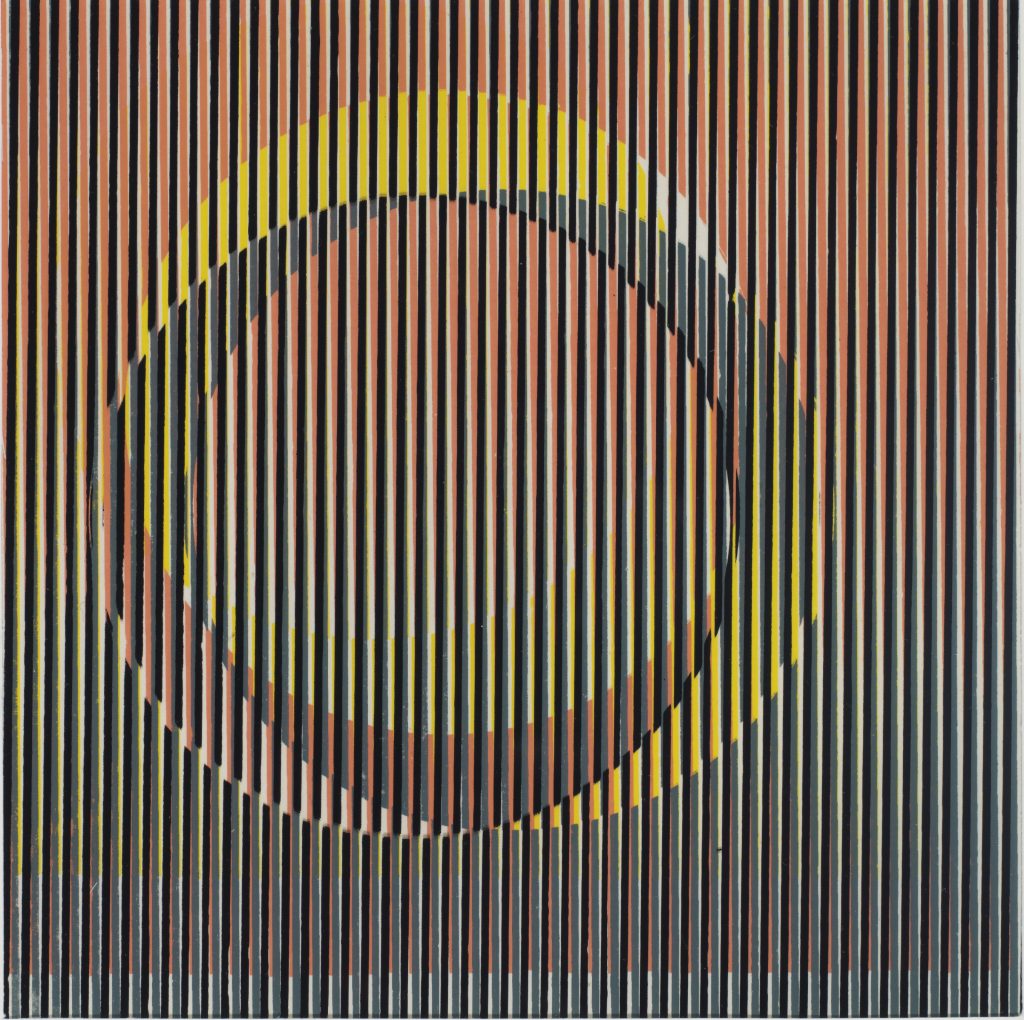
Cruz-Diez was pioneering in his choice of materials, embracing the material logic of the industrial age.
- Aluminum sheet and plexiglass: To achieve precise physical reflection, he made extensive use of thin aluminum alloy sheets or laser-cut acrylic glass. These materials provide perfectly vertical edges and stable light-reflecting surfaces. Using these industrial materials, he constructed a miniature one-dimensional grid system to capture every subtle leap of light.
- Artistic intervention in public facilities: He extended the use of materials to urban infrastructure such as pedestrian crossings, docks, and airport buildings. He utilized durable industrial floor coatings and high-performance architectural paints to transform urban landscapes into vast dynamic laboratories. In these projects, materials were not merely carriers, but tools for guiding pedestrian flow and altering spatial perception.
- Digital design and high-precision manufacturing: In his later works, he used computer-aided design (CAD) to simulate complex color interference effects and CNC machine tools for high-precision material cutting. This approach to materials ensured that he could maintain the scientific accuracy of color overlay in large-scale public projects, reproducing the optical mysteries he discovered in the laboratory.
 简体中文
简体中文  English
  日本語
日本語  Español
  Français
  हिन्दी
  العربية
  বাংলা
বাংলা  Português do Brasil
  Русский
  اردو
اردو  Bahasa Indonesia
  Deutsch
  Kiswahili
  मराठी
मराठी  తెలుగు
  Tiếng Việt
  Türkçe
  Italiano
  தமிழ்
தமிழ்  한국어
한국어