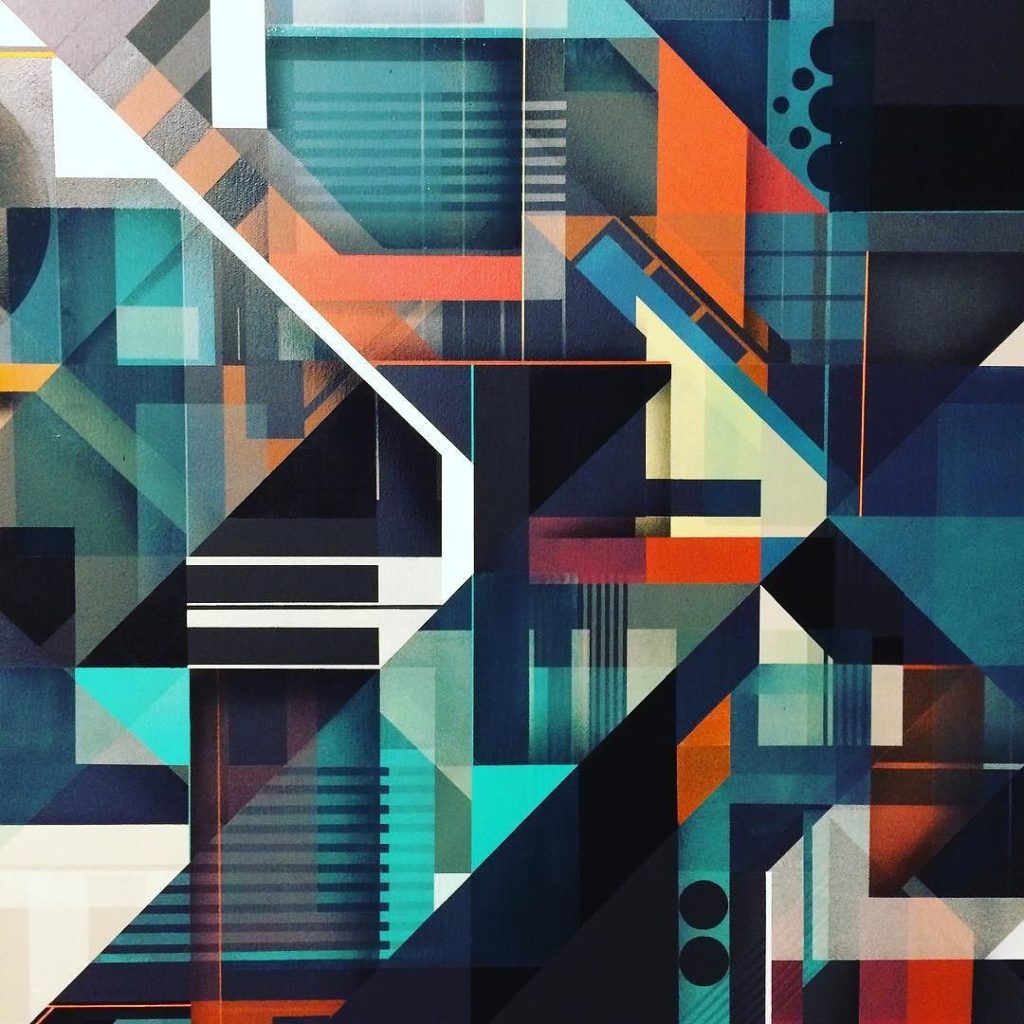
French artist Swiz's work bridges the gap between street energy and modernist abstraction through the deep deconstruction of graffiti letters, the layering of high-energy colors, and a precise grid system. His methods and Arthur Dorval's geometric compositions present a highly dynamic complement in terms of "incubation of volume" and "construction of order."
Creative methods: The evolution of letter topology and urban crystallization
Switz's creative method is a process of transforming "symbols" into "space". The logic behind the creation of "he" does not begin with shape, but with the language code hidden behind geometry.
- Typography as a Geometric Embryo (Typography-to-Volume): Switz's core technique is the "invisibility of graffiti letters." All of his compositions initially originate from specific words or letters (i.e., his street "tags"). This technique breaks down the emptiness of traditional abstraction. Switz breaks down the strokes of the letters into rectangles, parallelograms, and polygons, and uses perspective to "stretch" these strokes into three-dimensional volumes. This technique gives each geometric block in the image an inherent "contextual tension."
- Moiré ripples and grid interference: His creative logic involves the overlapping of numerous high-frequency lines. He often overlays a dense grid of parallel lines on top of the main composition. This technique breaks down a single visual plane. When these lines overlap with the underlying geometric blocks, a physical visual vibration is created. This is similar to Dorval's "incubation" logic—Dorval uses the penetration of color, while Switz uses the interference of line frequencies; both aim to create an illusion of depth that transcends the surface of the canvas.
- Chromatic Chiseling of Color: Swayze uses differences in color saturation to define the "faces" of objects. He often uses complementary or gradient colors on the same geometric shape to simulate the refraction of light on the surface of complex crystals. This technique forces the viewer's brain to complete the geometric process, making the originally flat shape look like a multidimensional mineral growing out of the canvas.
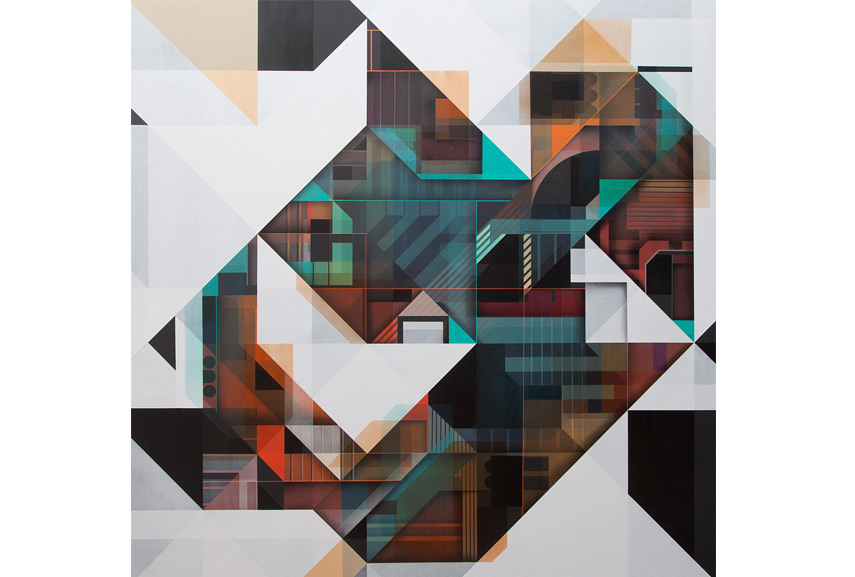
Stylistic characteristics: Neo-abstract art, high-frequency visuals, and digital glitch aesthetics
Switz's style presents an extremely sharp, urban-speed-filled visual quality with a touch of "digital realism".
- Urban Crystallization: His style is an artistic sublimation of modern architecture and transportation networks. A key stylistic feature is the "folding" of geometric structures. The images resemble a highly compressed city, with buildings, streets, and signal lines crystallized into nested volumes. This stylistic characteristic establishes a critical point between "order" and "explosion," reflecting the rapid flow of information in contemporary metropolises.
- The rhythmic beating of the retina: Swayze's work possesses a strong sense of "pulsation." He contrasts highly saturated fluorescent colors (such as electric blue and magenta) with somber industrial base colors (such as cement gray and asphalt black). This stylistic feature breathes life into cold geometric shapes. As the viewer observes, their gaze is forcefully guided by the high-frequency exchange of colors, creating a visual rhythm akin to listening to electronic music.
- A hybrid of digital and street elements: Despite the extremely precise overall composition, Swayze skillfully retains a sense of "glitch" within his images. This balance establishes an overlap between "perfect rationality" and "human intervention" in his work. This style contrasts with Dorval's transparent incubation—Dorval pursues the warmth of light, while Swayze pursues the fragmentation and reconstruction of light.
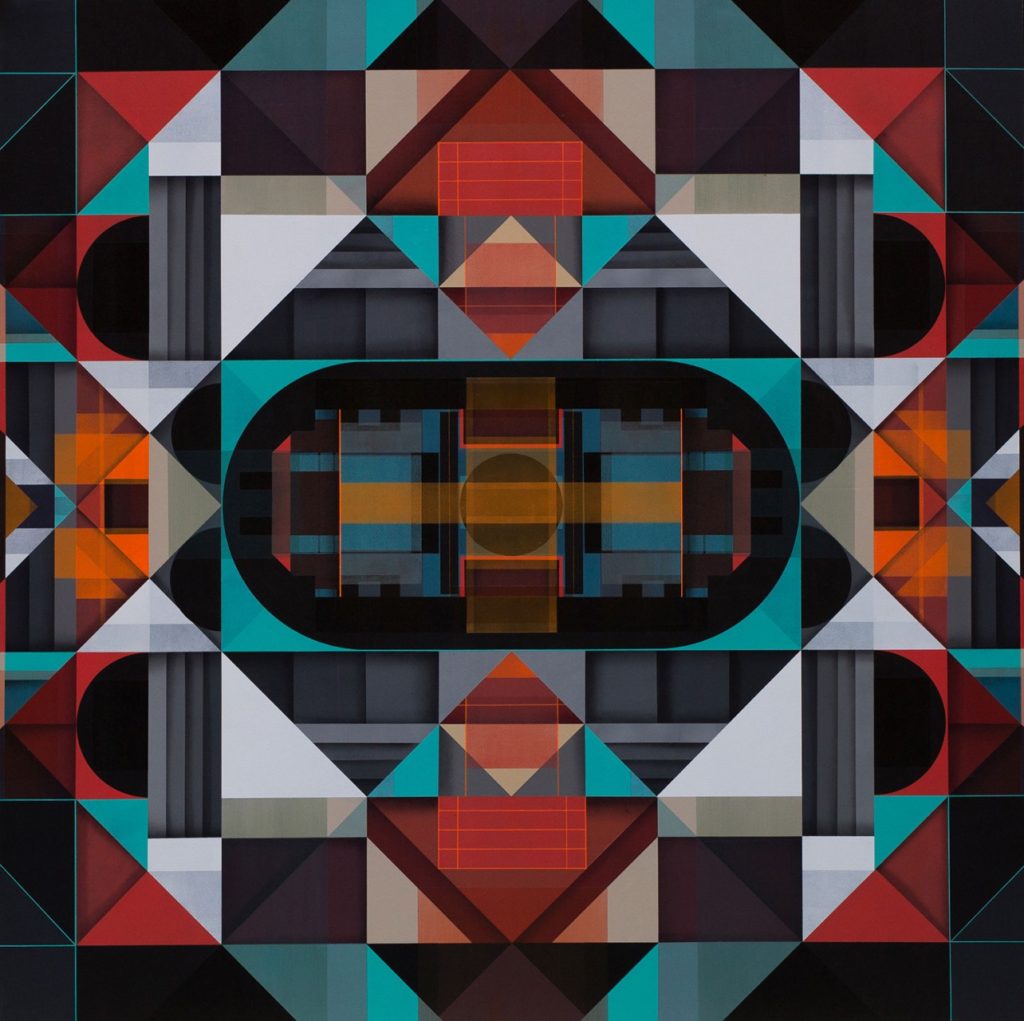
Materials Used: A Battle Between Hardwood Boards, Industrial Paint, and Laser Cutting
In his choice of materials, Switz combines a tribute to "street heritage" with industrial precision, viewing his work as a kind of physical relief with thickness.
- Physical stacking of medium-density fiberboard (MDF): The artist extensively uses precisely cut MDF boards. By layering and splicing boards of varying thicknesses, they create realistic physical height. This approach transforms "painting" into "spatial components." The edges of the boards are sharpened to a blade-like edge, ensuring the absolute definition of every geometric corner.
- Mixed medium of spray paint and acrylic: Swayze utilizes the atomizing properties of spray paint to handle shadows and transitions, while leveraging the covering power of acrylic to process core color blocks. This material approach breaks the monotony of a single material, creating a visual texture similar to the contrast between metal frames and frosted glass in modern architecture. The fine graininess of the spray paint infuses the image with a raw, street-style energy.
- Masking membrane and high-precision cutting technology: To accommodate extremely complex geometric structures and grids of lines, he typically employs laser cutting and industrial-grade masking systems. This engineered treatment of hard materials gives his works a material weight under light, similar to that inside an electronic chip or precision instrument, forcing viewers to consider their absolute nature as "artificial creations" when perceiving space.
 简体中文
简体中文  English
  日本語
日本語  Español
  Français
  हिन्दी
  العربية
  বাংলা
বাংলা  Português do Brasil
  Русский
  اردو
اردو  Bahasa Indonesia
  Deutsch
  Kiswahili
  मराठी
मराठी  తెలుగు
  Tiếng Việt
  Türkçe
  Italiano
  தமிழ்
தமிழ்  한국어
한국어