
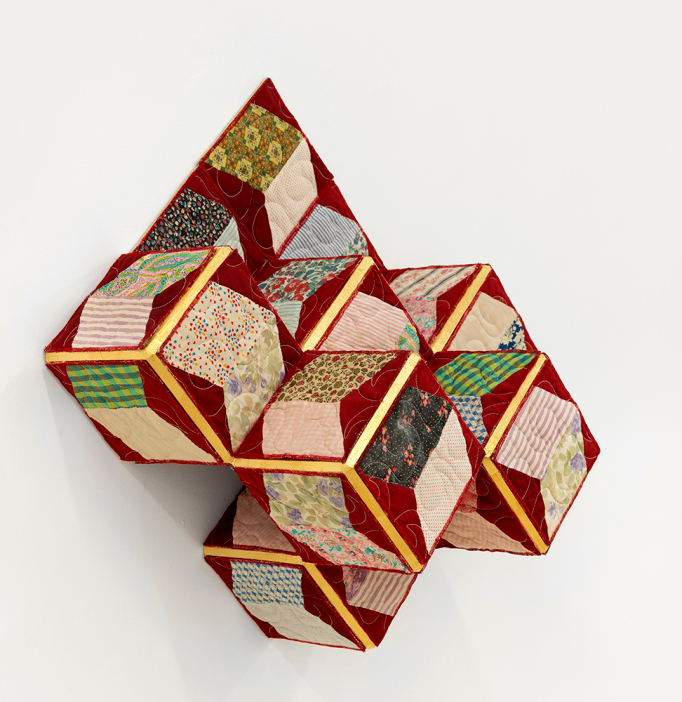
American interdisciplinary artist Sanford Biggers' work deconstructs the false opposition between abstract art and political narratives through geometric patterns and color application on antique quilts. His methods achieve a profound philosophical resonance with Arthur Dorval's geometric overlays in the "spatial superposition of multiple layers of information," but Biggers introduces a sociological logic with greater "archaeological depth" and "cultural translation."
Creative methods: superimposing historical cartography with "mandala" geometry
Biggs' creative method is an "intrusion" and "reconstruction" of existing cultural carriers. His production logic begins with the excavation of historical relics and ends with the encoding of universal geometric codes.
- “The geometric overlap of the "underground railway" code: Biggs' core approach involves working on 19th-century antique quilted quilts. In African American history, quilted patterns have been rumored to be escape codes for the Underground Railroad. By overlaying spray-painted geometric blocks onto these fabrics with ready-made geometric textures, Biggs deciphers a single dimension of time. The interweaving of ready-made rhomboid or square patches with modern hard-edged geometric color blocks creates a spatial "double exposure" of historical memory and contemporary politics. This echoes Dorval's logic of "incubation"—Dorval represents layers of color, while Biggs represents the "incubation" of historical layers.
- The "interference" between mandalas and symbols: His creative logic involves the extensive use of sacred geometry, such as mandalas or Vedic symbols. He uses these symbols as visual distractions, deconstructing them into circles, hexagons, or radial lines, superimposed on complex fabric backgrounds. This approach breaks down the exclusivity of traditional Western abstraction, stitching together Eastern philosophy with African narratives. Through this geometric "distraction," color is no longer a purely visual experience, but becomes a kind of ritualistic language with a summoning quality.
- Fractal topology of matter recombination: Biggs frequently uses the physical patchwork of quilted blankets for topological experiments. He would cut, flip, or reconnect the blanket surface to create a geometric field with three-dimensional undulations. This technique forces the viewer's gaze to frequently shift between the microscopic fibers of the fabric and its macroscopic geometric layout, simulating the sense of turbulence in the process of cultural identity being deconstructed and reconstructed.
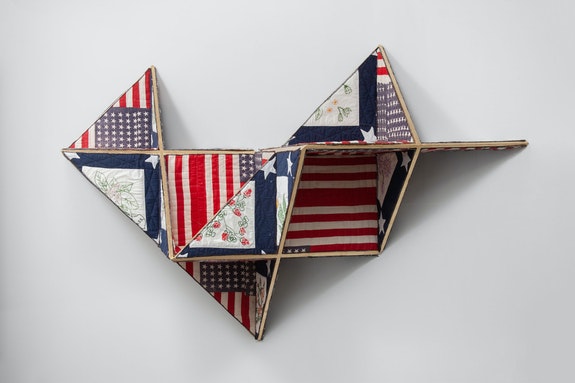
Stylistic characteristics: Afrofuturism – geometry, historical resonance, and the subtle flow of symbols.
Biggs' style presents an extremely profound, religiously ritualistic, and reflective visual quality, transforming historical trauma into geometric eternity.
- “The historical depth of ”overlapping”: The most striking feature of Biggs' style is the "unreadable" nature of his images. Due to the interplay of multiple layers of geometric codes and fabric textures, viewers cannot immediately discern all the details. This stylistic characteristic establishes the works as "living archives." The colors often possess a mottled quality, as if bleached by time, or a sense of conflict, as if forcibly covered by street graffiti, simulating the visual tension of buried history erupting in contemporary society.
- Visual Syncopation Rhythm: His style is characterized by a manipulation of "visual rhythm." The geometric blocks in his images often exhibit an irregular, pulsating quality, similar to syncopation in jazz. This stylistic feature strips away the static beauty of minimalism, instead pursuing a kinetic energy with a "physical" feel. When viewers observe, the overlapping geometric shapes create a "cultural tremor" on their retina, evoking a cross-temporal resonance of identity.
- The spiritual cosmic order: Compared to Dorval's exploration of the psychology of color, Biggs' style places greater emphasis on "spiritual integration." The position of each circle suggests the cycle of the universe, while each straight line points to the horizon of escape to freedom. This style pursues a "dwelling place for the soul," using the purity of geometry to provide a sacred and unified framework for fragments of history amidst intense social contradictions.
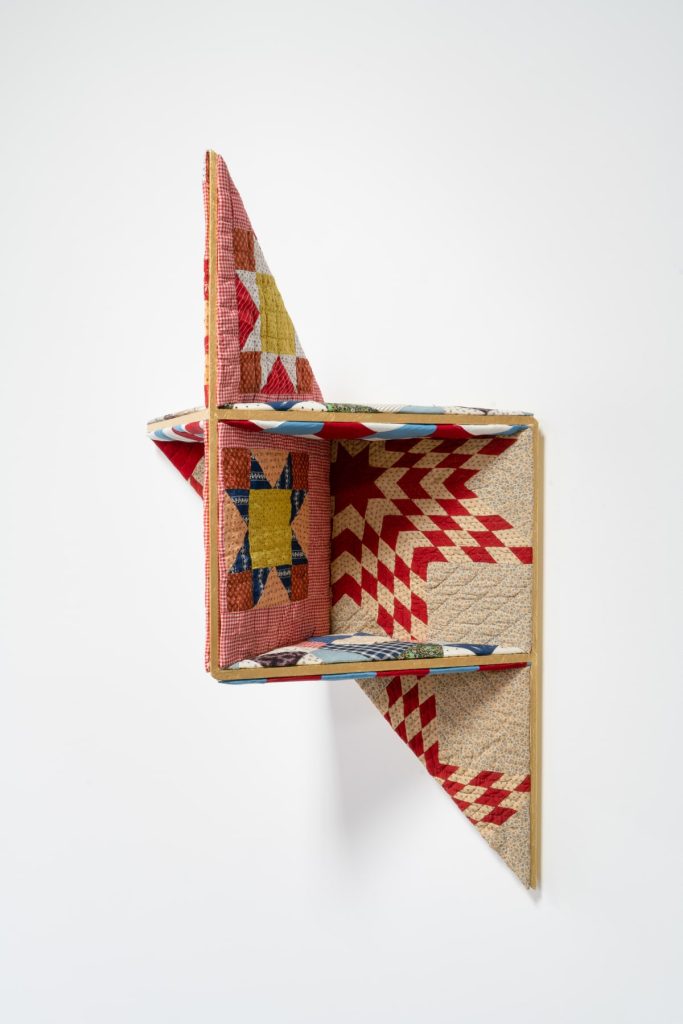
Material Usage: A hybrid narrative of recycled vintage fabrics, industrial spray paint, and sequins.
Biggs demonstrates an extreme respect for "material energy" in his choice of materials, regarding his work as a battery that stores cultural energy.
- Quilted fabric as a container: He chose antique quilts, hand-sewn and imbued with the sweat and warmth of their predecessors, as his base. This approach to material application elevates the "painted surface" to the level of "human skin." In Biggs' view, each seam of the fabric is a "linear history" left by his predecessors, and his geometric paintings are a continuation and rewriting of these lines.
- A comparison of the "speed" of street spray painting and glitter application: Biggs extensively uses industrial spray paint, a medium with a street-expansion quality, juxtaposing it with intricately sequined pieces. Spray paint represents the instantaneous explosion and the violent aesthetics of the city, while sequins represent the solemnity of ritual and the tedious investment of time. This use of materials breaks down the boundaries between high art and popular culture, establishing a contradictory texture in the artwork that is both rugged and delicate.
- Birch tar and hard filler: To provide physical support and pressure to the soft fabrics, he sometimes uses viscous, primitive-sounding birch tar. This use of material enhances the "heaviness" of the work, making the originally light fabrics look like cultural totems excavated from the depths of the earth, bearing the weight of geological pressure.
 简体中文
简体中文  English
  日本語
日本語  Español
  Français
  हिन्दी
  العربية
  বাংলা
বাংলা  Português do Brasil
  Русский
  اردو
اردو  Bahasa Indonesia
  Deutsch
  Kiswahili
  मराठी
मराठी  తెలుగు
  Tiếng Việt
  Türkçe
  Italiano
  தமிழ்
தமிழ்  한국어
한국어