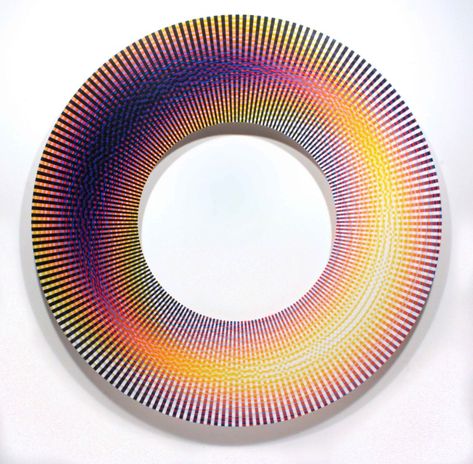
American artist Eric Zammitt's work breaks down the boundaries between painted surfaces and three-dimensional luminescent bodies through the precise layering, bonding, and slicing of tens of thousands of colored acrylic fragments. His methods, along with Arthur Dorval's geometric overlap, achieve an ultimate material unity in the "physical superposition of color" and the "deep construction of perception." However, Zammitt pushes geometric abstraction to the limits of optics through a labor-intensive approach akin to "simulating pixels."
Creative techniques: Lamination and cross-sectional drawing logic
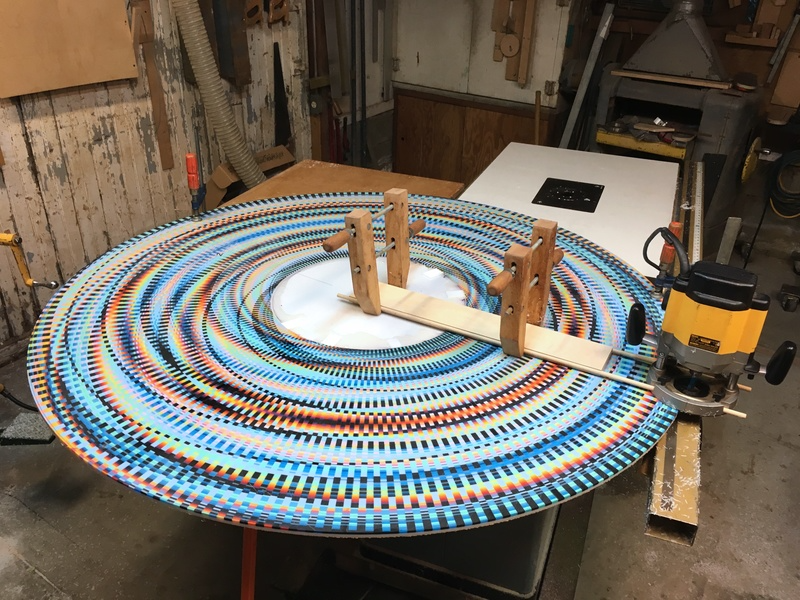
Zamit's creative method is a precise ritual of "material accumulation" and "structural revelation." His production logic is not about applying paint to a flat surface, but about constructing a framework of color within a pre-designed cube.
- “Physical stacking of ”simulated pixels”: Zamite's core technique involves massively layering acrylic strips of varying thicknesses and colors. He treats each acrylic strip as a "physical pixel." By arranging and combining thousands of colored strips in complex ways, he constructs a massive acrylic blank with internal texture. This method breaks down the illusion of digital images, transforming "pixelation" into a physical structure with real weight and transparent depth. This echoes Dorval's "incubation" logic—Dorval is about layering colors, while Zamite is about the "biochemical accumulation" of pixels.
- Sectional Reconstruction: His production logic involves a secondary reconstruction of the raw materials. After the slab has fully solidified, Zamit uses precision machine tools to cut it vertically, revealing the extremely complex cross-sections hidden inside due to the layering. This method breaks the monotony of composition. By flipping, swapping, or re-gluing the cut sections, he creates a visual texture similar to a symmetrical mandala or a wavering energy field, so that the final surface of the work is "mapped" by the physical thickness of several layers of color.
- Mathematical rhythm and field mapping: Zamit uses a rigorous sequence algorithm to control the gradient of colors. His method involves using the "transparency gradient" of colors to simulate the flow of energy. By embedding opaque, semi-transparent, and fully transparent acrylic in layers of different depths, he constructs a physical field that can capture and bend light, forcing viewers to move in front of the image to observe the parallax effect caused by changes in perspective.
Stylistic features: light energy matrix, flowing order, and the "dematerialization" of matter.“
Zamit's style presents an extremely dazzling, precise, and futuristic visual quality, transforming hard plastic into flowing light.
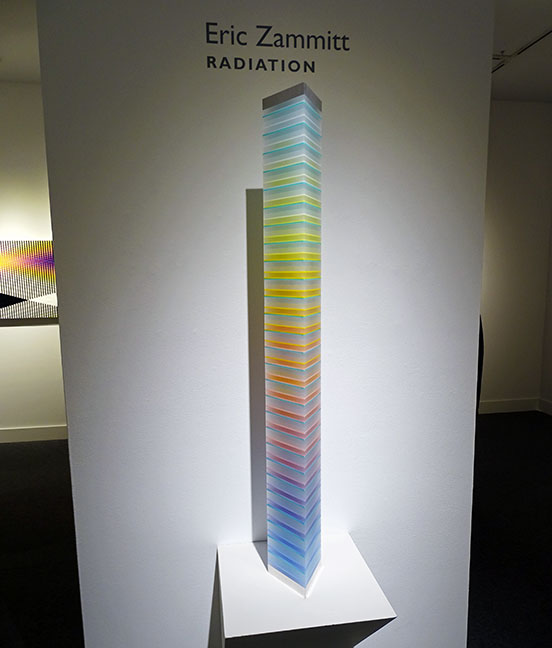
- “A radiating sensation "from the inside out": The most striking feature of the Zamit style is that the image appears to have built-in light-emitting diodes. Due to the multiple reflections and refractions of light within the transparent acrylic layer, the colors exhibit a "radiative force" that transcends the surface of the material. This stylistic characteristic establishes the work as an "energy window," simulating the supernatural feeling of digital screen backlighting intertwining with the natural spectrum within a crystal.
- Digital Aesthetics in the Analog Era: His style is characterized by the simulation of "digital glitches" or "data streams." The dense array of tiny geometric cubes in the image evokes a dynamic sense of computer data exchange. This stylistic feature strips away the randomness of handcraftsmanship, instead pursuing a near-machine-produced perfection. Viewers experience a visual "overload of pleasure" as their senses are simultaneously stimulated by tens of thousands of tiny units, establishing his position at the intersection of "technological aesthetics" and "geometric abstraction."
- The abyss effect caused by thickness: Compared to Dorval's perspective overlapping, Zammit's style emphasizes "realistic thickness." Because each geometric color block has its own physical length, light will produce slight dispersion when passing through the layers. This style pursues a kind of "abyss of matter," where a geometric structure that can be seen through and infinitely recursively exists beneath a seemingly smooth, polished surface.
Materials used: Industrial acrylic, epoxy resin bonding system and extreme grinding
Zamit demonstrated an extreme pursuit of "industrial purity" in his choice of materials, regarding acrylic as a kind of light that can be sculpted.
- High-transparency cast acrylic: This is his sole core medium. He chose this material because of its superior optical conductivity. Through screening hundreds of industrial colorants, he developed his own "physical palette." This method of using the material elevates "synthetic chemicals" to the level of "artistic crystals," establishing a color purity in the painting that cannot be imitated by brushstrokes.
- Leaves-free bonding with high-viscosity epoxy resin: To bond thousands of acrylic units together, Zamit uses an industrial epoxy resin with extremely high strength and perfect transparency. The bonding process must be carried out in a controlled environment to eliminate any air bubbles. This material application ensures that after cutting, the different layers of the work exhibit an "atomic-level" seamless fusion, simulating the texture of geological layers formed under high pressure in nature.
- Ultimate water grinding and polishing process: After completing the construction, Zamit grinds the surface for hundreds of hours. He uses sandpaper ranging from coarse to fine (down to the micrometer level) in multiple iterations, finally polishing it mechanically with a high-speed cloth wheel. This method of material application enhances the "illusory" feel of the work, making the originally heavy acrylic cube appear as a thin, floating digital illusion, forcing the viewer to perceive its weight while being bewildered by its extreme lightness.
 简体中文
简体中文  English
  日本語
日本語  Español
  Français
  हिन्दी
  العربية
  বাংলা
বাংলা  Português do Brasil
  Русский
  اردو
اردو  Bahasa Indonesia
  Deutsch
  Kiswahili
  मराठी
मराठी  తెలుగు
  Tiếng Việt
  Türkçe
  Italiano
  தமிழ்
தமிழ்  한국어
한국어