
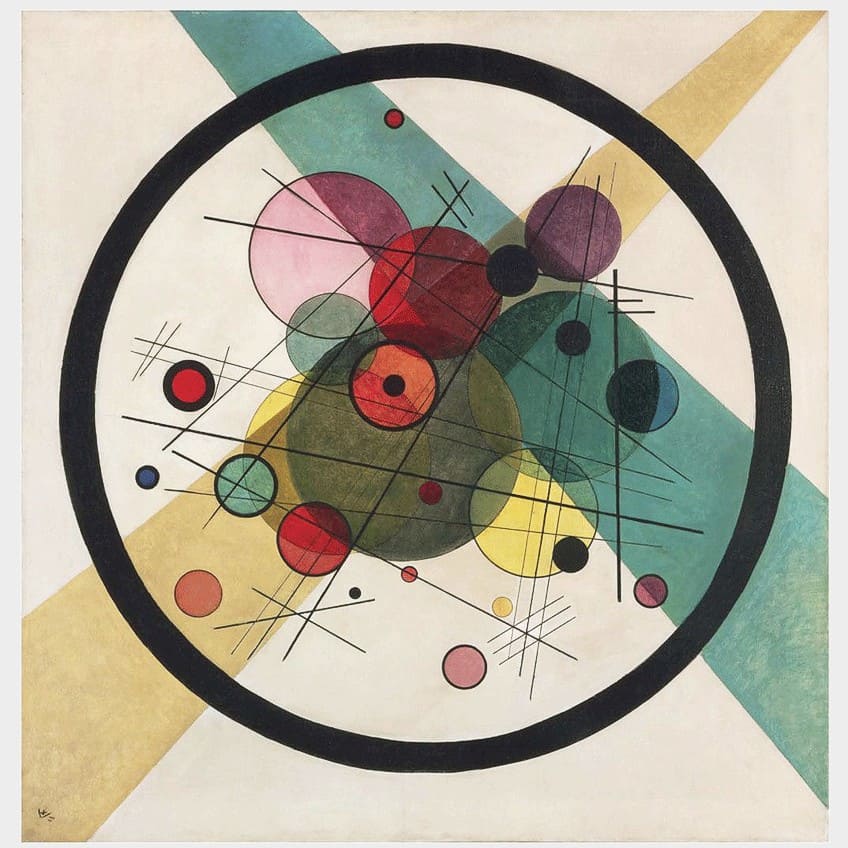
Vasily Kandinsky's *Several Circles*, painted between January and February 1926, is an oil painting on canvas and is now in the collection of the Guggenheim Museum in New York. It measures approximately 140.7 × 140.3 cm. Chronologically, this work falls within the mature phase of his Bauhaus period. Guggenheim teaching materials indicate that between 1926 and 1929, Kandinsky created a series of works "using only circles," and *Several Circles* is summarized by the museum as a representative image of this period's "cosmic harmony." In other words, this painting is not merely a randomly created circular composition, but a key work representing a concentrated compression of geometric forms, spiritual pursuits, and visual order.
If analyzed within the framework of the "concentric expansion module," this work becomes highly typical. On the surface, the image is composed of discs and rings of varying sizes and colors, but what truly dominates the whole is not the scattered small circles, but rather the massive black core slightly off-center in the upper left, surrounded by a blue ring, a white halo, and several transparent, overlapping secondary circular surfaces. This structure closely resembles the generative logic of "expansion from the center": first a powerful center, then an outer ring, followed by secondary circles that surround, float, and echo it. Thus, the entire painting is not a scattered distribution, but rather resembles a cosmic system expanding outward from a central energy field. The Guggenheim audio introduction also emphasizes that Kandinsky consciously used circles as the dominant form in this work, employing their relationships to organize the overall composition.
The most important aspect of this work lies in its elevation of the "circle" from an ordinary geometric figure to a structural principle. Guggenheim teaching materials preserve Kandinsky's famous description of the circle: the circle is "the synthesis of the greatest opposites," unifying "concentricity" and "centrifugation" within a single form, and pointing to a higher dimension in balance. This judgment is the key to understanding *Several Circles*. On the one hand, the circles in the painting naturally possess centripetal force, drawing the viewer in with the largest black circle; on the other hand, smaller circles of varying sizes constantly radiate outwards, generating centrifugal force, expansion, and drift. Thus, the painting's charm lies not in static symmetry, but in a balance that constantly oscillates between convergence and diffusion. It is perfectly suited as a classic example of a "concentric expansion module" because it illustrates that concentric structures are not rigid loops, but an organizational method capable of simultaneously accommodating concentration, fluctuation, and spillover.
Formally, *Several Circles* employs another highly ingenious technique: it layers the "expansion." The largest black circle is not isolated; it is surrounded by a blue ring, which in turn has an almost luminous white edge. Around it are smaller, transparent or semi-transparent circles in yellow, pink, light blue, and green. These smaller circles resemble both satellites and energy particles detached from the central structure. The large light pink circle in the lower right corner, the cyan circle on the right, and the scattered yellow and red dots further draw the eye from the center to the edges, creating a three-tiered space: "center—outer circle—far end." In other words, the "concentric expansion" of this work is not a mechanical circularity, but rather a rhythmic and breathing process achieved through variations in size, overlapping transparency, contrasting density, and varying distances. The Guggenheim study also draws the viewer’s attention to the square canvas itself: for Kandinsky, the circle was not the only geometric element; the overall squareness of the canvas also provided an external boundary, ensuring that the inner circular universe was always placed within a quiet and stable overall framework.
In its handling of color, this work also demonstrates Kandinsky's mature control. The black background is not simply emptiness, but more like deep space or infinite space, making the circles appear luminous like celestial bodies. The large blue rings, white edges, pale pink, light yellow, and small red dots together create a color system that is both tranquil and vibrant. Because many circular surfaces have transparent overlaps, the colors are not isolated from each other, but rather generate new intermediate colors and spatial layers at the intersections. Thus, the circle is no longer just a geometric shape on the outline, but becomes a carrier of color vibration. Guggenheim teaching materials mention that Kandinsky developed a set of formal theories based on geometry during his Bauhaus period, and associated triangles, squares, and circles with different psychological and spiritual qualities; in this painting, the "spirituality" represented by the circle is most concentrated. It is not narrating a specific celestial body, but establishing an almost musical cosmic order through pure form.
Therefore, *Several Circles* stands as a representative work of the "concentric expansion module" not merely because it depicts numerous circles, but because it truly transforms the circle into a generative mechanism: expanding outward from the core, deriving hierarchy, rhythm, drift, echo, and overall balance from a single circle. It reminds us that concentric expansion modules are not simply about nested rules; they can also be flexible, transparent, and cosmic structural systems. For contemporary creation, this work is particularly well-suited for translation into light installations, glass interlayers, digital interfaces, sound visualizations, dynamic projections, and spatial wayfinding, because it offers not a fixed pattern, but a circular organizational logic that can be magnified, layered, illuminated, and dynamic. What Kandinsky accomplished in this work was precisely the transformation of the simplest geometric form into the richest spiritual space.
Lessons F2-16: Analysis of Vasily Kandinsky's Works (Click to listen to the reading)
Vasily Kandinsky's *Several Circles*, painted between January and February 1926, is an oil painting on canvas and is now in the collection of the Guggenheim Museum in New York. It measures approximately 140.7 × 140.3 cm. Chronologically, this work falls within the mature phase of his Bauhaus period. Guggenheim teaching materials indicate that between 1926 and 1929, Kandinsky created a series of works "using only circles," and *Several Circles* is summarized by the museum as a representative image of this period's "cosmic harmony." In other words, this painting is not merely a randomly created circular composition, but a key work that concentrates and compresses geometric forms, spiritual pursuits, and visual order. If analyzed within the context of "concentric expansion modules," this work becomes highly typical. On the surface, the image is composed of discs and rings of varying sizes and colors. However, what truly dominates the whole is not the scattered small circles, but the enormous black core in the upper left corner, surrounded by a blue ring, a white halo, and several transparent, overlapping secondary circular surfaces. This structure closely resembles the generative logic of "expansion from the center": first a powerful center, then an outer ring, and then secondary circles surrounding, floating, and echoing it. Thus, the entire painting is not a scattered distribution, but rather resembles a cosmic system expanding outward from a central energy field. The Guggenheim audio introduction also emphasizes that Kandinsky consciously used the circle as the dominant form in this work, using its relationships to organize the overall composition. The most important aspect of this work is that it elevates the "circle" from an ordinary geometric shape to a structural principle. Guggenheim teaching materials preserve Kandinsky's famous statement about the circle: the circle is "the synthesis of the greatest opposites," unifying "concentricity" and "centrifugality" within a single form, and pointing to a higher dimension in balance. This judgment is the key to understanding *Several Circles*. The circles in the painting naturally possess centripetal force, drawing the viewer in with the largest black circle; on the other hand, smaller circles of varying sizes constantly radiate outwards, creating centrifugal force, expansion, and drift. Thus, the painting's charm lies not in static symmetry, but in a balance that constantly oscillates between convergence and diffusion. It is a perfect example of a "concentric expansion module," illustrating that concentric structures are not rigid rings, but an organizational method capable of simultaneously accommodating concentration, fluctuation, and spillover. Formally, *Several Circles* also features a highly ingenious treatment: it layers "expansion." The largest black circle is not isolated; it is surrounded by a blue ring, which in turn has an almost luminous white edge. Around it are smaller, transparent or translucent circles in yellow, pink, light blue, and green. These smaller circles resemble both satellites and energy particles detached from the central structure. The large, light pink circle in the lower right corner, the turquoise circle on the right, and the scattered yellow and red dots further draw the eye from the center to the edge, creating a three-tiered space of "center-outer circle-far end." In other words, the "concentric expansion" of this work is not a mechanical circularity, but rather a rhythmic and breathing process achieved through variations in size, transparent overlays, contrasts in density, and distribution at different distances. Guggenheim's research also reminds viewers to pay attention to the square canvas itself: for Kandinsky, the circle is not the only geometric element; the overall squareness of the canvas also provides an external boundary, ensuring that the internal circular universe is always placed within a quiet and stable overall framework. In terms of color treatment, this work also demonstrates Kandinsky's mature control. The black background is not simply empty, but more like deep space or infinite space, making the circles appear luminous like celestial bodies; the large blue ring, the white rim, the light pink, the pale yellow, and the small red dots together create a color system that is both tranquil and vibrant. Because many circular surfaces overlap with transparency, the colors are not isolated from each other, but rather generate new intermediate colors and spatial layers at the overlaps. Thus, the circle is no longer just a geometric shape on the outline, but becomes a carrier of color vibration. Guggenheim teaching materials mention that Kandinsky developed a geometric-based theory of form during his Bauhaus period, linking triangles, squares, and circles to different psychological and spiritual qualities; in this painting, the "spirituality" represented by the circle is most concentrated. It is not describing a specific celestial body, but establishing an almost musical cosmic order through pure form. Therefore, the reason why "Several Circles" can become a representative work of "concentric expansion modules" is not only because it depicts many circles, but because it truly transforms the circle into a mode of generation: expanding outward from the core, deriving levels, rhythms, drifts, echoes, and overall balance from a single circle. It reminds us that concentric expansion modules are not simply regular nesting, but can also be a flexible, transparent, and cosmic structural system. For contemporary creative endeavors, this work is particularly well-suited for translation into light installations, glass interlayers, digital interfaces, sound visualizations, dynamic projections, and spatial wayfinding, because it offers not a fixed pattern, but a circular organizational logic that can be magnified, layered, illuminated, and animated. What Kandinsky accomplished in this work was precisely the transformation of the simplest geometric forms into the richest spiritual space.
 简体中文
简体中文  English
  日本語
日本語  Español
  Français
  हिन्दी
  العربية
  বাংলা
বাংলা  Português do Brasil
  Русский
  اردو
اردو  Bahasa Indonesia
  Deutsch
  Kiswahili
  मराठी
मराठी  తెలుగు
  Tiếng Việt
  Türkçe
  Italiano
  தமிழ்
தமிழ்  한국어
한국어