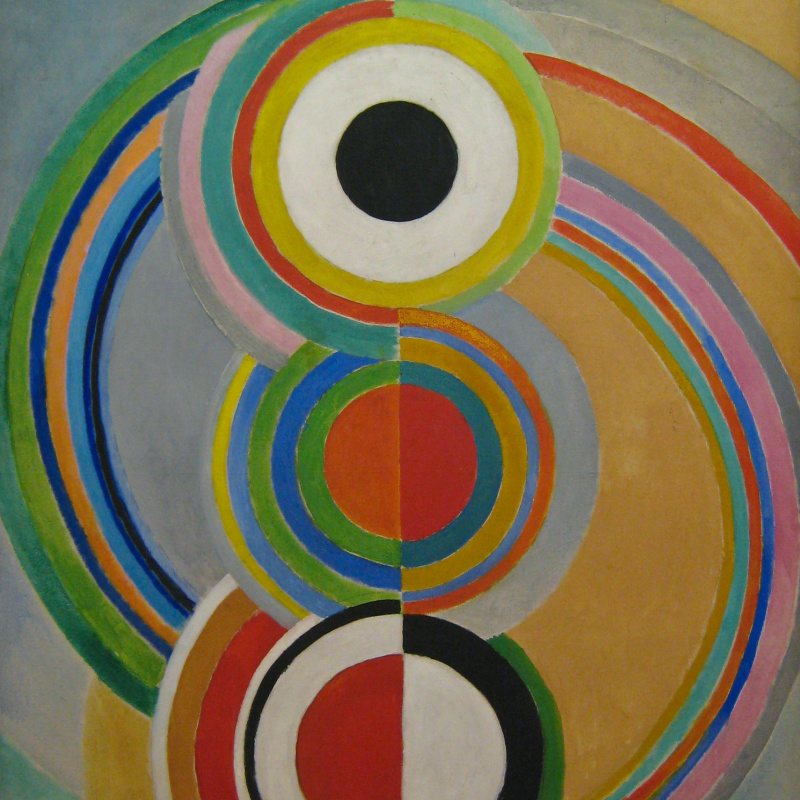
Sonia Delaunay's "Electric Prisms" (French title) Prismes électriquesPainted in 1914, now in the Centre Pompidou, Paris, this oil painting on canvas measures approximately 250 × 250 cm. In terms of its context, it falls within a crucial period in the development of "simultaneity" and the Orpheian language by Robert and Sonia Delaunay. Tate's definition of Simultaneity points out that this term was precisely used by Robert Delaunay to describe the abstract painting method he and Sonia developed around 1910; while the Pompidou Centre's description of this work explicitly emphasizes that the painting, starting from a cityscape illuminated by electric lights, celebrates the poetry of urban life and modernity.
If we analyze this work within the framework of "misaligned layered modules," its representativeness becomes extremely strong. The composition is not based on a single central image, but rather on a series of discs, arcs, color rings, and fragmented color surfaces that overlap, shift, and interweave. The Pompidou Centre's description specifically points out that the "massive modules" in this painting are decomposed and multiplied into colored rings, almost absorbing the entire surface of the canvas and eliminating traditional perspective. In other words, the so-called "layering" here is not about arranging forms neatly in layers, but about allowing different rings to overlap in a misaligned manner, keeping the relationship between foreground and background in a constant state of flux. The viewer will not remain static on any one layer, but will continuously move back and forth between the discs; this is the core visual characteristic of misaligned layered modules.
The most important aspect of this work lies in its transformation of "layers" from a spatial background into a mechanism for color generation. The Khan Academy's summary of this work is crucial: it is both a demonstration of color relationships and an abstract representation of Sonia's first experience with electric streetlights on a Parisian avenue. In other words, the circles in the painting do not depict individual streetlights, but rather translate the colorful halos, shadows, and diffusion effects created by light in the night. Circular surfaces of different colors press against, cover, and permeate each other; red and green, blue and orange, yellow and purple constantly reinforce each other in their adjacent relationships, making the image appear to glow, vibrate, and expand. Thus, color is no longer merely a surface attribute filling shapes, but becomes the most active structural force between the layers.
From a formal structural perspective, the brilliance of *Electric Prisms* lies in its avoidance of creating rigid geometric collages; instead, it imbues each layer with a sense of movement. The 2012 MoMA description of the work mentions that the "vibrant orbs of color moving across the canvas" are a classic example of Delaunay's theory of simultaneity. Pompidou's explanation further points out that this circular system, inspired by electric lights, ultimately acquires a "cosmic scale." Understanding these two points together is crucial: on the one hand, the painting retains the modern rhythm of the urban nightscape, with lingering impressions of streetlights, traffic, pedestrians, and the light of the avenues; on the other hand, the enlarged, repeated, and offset circular patterns transcend the figurative urban scene, becoming a more universal optical and rhythmic structure. Therefore, the misaligned, layered modules here are not merely an increase in formal hierarchy, but a modern abstract order that grows from urban experience.
From an art historical perspective, this work is also crucial. Tate's Sonia Delaunay exhibition materials list *Electric Prisms* as one of her most iconic works, and Tate's explanation of Simultanism states that the core of this method lies in the fact that color does not exist in isolation, but rather creates new perceptual effects through adjacency, contrast, and overlap. In *Electric Prisms*, this "simultaneity" is specifically manifested in the fact that different rings are both independent color layers, yet also generate new composite color bands at their overlaps; layers both overlap and permeate each other through transparency. Thus, the painting resembles both a series of halos traversing each other and a melody composed of color rhythms. For this reason, this work becomes one of the most representative cases of Orff: it proves that abstract painting does not necessarily rely on traditional perspective and object outlines, but can also create rhythm, movement, and a sense of space through layering colors.
Therefore, from the perspective of "misaligned layered modules," the significance of *Electric Prisms* is not merely "drawing many circles," but rather its integration of misalignment, transparency, double images, color wheel diffusion, and urban light into a unified system. It demonstrates that layering is not simply piling up material, but rather that new rhythms can be continuously generated through offset and overlap; it also shows that modern urban experiences—especially the new visual experiences brought about by electric lighting—can be directly transformed into the formal language of abstract art. For contemporary creation, this work remains highly inspiring because it is particularly suitable for extension into glass interlayers, acrylic sheets, light installations, dynamic interfaces, and spatial projections: central light sources, color diffusion, ring offsets, and layered overlaps can all continue to develop into visual systems in reality. Sonia Delaunay, in *Electric Prisms*, elevates "misaligned layering" from a compositional technique to an abstract method for depicting modern perception and the rhythm of modern life.
Lessons F2-20: Analysis of Sonia Delaunay's Works (Click to view and listen to the reading)
Sonia Delaunay's "Electric Prisms" (French title) Prismes électriquesPainted in 1914, now in the Centre Pompidou, Paris, this oil painting on canvas measures approximately 250 × 250 cm. In terms of its context, it falls within a crucial period in the development of "simultaneity" and the Orpheian language by Robert and Sonia Delaunay. Tate's definition of Simultaneity points out that this term was precisely used by Robert Delaunay to describe the abstract painting method he and Sonia developed around 1910; while the Pompidou Centre's description of this work explicitly emphasizes that the painting, starting from a cityscape illuminated by electric lights, celebrates the poetry of urban life and modernity. If this work is analyzed within the framework of "misaligned, layered modules," it becomes highly representative. The composition is not based on a single central image, but rather on a series of discs, arcs, color rings, and fragmented color surfaces that overlap, offset, and interweave. The Pompidou Centre's description specifically points out that the "massive modules" in this painting are decomposed and multiplied into colored rings, almost absorbing the entire surface of the canvas and eliminating traditional perspective. In other words, the so-called "layering" here is not about arranging shapes neatly in layers, but rather about overlapping different rings in a staggered manner, keeping the relationship between them constantly in a sliding state. Viewers will not remain fixed on any one layer, but will continuously move back and forth between the discs; this is the core visual characteristic of the staggered layered module. The most important aspect of this work is that it transforms "layers" from a spatial background into a color generation mechanism. Khan Academy's summary of this work is crucial: it is both a demonstration of color relationships and an abstract representation of Sonia's first experience with electric streetlights on a Paris avenue. In other words, the rings in the painting are not depicting individual streetlights, but translating the colorful halos, shadows, and diffusion effects formed by light in the night. Different colored circles press against, cover, and permeate each other; red and green, blue and orange, yellow and purple constantly reinforce each other in their adjacent relationships, making the image appear to glow, vibrate, and expand. Thus, color is no longer merely a surface attribute filling shapes, but becomes the most active structural force between the layers. From a formal structural perspective, the brilliance of *Electric Prisms* lies in its avoidance of creating rigid geometric collages; instead, it imbues each layer with a sense of movement. The 2012 MoMA description of the work mentions that the "vibrant orbs of color moving across the canvas" are a typical example of Delaunay's theory of simultaneity. Pompidou's explanation further points out that this circular system, inspired by electric lights, ultimately acquires a "cosmic scale." Understanding these two points together is crucial: on the one hand, the painting retains the modern rhythm of the urban nightscape, with lingering impressions of streetlights, traffic, pedestrians, and the light of the avenues; on the other hand, the enlarged, repeated, and offset rings transcend the figurative urban scene, becoming a more universal optical and rhythmic structure. Therefore, the misaligned, layered modules here are not merely an increase in formal hierarchy, but a modern abstract order growing from urban experience. From an art historical perspective, this work is also extremely important. Tate's Sonia Delaunay exhibition materials list *Electric Prisms* as one of her most iconic works. Tate's explanation of Simultanism states that the core of this method lies in the fact that color does not exist in isolation, but rather creates new perceptual effects through adjacency, contrast, and overlap. In *Electric Prisms*, this "simultaneity" is specifically manifested in the fact that different rings are both independent color layers and generate new composite color bands at their overlaps; layers both overlap and permeate each other through transparency. Thus, the painting resembles both a series of halos traversing each other and a melody composed of color rhythms. For this reason, this work has become one of the most representative cases of Orff: it proves that abstract painting does not need to rely on traditional perspective and object outlines to create rhythm, movement, and a sense of space through layering colors. Therefore, from the perspective of "misaligned layered modules," the significance of *Electric Prisms* is not merely "drawing many circles," but rather its integration of misalignment, transparency, double images, color wheel diffusion, and urban light into a unified system. It demonstrates that layering is not simply piling up material, but rather that new rhythms can be continuously generated through offset and overlap; it also shows that modern urban experiences—especially the new visual experiences brought about by electric lighting—can be directly transformed into the formal language of abstract art. For contemporary creation, this work remains highly inspiring because it is particularly suitable for extension into glass interlayers, acrylic sheets, light installations, dynamic interfaces, and spatial projections: central light sources, color diffusion, ring offsets, and layered overlaps can all continue to develop into visual systems in reality. Sonia Delaunay, in *Electric Prisms*, elevates "misaligned layering" from a compositional technique to an abstract method for depicting modern perception and the rhythm of modern life.
 简体中文
简体中文  English
  日本語
日本語  Español
  Français
  हिन्दी
  العربية
  বাংলা
বাংলা  Português do Brasil
  Русский
  اردو
اردو  Bahasa Indonesia
  Deutsch
  Kiswahili
  मराठी
मराठी  తెలుగు
  Tiếng Việt
  Türkçe
  Italiano
  தமிழ்
தமிழ்  한국어
한국어