
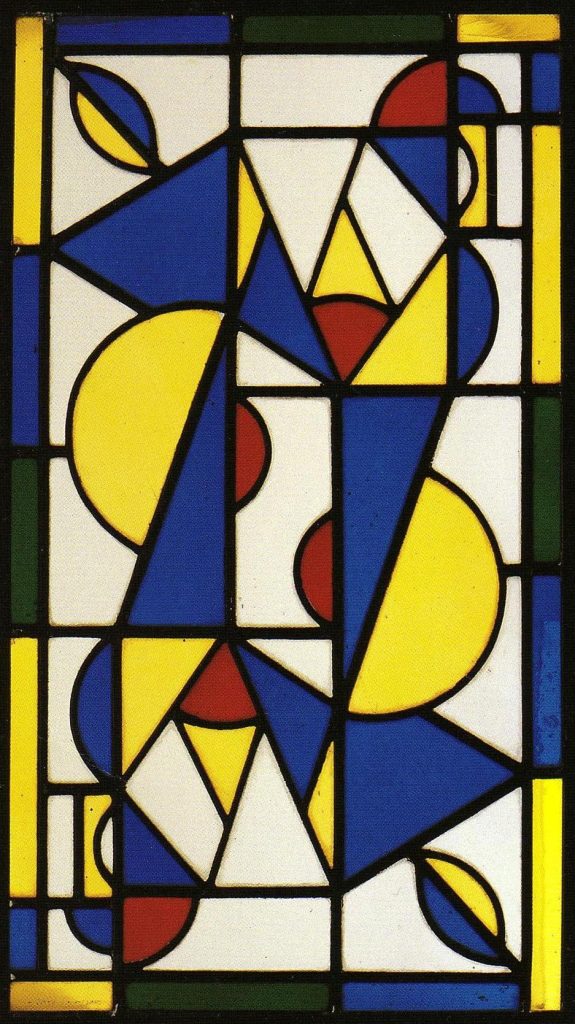
Theo van Doesburg's *Rhythm of a Russian Dance*, painted in June 1918, is now in the collection of the Museum of Modern Art (MoMA) in New York. It is an oil painting on canvas, measuring approximately 135.9 × 61.6 cm. MoMA's collection confirms this basic information, and it can also be seen from its related research and exhibition pages that this work occupies a crucial juncture in van Doesburg's rapid transition from figuration to De Stijl's geometric abstraction. In other words, this painting is not a repetition of a mature formula, but rather an important work from his formative period.
If we analyze this work within the "block-based composition module," its representativeness becomes extremely strong. This is because the entire painting is not organized around a single central image, but rather composed of numerous rectangles and colored blocks of varying sizes and clear orientations. Red, yellow, blue, gray, and white planes are cut into short, distinct units, then densely arranged according to their different widths, lengths, and spatial relationships, creating a rhythm that is both dispersed and unified. Here, the blocks are not background filler, but rather the fundamental grammar of composition: each small rectangle is like a beat unit, and the entire painting resembles a visual musical score pieced together from these units. The inclusion of "Rhythm" directly in the title of MoMA already hints at the relationship between this compositional method and rhythmic organization.
The most important aspect of this work lies in its transformation of "collage" from a physical fit into a visual structure. Generally, when people talk about collage, they tend to think of a plane being cut into geometric regions and then recombined; however, in *Rhythm of a Russian Dance*, the collage is not a static jigsaw puzzle, but an arrangement imbued with a sense of time and rhythm. The rectangular blocks of different sizes are not uniformly placed, but rather appear to be constantly jumping, pushing, and responding, forming a visual progression resembling dance steps or musical beats. The title, "Russian Dance," does not imply a realistic depiction of a dance, but rather an abstract translation of the dance's rhythm, segmentation, acceleration, and pauses into the juxtaposition of color blocks and planes. In this way, the planes are not merely shapes, but also bearers of rhythm.
Formally, the brilliance of this work lies in its non-rigid composition, formed by numerous small rectangles. Many surfaces exhibit a slight irregularity, resembling industrial modules measured entirely by machinery, yet retaining a certain vitality of hand-tuning. An unofficial research page, consistent with MoMA data, also mentions that these rectangles "appear roughly sketched, yet were carefully painted," an observation of considerable value: it suggests that van Doesburg's aim here is not a cold, technical grid, but a dynamic order achieved through geometric simplification. The smaller the surfaces, the more lively the rhythm; the denser the assembly, the more the whole seems driven by music.
Therefore, the core value of this work in the "block splicing module" lies not only in its use of rectangles, but also in its demonstration that rectangular blocks can be organized like musical notes. Each color block has its own position and weight: some act as strong notes, grabbing the eye with high-purity primary colors; others serve as buffers and pauses, maintaining the breath of the image with gray and white; some blocks are longer, like drawn-out notes; others are short and compact, like syncopated beats. The blocks are both independent of each other and collectively subject to a larger rhythmic system. In other words, splicing here is not about forcibly piecing together scattered fragments into a whole, but about allowing the whole itself to be built upon the orderly connection of differentiated units.
From the perspective of De Stijl's development, this work is also very significant. It hasn't yet reached the later stage of extreme simplification, clear horizontal and vertical divisions, and large areas of white space; instead, it retains a transitional richness: numerous planes, a denser rhythm, and graphic relationships closer to "the moment of occurrence in composition." Precisely because of this, it is particularly suitable as a teaching case for the "plane-laying module." It clearly shows that geometric abstraction doesn't immediately transform into large blocks of color and thick black lines, but often first goes through a stage where planes are cut into smaller pieces, pieced together, and organized at an accelerated pace. For learners, this work helps to understand that plane-laying is not a static assembly, but rather, through different scales, colors, and positions, the collage itself generates a dynamic order.
From today's creative and application perspective, *Rhythm of a Russian Dance* remains highly inspiring. It is well-suited for translation into collage design, textile patterns, architectural facades, wayfinding systems, digital interfaces, and modular installations because it offers not an unreproducible image, but a clear methodology: first, establish basic block units, then piece these units together into a rhythmic whole through differences in scale, color, and position. In other words, the key to the block-based collage module lies not in the "collage" itself, but in "how to create order and rhythm through the collage." What Theo van Doesburg accomplished in this 1918 work was precisely elevating the simple combination of rectangular blocks into a perceptible, scalable, and sustainably generative modern abstract language.

Lessons F2-22: Analysis of Theo van Doesburg's work. Click to view and listen to the reading.
Theo van Doesburg's *Rhythm of a Russian Dance*, painted in June 1918, is now in the collection of the Museum of Modern Art (MoMA) in New York. It is an oil painting on canvas, measuring approximately 135.9 × 61.6 cm. MoMA's collection confirms this basic information, and it can also be seen from its related research and exhibition pages that this work occupies a crucial juncture in van Doesburg's rapid transition from figuration to De Stijl's geometric abstraction. In other words, this painting is not a repetition of a mature formula, but an important work from his formative period. If we analyze this work within the framework of "block-based composition," its representativeness is very strong. This is because the entire painting is not organized by a single central image, but rather by a large number of rectangles and colored blocks of varying sizes and clear directions. Red, yellow, blue, gray, and white planes are cut into short, clear units, then densely arranged according to different widths, lengths, and positional relationships, forming a rhythm that is both dispersed and unified. Here, the blocks are not background fillers, but rather the fundamental grammar of composition: each small rectangle is like a beat unit, and the entire painting resembles a visual musical score pieced together from these units. The inclusion of "Rhythm" directly in MoMA's title already hints at the relationship between this compositional method and rhythmic organization. The most important aspect of this work lies in its transformation of "collage" from physical adhesion into visual structure. Generally, when people talk about block collage, they tend to think of a plane being cut into several geometric regions and then recombined; but in "Rhythm of a Russian Dance," the collage is not a static jigsaw puzzle, but an arrangement imbued with a sense of time and rhythm. The rectangular blocks of different sizes are not uniformly placed, but rather appear to be constantly jumping, pushing, and responding, forming a visual progression resembling dance steps or musical beats. The title mentions "Russian Dance," but this does not mean it is realistically depicting a dance; rather, it is more like abstractly translating the rhythm, segmentation, acceleration, and pauses of the dance into the juxtaposition of color blocks and planes. In this way, the blocks are not merely shapes, but also bearers of rhythm. Formally, the brilliance of this work lies in its non-rigid composition, formed by numerous small rectangles. Many surfaces exhibit a slight irregularity, resembling industrial modules measured entirely by machinery, yet retaining a certain vitality of hand-tuned design. An unofficial research page, consistent with MoMA data, also mentions that these rectangles "appear roughly sketched, yet were carefully painted," an observation of considerable value: it suggests that van Doesburg's aim here is not a cold, technical grid, but a dynamic order achieved through geometric simplification. The smaller the surfaces, the more lively the rhythm; the denser the arrangement, the more the whole seems driven by music. Therefore, the core value of this work in the "block-based module" is not merely its use of rectangles, but its demonstration that rectangular surfaces can be organized like musical notes. Each colored surface possesses its own position and weight: some act as strong notes, capturing the eye with high-purity primary colors; others serve as buffers and pauses, maintaining the breath of the image with gray and white; some surfaces are longer, like drawn-out notes; others are short and compact, like syncopated beats. The blocks are both independent of each other and collectively subject to a larger rhythmic system. That is to say, the juxtaposition here is not about forcibly piecing together scattered fragments into a whole, but rather about allowing the whole itself to be built upon the orderly connection of differentiated units. From the developmental perspective of De Stijl, this work is also very significant. It has not yet reached the later stage of extreme simplification, clear horizontal and vertical divisions, and large areas of white space, but rather retains a transitional richness: more blocks, denser rhythms, and graphic relationships closer to "the moment of occurrence in composition." Precisely because of this, it is particularly suitable as a teaching case for the "block juxtaposition module." It clearly shows that geometric abstraction does not immediately transform into large blocks of color and thick black lines, but often first goes through a stage where blocks are cut into smaller pieces, juxtaposed, and organized at an accelerated pace. For learners, this work helps to understand that block juxtaposition is not a static assembly, but rather, through different scales, colors, and positions, the juxtaposition itself generates dynamic order. From today's creative and application perspective, *Rhythm of a Russian Dance* remains highly inspiring. It is well-suited for translation into collage design, textile patterns, building facades, wayfinding systems, digital interfaces, and modular installations because it offers not an unreproducible image, but a clear methodology: first, establish basic block units, and then piece these units together into a rhythmic whole through differences in scale, color, and position. In other words, the key to block-based collage modules lies not in the "collage" itself, but in "how to create order and rhythm through the collage." Theo van Doesburg, in his 1918 work, elevates the simple combination of rectangular blocks into a perceptible, scalable, and sustainably generative modern abstract language.
 简体中文
简体中文  English
  日本語
日本語  Español
  Français
  हिन्दी
  العربية
  বাংলা
বাংলা  Português do Brasil
  Русский
  اردو
اردو  Bahasa Indonesia
  Deutsch
  Kiswahili
  मराठी
मराठी  తెలుగు
  Tiếng Việt
  Türkçe
  Italiano
  தமிழ்
தமிழ்  한국어
한국어