
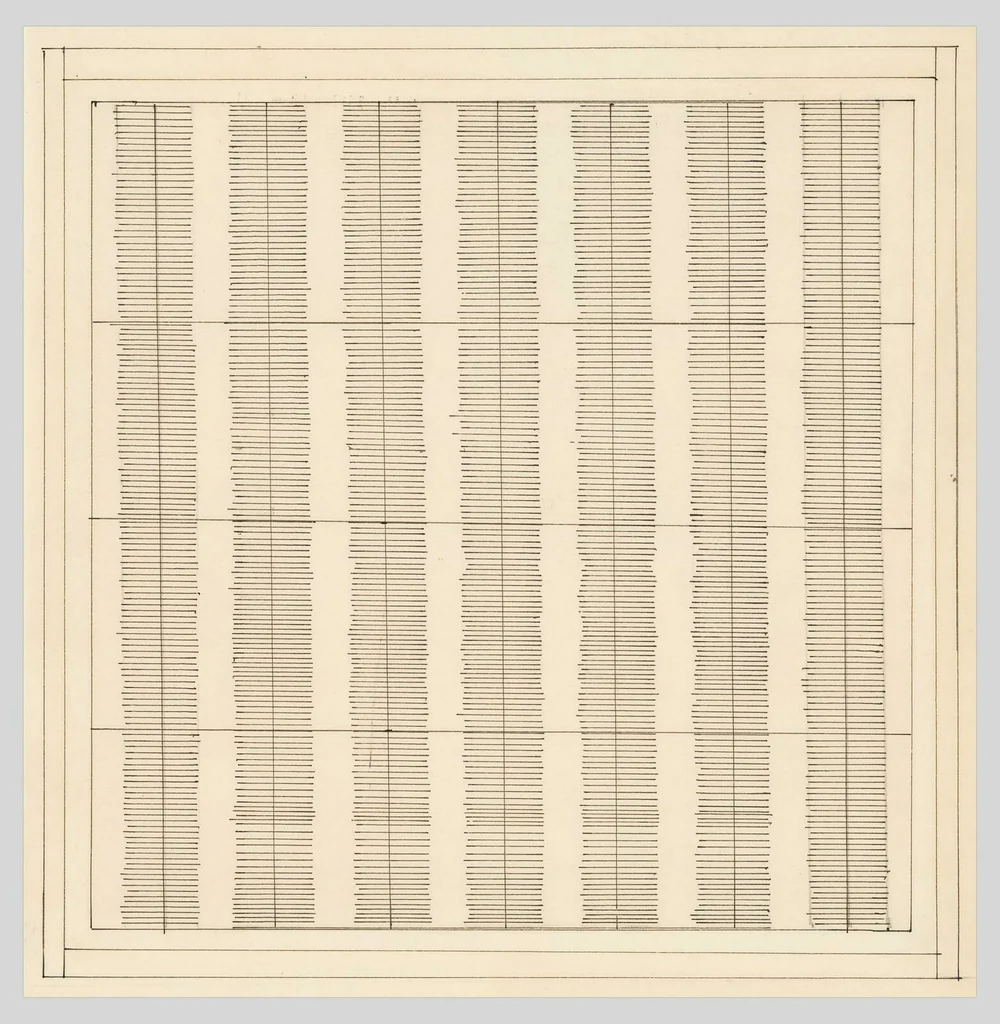
Agnes Martin's *Tremolo*, created in 1962 with ink on paper, is now in the collection of the Museum of Modern Art (MoMA) in New York. Chronologically, it marks a crucial stage in Martin's development of her mature grid-based language: in the late 1950s and early 1960s, she gradually formed an abstract method centered on fine lines, grids, subtle tones, and strict proportions, and *Tremolo* is a prime example of this method compressed and refined on paper. Unlike many geometric abstractions that emphasize strong compositional conflict, the power of this work comes from its extremely restrained approach—small in size, simple in materials, and visually almost "nothing happens." But precisely because of this, the relationships between lines and spacing, order and deviation, stillness and vibration are amplified to an extremely sensitive degree. MoMA labels it as a 1962 ink-on-paper work; and the summaries of Martin by institutions such as Guggenheim and LACMA also emphasize her use of grids and stripes to establish an almost meditative visual language.
If we understand *Tremolo* within the context of the "basic grid module," its most significant meaning lies in transforming the grid from an external framework into an internal rhythm. Mondrian's grids tend towards clear vertical-horizontal divisions, emphasizing structural clarity and tension; while Martin's grids are lighter, finer, and closer to breathing and pulsation. The lines in the work are not rigid, mechanically drawn edges, but rather hand-drawn lines that retain slight tremors and unevenness, making the grid both existent and seemingly on the verge of dissipating. Dia, in discussing Martin's work from the 1960s, describes this state as "visual tremolo" and "a grid floating like veils, shadows, or blurs," a very accurate description: she doesn't aim to create an absolutely controlled order with the grid, but rather to imbue that order with a constant, subtle vibration, allowing the viewer to feel a continuous flow within the calm.
From a formal analysis perspective, the core of *Tremolo* lies not in individual lines, but in the spacing between them. Martin's uniqueness lies in her understanding of geometric abstraction not as a "pile of shapes," but rather in the "organization of spacing." These almost uniform, yet not entirely uniform, fine lines form a very restrained grid order on the paper; however, when the viewer approaches, they discover that each line is not the result of industrial replication, but rather carries human gestures, speed, and pauses. Thus, the work possesses two seemingly contradictory qualities: from a distance, it is rational, calm, and almost mathematical; up close, it is soft, sensitive, and imbued with a sense of handcrafted time. LACMA mentions that Martin establishes a geometric and spatial language with subtle lines and pale color gamuts; the Cleveland Museum of Art also points out that her representative works from this period often use hand-drawn fine lines to cover the canvas, allowing the background and lines to produce subtle variations in light and rhythm. In *Tremolo*, this "difference within near-identity" is precisely its most essential aesthetic.
Therefore, the inspiration for the "basic grid module" in *Tremolo* is not about teaching how to divide the image into regular squares, but about understanding that the grid can also be a perceptual device. It illustrates that the basic grid does not necessarily mean heavy boundaries, strong color blocks, and explicit confrontation; it can also be extremely light, extremely slow, and extremely quiet, yet still highly structured. Martin elevates the grid beyond a mere rational partitioning system, making it a field that carries emotions, time, and the rhythm of viewing. Guggenheim, in introducing her work, emphasizes that for decades she has consistently used grids and stripes to construct tranquil images, connecting this minimalist approach with a deeper spiritual pursuit; the National Galleries of Scotland also points out that her grids emphasize both the flatness of the image and suggest a meditative spiritual space. In other words, the grid in *Tremolo* is not for "representing things," but for allowing the viewer to enter a state of focused concentration continuously awakened by subtle differences.
From the perspective of contemporary creation and material translation, this work is particularly noteworthy. It proves that the basic grid module is not only applicable to architectural feel, hard edges, and color block partitioning, but also to systems requiring "weak contrast" and "detail density," such as paper, textiles, films, light and shadow, and interface design. Martin's method can be transformed into embroidered grids, embossed grids, microporous arrays, translucent film layers, fine line partitioning of electronic interfaces, and even sound visualization structures, because the true core of *Tremolo* is not the ink lines on paper themselves, but how "slight differences in repetition" are transformed into perceptual vibrations. Therefore, this small-scale work from 1962 is not merely a quiet paper exercise in the history of geometric abstraction, but an important example of the basic grid module developing to a higher level: it advances the grid from external order to internal rhythm, and abstraction from formal control to perceptual experience. For those studying geometric abstraction, *Tremolo* reminds us that the most mature grid is not the hardest, fullest, or most complex grid, but the grid that can generate continuous fluctuations within restraint.
Lessons F2-3: Analysis of Agnes Martin's "Tremolo" (Click to view and listen to the reading)
Agnes Martin's *Tremolo*, created in 1962 with ink on paper, is now in the collection of the Museum of Modern Art (MoMA) in New York. Chronologically, it marks a crucial stage in Martin's development of her mature grid-based language: in the late 1950s and early 1960s, she gradually formed an abstract method centered on fine lines, grids, subtle tones, and strict proportions, and *Tremolo* is a prime example of this method compressed and refined on paper. Unlike many geometric abstractions that emphasize strong compositional conflict, the power of this work comes from its extremely restrained approach—small in size, simple in materials, and visually almost "nothing happens." But precisely because of this, the relationships between lines and spacing, order and deviation, stillness and vibration are amplified to an extremely sensitive degree. MoMA labels it as a 1962 ink-on-paper work; and the summaries of Martin by institutions such as Guggenheim and LACMA also emphasize her use of grids and stripes to establish an almost meditative visual language. If we understand *Tremolo* within the context of the "basic grid module," its most significant meaning lies in transforming the grid from an external framework into an internal rhythm. Mondrian's grid leans towards clear vertical-horizontal divisions, emphasizing structural clarity and tension; while Martin's grid is lighter, finer, and closer to breathing and pulsation. The lines in the work are not rigid, mechanically drawn edges, but rather hand-drawn lines that retain slight tremors and unevenness, making the grid both existent and seemingly on the verge of dissipating. Dia, in discussing Martin's work from the 1960s, described this state as "visual tremolo" and "a grid floating like veils, shadows, or blurs," a very accurate description: she didn't aim to create an absolutely controlled order with the grid, but rather to imbue that order with a constant, subtle vibration, allowing the viewer to feel a continuous flow within the calm. From a formal analysis perspective, the core of *Tremolo* lies not in individual lines, but in the spacing formed between them. Martin's uniqueness lies in her understanding of geometric abstraction not as a "pile of forms," but rather in her emphasis on the "organization of spacing." These almost uniform, yet not perfectly uniform, fine lines form a very restrained grid order on the paper; but as the viewer approaches, they discover that each line is not the result of industrial replication, but rather carries the gestures, speed, and pauses of a person. Thus, the work possesses two seemingly contradictory qualities: from afar, it is rational, calm, and almost mathematical; up close, it is soft, sensitive, and imbued with a handcrafted sense of time. LACMA mentions that Martin establishes a geometric and spatial language with subtle lines and pale color gamuts; the Cleveland Museum of Art also points out that her representative works from this period often use hand-drawn fine lines to cover the canvas, allowing the background and lines to produce subtle variations in light and rhythm. In *Tremolo*, this "difference within near-identity" is precisely its most essential aesthetic. Therefore, *Tremolo*'s inspiration for the "basic grid module" is not about teaching how to cut the canvas into regular squares, but about understanding that a grid can also be a perceptual device. This illustrates that a basic grid doesn't necessarily imply heavy boundaries, strong color blocks, and explicit confrontation; it can also be extremely light, slow, and quiet, yet still highly structural. Martin elevates the grid beyond a mere rational zoning system, transforming it into a space that carries emotions, time, and the rhythm of viewing. Guggenheim, in introducing her work, emphasizes that for decades she has consistently used grids and stripes to construct tranquil images, connecting this minimalist approach with a deeper spiritual pursuit; the National Galleries of Scotland also points out that her grids emphasize both the flatness of the image and suggest a meditative spiritual space. In other words, the grid in *Tremolo* is not for "representing things," but for guiding the viewer into a state of focused concentration continuously awakened by subtle differences. From the perspective of contemporary creation and material translation, this work is particularly noteworthy. It proves that basic grid modules are not only suitable for architectural feel, hard edges, and color block zoning, but also for systems requiring "weak contrast" and "detail density," such as paper, textiles, films, light and shadow, and interface design. Martin's method can be transformed into embroidered grids, embossed grids, microporous arrays, translucent film layers, fine-line partitioning of electronic interfaces, and even sound visualization structures, because the true core of *Tremolo* is not the ink lines on paper themselves, but how "slight differences in repetition" are transformed into perceptual vibrations. Therefore, this small-scale work from 1962 is not merely a quiet paper exercise in the history of geometric abstraction, but a significant example of the development of basic grid modules to higher levels: it advances the grid from external order to internal rhythm, and abstraction from formal control to perceptual experience. For those studying geometric abstraction, *Tremolo* reminds us that the most mature grid is not the hardest, fullest, or most complex, but rather the grid that can generate continuous fluctuations within restraint.
 简体中文
简体中文  English
  日本語
日本語  Español
  Français
  हिन्दी
  العربية
  বাংলা
বাংলা  Português do Brasil
  Русский
  اردو
اردو  Bahasa Indonesia
  Deutsch
  Kiswahili
  मराठी
मराठी  తెలుగు
  Tiếng Việt
  Türkçe
  Italiano
  தமிழ்
தமிழ்  한국어
한국어