
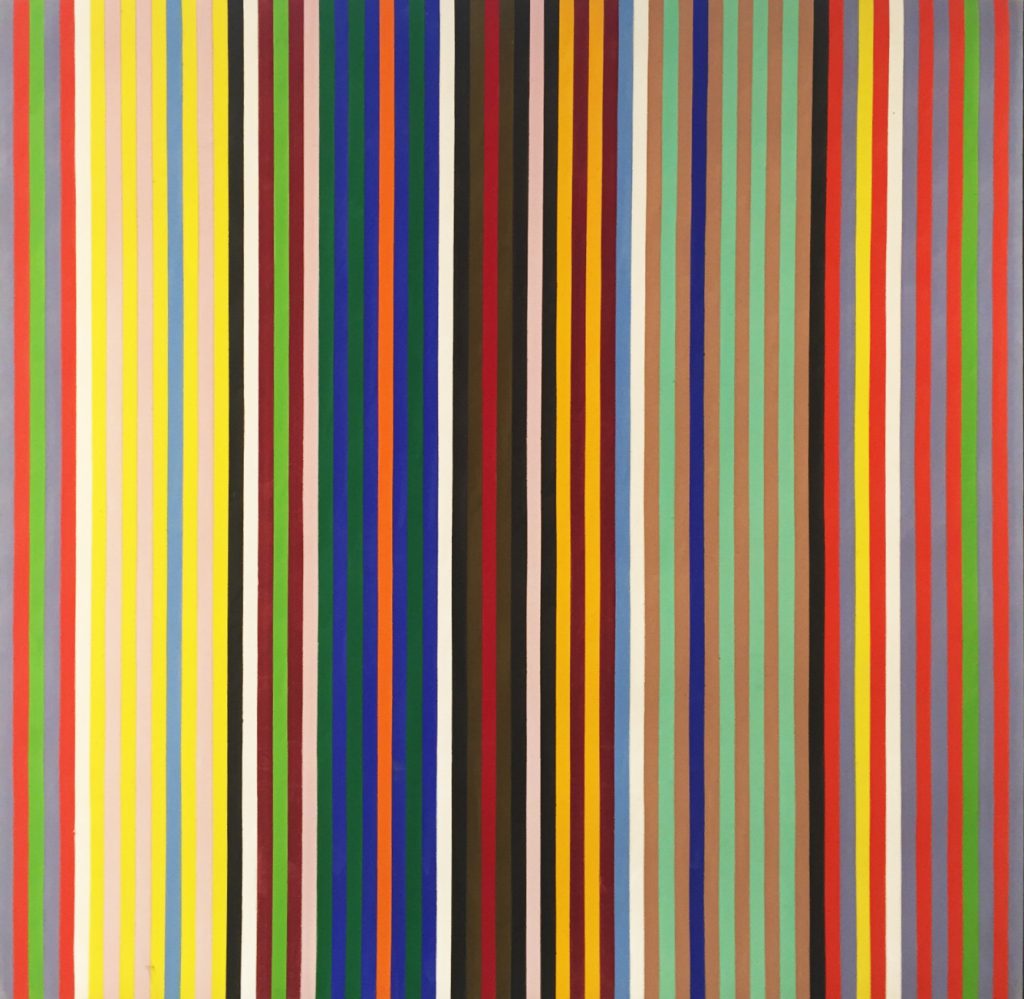
Gene Davis's *Satan's Flag*, created in 1970 and now housed in the National Gallery of Art, is an oil painting on canvas. The National Gallery's visual description of the work is very direct: the canvas is composed of a series of vertical lines of varying widths, with colors concentrated between off-white, gray, and black. Several thick black sections are separated by thinner gray-white stripes, the boundaries of which are straight and clear, the overall effect resembling an elongated barcode or flag. This basic information itself reveals the core of the work: it does not rely on a central image to organize the composition, but rather on the division, juxtaposition, and rhythm of the vertical stripes to establish its structure.
If we analyze this work within the framework of "strip division," it becomes one of the most typical examples. The stripes here are not decorative patterns added to the canvas, but rather the fundamental method by which the work is generated. Each vertical boundary simultaneously serves two functions: on the one hand, it clearly cuts apart adjacent areas; on the other hand, its continuous juxtaposition stitches the whole back together. In other words, division here does not signify fragmentation, but rather the establishment of order. The thick black stripes resemble heavy structural columns, while the thin gray-white stripes act as faster-paced transitional zones; the constant repetition of these differences in width creates a sense of both stability and tension. The National Gallery refers to these vertical lines as an "array of vertical lines in different thicknesses," which precisely illustrates that the true theme of the work is not a single stripe, but rather the array relationship formed by the entire array of stripes.
The most important aspect of this work lies in its transformation of "division" into a positive visual force. In traditional painting, division often serves perspective, composition, or the arrangement of objects, but in *Satan's Flag*, division itself is the content. When faced with it, the viewer first feels not the image, but a vertically upward pressure of order: the thick black bands seem to solidify the space, while the thin gray-white bands create breathing, pauses, and transitions within it. Because all boundaries are straight, clear, and unambiguous, the painting leaves almost no room for narrative or association, forcing the viewer to focus on the most fundamental questions: "How does the width change?", "How do black, white, and gray alternate?", and "How does the rhythm advance?" Thus, the bands are no longer a superficial style, but become an almost architectural structural language.
Formally, the brilliance of *Satan's Flag* lies not in its complexity, but in its extreme restraint. It uses a very limited color gamut, lacking vibrant primary colors, undulating curves, and obvious traces of gesture; yet, precisely because of this, the variations in width are amplified. The weight of the thick black sections, the buffering effect of the gray bands, and the shimmering effect of the milky white lines are all clearly perceived by the viewer in their adjacent relationships. The work resembles a wall composed of strips, or a taut flag: its overall simplicity borders on austere, yet its internal rhythm constantly fluctuates. This demonstrates that the most mature state of striped segmentation is not about making the stripes as numerous and complex as possible, but about controlling contrast, density, and spacing with sufficient precision within a minimal set of elements.
Therefore, *Satan's Flag* stands as a representative work of "striped modularity" not merely because it employs vertical stripes, but because it elevates stripes to a truly modern structural method. Here, stripes serve as both a partitioning tool and a rhythmic system; they can create both order and a sense of oppression; they can be understood as a painterly language, and can also be translated into the modular logic of architectural facades, textile patterns, wayfinding systems, lighting facades, and digital interfaces. It reminds us that striped division is not about fragmenting the image, but rather about transforming the simplest vertical relationships into the strongest overall order through repetition, variations in width, and boundary control. The true value of *Satan's Flag* lies in its demonstration that when stripes are organized with sufficient precision, even the fewest visual elements can create an extremely high-density structural experience.
Lessons F2-8: Analysis of Gene Davis's Works (Click to listen to the reading)
Gene Davis's *Satan's Flag*, created in 1970 and now housed in the National Gallery of Art, is an oil painting on canvas. The National Gallery's visual description of the work is very direct: the canvas is composed of a series of vertical lines of varying widths, with colors concentrated between off-white, gray, and black. Several thick black sections are separated by thinner gray-white stripes, the boundaries straight and clear, the overall effect resembling an elongated barcode or flag. This basic information itself reveals the core of the work: it does not rely on a central image to organize the composition, but rather on the division, juxtaposition, and rhythm of vertical stripes to establish its structure. If this work is analyzed within the "strip division module," it is almost a prime example. Here, the stripes are not decorative patterns added to the canvas, but rather the fundamental method by which the work is generated. Each vertical boundary simultaneously serves two functions: on the one hand, it clearly cuts apart adjacent areas; on the other hand, it stitches the whole back together through continuous juxtaposition. In other words, division here does not mean fragmentation, but rather the establishment of order. The thick black bands resemble heavy structural columns, while the thin gray-white bands act as faster-paced transitional zones. The constant repetition of these differences in width creates a sense of both stability and tension in the composition. The National Gallery refers to these vertical lines as an "array of vertical lines in different thicknesses," which aptly illustrates that the true theme of the work is not a single stripe, but rather the array relationship formed by the entire array of bands. The most important aspect of this work is that it transforms "division" into an active visual force. In traditional painting, division often serves perspective, composition, or the arrangement of objects, but in *Satan's Flag*, division itself is the content. When viewers face it, they first perceive not the image itself, but a vertically upward pressure of order: the thick black bands seem to solidify the space, while the thin gray-white bands create breathing, pauses, and transitions within it. Because all boundaries are straight, clear, and unambiguous, the composition leaves almost no room for narrative or association, forcing viewers to focus on the most fundamental questions: "How does the width change?", "How do black, white, and gray alternate?", and "How does the rhythm advance?" Thus, the bands are no longer a surface style, but become an almost architectural structural language. Formally, the brilliance of *Satan's Flag* lies not in its complexity, but in its extreme restraint. It uses a very limited color gamut, devoid of vibrant primary colors, undulating curves, and obvious traces of gesture; yet, precisely because of this, the variations in width are amplified. The weight of the thick black sections, the buffering effect of the gray bands, and the shimmering effect of the milky white lines are all clearly perceived by the viewer in their adjacent relationships. The work resembles a wall composed of strips, or a taut flag: its overall simplicity borders on austere, yet its internal rhythm constantly fluctuates. This demonstrates that the most mature state of striped modularity is not about making the stripes as numerous and complex as possible, but about controlling contrast, density, and spacing with sufficient precision within a minimal set of elements. Therefore, *Satan's Flag* becomes a representative work of "striped modularity" not merely because it employs vertical stripes, but because it truly elevates stripes to a modern structural method. Here, the stripes serve as both a zoning tool and a rhythmic system; they can create both order and a sense of oppression; they can be understood as a painterly language, but can also be translated into the modular logic of architectural facades, textile patterns, wayfinding systems, lighting facades, and digital interfaces. It reminds us that strip division is not about fragmenting the image, but rather about transforming the simplest vertical relationships into the strongest overall order through repetition, variations in width, and boundary control. The true value of *Satan's Flag* lies in its demonstration that when stripes are organized precisely enough, even the fewest visual elements can create an extremely high-density structural experience.
 简体中文
简体中文  English
  日本語
日本語  Español
  Français
  हिन्दी
  العربية
  বাংলা
বাংলা  Português do Brasil
  Русский
  اردو
اردو  Bahasa Indonesia
  Deutsch
  Kiswahili
  मराठी
मराठी  తెలుగు
  Tiếng Việt
  Türkçe
  Italiano
  தமிழ்
தமிழ்  한국어
한국어