
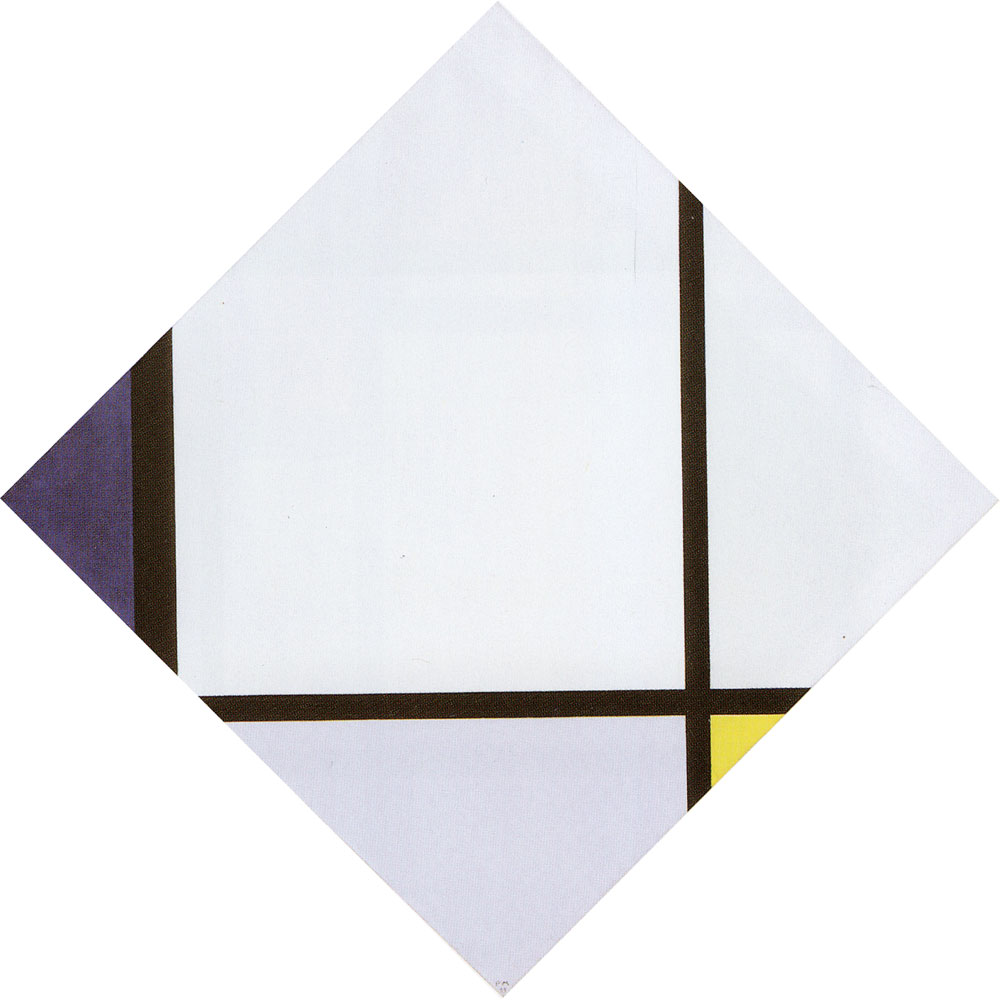
Piet Mondrian's *Tableau I: Lozenge with Four Lines and Gray*, painted in 1926 and now in the Museum of Modern Art (MoMA) in New York, is an oil painting on canvas, the canvas itself rotated into a rhombus shape and suspended. MoMA's catalogue clearly provides the title, year, and medium, while the Guggenheim's description of Mondrian's rhombus paintings indicates that he began rotating square canvases by 45 degrees as early as 1918, developing what is known as the "losangique" rhombus composition. This work is important to the "diagonal cut-in module" precisely because it doesn't add extra diagonal lines within the canvas, but rather tilts the entire coordinate system of the canvas, giving the originally vertical and horizontal structure a strong diagonal tension upon first viewing.
Formally, this work is almost simplified to its extreme: a white background with only four black lines and a gray area. Yet, it is precisely because of these few elements that Mondrian's treatment of "diagonal cuts" appears exceptionally clear. The real power here lies not in the number of lines, but in the relationship between the lines and the diamond-shaped border. Educational materials from the Centre Pompidou in France indicate that when Mondrian rotated the canvas, he seemed to be showing that diagonals can still be established by horizontal and vertical relationships, only they are placed at new angles. Furthermore, research on Mondrian's diamond compositions at the National Gallery further emphasizes that it was in these paintings that he first truly realized the "cutting power of the diagonal edges." In other words, the sense of diagonality does not come from diagonally drawn lines, but from the re-cutting of the orthogonal structure by the diagonally placed canvas boundaries.
This is precisely the core value of *Tableau I: Lozenge with Four Lines and Gray* within the "diagonal cut-in module." Mondrian did not deviate from his insistence on verticality and horizontality; instead, he empowered the external diagonal boundaries by maintaining the orthogonality of the internal structure. The black lines in the work still operate at right angles, but when placed within the rhomboid canvas, the viewer feels as if the entire image has been cut, lifted, or pushed by a diagonal force. Thus, the internal order of the image contrasts with the tilt of the external contours: the interior remains calm, while the exterior creates instability. This approach of "orthogonal structure + diagonal boundary" allows Mondrian to demonstrate that diagonal tension does not necessarily depend on actual diagonal lines, but can also be generated through a boundary system.
From a visual perspective, the most intriguing aspect of this work lies in its transformation of extreme restraint into immense tension. The four lines do not fill the canvas, leaving ample white space; the gray areas are not exaggerated, yet they create a subtle shift in the center of gravity against the white background. Thus, the viewer's eye moves back and forth between the black lines, while simultaneously being drawn towards the outer edges by the four corners of the rhombus. MoMA's information indicates that this is a rhombus painting from 1926; the Pompidou Centre's explanation helps us understand that when Mondrian rotated the canvas, he effectively turned the four corners of the painting into more sensitive points of pressure. In this way, the originally stable rectangular balance is rewritten: the visual perception no longer simply moves left and right, up and down, but naturally tends to slide and converge along the diagonal directions.
Therefore, this work is not simply "turning the canvas around," but rather redefining the way we view composition through this action. Traditional rectangular canvases often emphasize horizontal expansion and vertical stability, with the four sides resembling a quiet container; while Mondrian's rhomboid canvas seems to transform the container itself into an active structural force. Research from the National Gallery of Art mentions that diagonal edges have obvious "cutting qualities," that is, the function of cutting, severing, and cutting. In this work, it can be understood as: the black lines establish order internally, while the rhomboid edges implement cutting externally, thus creating a feeling of the overall composition being constantly compressed and tightened by the diagonal boundaries. The diagonal cutting module here is no longer just a visual rhetoric, but becomes the fundamental method of image generation.
From the perspective of Mondrian's development, this work is also crucial. Guggenheim points out that his use of rhomboid compositions since 1918 indicates that this was not an accidental attempt, but a systematic exploration that lasted for many years. Placing *Tableau I: Lozenge with Four Lines and Gray* within this sequence reveals that it is at a highly refined stage: lacking the complexity of earlier grids and the rhythmic segmentation of later New York periods, it compresses the question of "how diagonal boundaries activate orthogonal order" to an almost pure state. For this reason, this work is particularly suitable as a representative case of "diagonal entry modules"—it demonstrates that diagonal forces can be fully realized in minimal form.
The inspiration from this work remains very direct for contemporary creation. It reminds us that diagonal cutting doesn't necessarily require adding many diagonal lines, sharp angles, or jarring shapes inside; a more effective approach is often to alter the overall boundaries, center of gravity, and viewing coordinates, allowing the originally stable structure to regain tension through the tilt of the outer frame. This logic is perfectly suited for translation into architectural facades, exhibition layouts, graphic design, spatial wayfinding, and digital interfaces: as long as the boundary system is reset, even the simplest horizontal and vertical elements can become aggressive and directional. The classic status of *Tableau I: Lozenge with Four Lines and Gray* lies in its elevation of "diagonal cutting" from a graphic technique to a structural method, and its demonstration that truly sophisticated diagonal tension often comes from the most rigorous control.
Lessons F2-16: Analysis of Piet Mondrian's Works (Click to view and listen to the reading)
Piet Mondrian's *Tableau I: Lozenge with Four Lines and Gray*, painted in 1926 and now housed in the Museum of Modern Art (MoMA) in New York, is an oil painting on canvas, the canvas itself rotated into a rhombus shape and suspended. MoMA's catalogue clearly provides the title, year, and medium, while the Guggenheim's description of Mondrian's rhombus paintings indicates that he began rotating square canvases by 45 degrees as early as 1918, developing what is known as the "losangique" rhombus composition. This work is important for the "diagonal cut-in module" precisely because it doesn't add extra diagonal lines within the canvas, but rather tilts the entire coordinate system of the canvas, giving the originally vertical and horizontal structure a strong diagonal tension upon first viewing. Formally, the work is almost simplified to its extreme: on a white background, there are only four black lines and a gray area. But it is precisely because of these few elements that Mondrian's treatment of the "diagonal cut-in" is so clear. What truly creates power here is not the number of lines, but the relationship between the lines and the diamond-shaped border. Educational materials from the Centre Pompidou in France indicate that when Mondrian rotated the canvas, he seemed to be showing that diagonals can still be established by horizontal and vertical relationships, only they are placed at new angles. The National Gallery's research on Mondrian's diamond compositions further emphasizes that it was in these paintings that he first truly realized the "cutting power of the diagonal edges." That is to say, the sense of obliqueness does not come from diagonally drawn lines, but from the re-cutting of the orthogonal structure by the diagonally placed canvas boundaries. This is precisely the core value of *Tableau I: Lozenge with Four Lines and Gray* in the "diagonal cut-in module." Mondrian did not deviate from his insistence on verticality and horizontality; on the contrary, he made the external diagonal boundaries more powerful by maintaining the orthogonality of the internal structure. The black lines in the work still operate at right angles, but when placed within the diamond-shaped canvas, the viewer feels as if the entire picture has been cut, lifted, or pushed by a diagonal force. Thus, the internal order of the painting contrasts with the tilt of its outer contours: the interior remains calm, while the exterior creates instability. This "orthogonal structure + diagonal boundary" approach allows Mondrian to demonstrate that diagonal tension does not necessarily depend on actual diagonal lines, but can also be generated through a boundary system. From a visual experience perspective, the most intriguing aspect of this work lies in its transformation of extreme restraint into intense tension. The four lines do not fill the canvas, leaving ample white space; the gray areas are not exaggerated, yet they create a subtle shift in the center of gravity against the white background. Consequently, the viewer's gaze moves back and forth between the black lines, while simultaneously being constantly drawn towards the outer edges by the four corners of the rhombus. MoMA's information indicates that this is a rhombus painting from 1926; while the Pompidou Centre's explanation helps us understand that by rotating the canvas, Mondrian effectively turned the four corners of the painting into more sensitive points of stress. In this way, the originally stable rectangular balance is rewritten: the visual perception no longer simply moves left and right, up and down, but naturally tends to slide and converge along the diagonal direction. Therefore, this work is not simply "turning the canvas around," but rather redefining the way we view composition through this action. Traditional rectangular canvases often emphasize horizontal expansion and vertical stability, with the four sides resembling a quiet container; while Mondrian's rhomboid canvas transforms the container itself into an active structural force. Research from the National Gallery mentions that diagonal edges possess distinct "cutting qualities," meaning they act as entry points, cuts, and slicing. In this work, this can be understood as: the black lines establish order internally, while the rhomboid edges implement cutting externally, resulting in a feeling of the overall composition being constantly compressed and tightened by the diagonal boundaries. The diagonal cutting module here is no longer merely a visual rhetoric, but becomes the fundamental method of image generation. From the perspective of Mondrian's development, this work is also crucial. Guggenheim points out that he began using rhomboid compositions in 1918, indicating that this was not an accidental attempt, but a systematic exploration that continued for many years. Placing *Tableau I: Lozenge with Four Lines and Gray* within this series reveals a highly refined stage: devoid of the earlier grid complexity and the rhythmic segmentation of the later New York period, it compresses the question of "how diagonal boundaries activate orthogonal order" to its purest form. For this reason, this work is particularly suitable as a representative case of "diagonal entry modules"—it demonstrates that diagonal force can be achieved with minimal form. The inspiration from this work remains very direct for contemporary creation. It reminds us that diagonal entry doesn't necessarily require adding many diagonal lines, sharp angles, or jarring forms internally; a more effective approach is often to alter the overall boundaries, center of gravity, and viewing coordinates, allowing the originally stable structure to regain tension through the tilt of the outer frame. This logic is well-suited for translation into architectural facades, exhibition layouts, graphic design, spatial wayfinding, and digital interfaces: as long as the boundary system is reset, even the simplest horizontal and vertical elements can become aggressive and directional. The classic status of "Tableau I: Lozenge with Four Lines and Gray" lies in its elevation of "diagonal cutting" from a graphic technique to a structural method, and its demonstration that truly advanced diagonal tension often comes from the most rigorous control.
 简体中文
简体中文  English
  日本語
日本語  Español
  Français
  हिन्दी
  العربية
  বাংলা
বাংলা  Português do Brasil
  Русский
  اردو
اردو  Bahasa Indonesia
  Deutsch
  Kiswahili
  मराठी
मराठी  తెలుగు
  Tiếng Việt
  Türkçe
  Italiano
  தமிழ்
தமிழ்  한국어
한국어