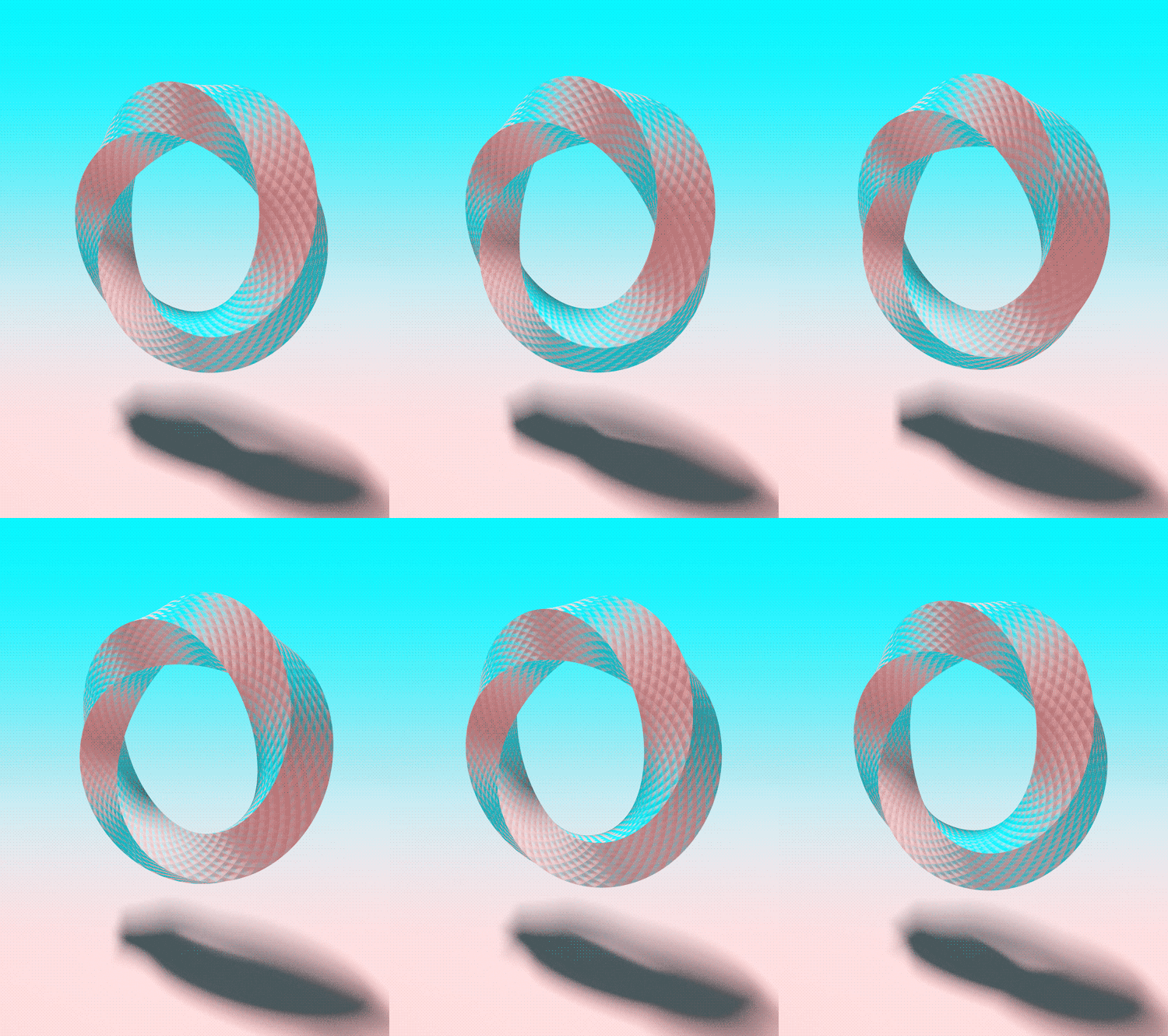
Triangle: François Morellet


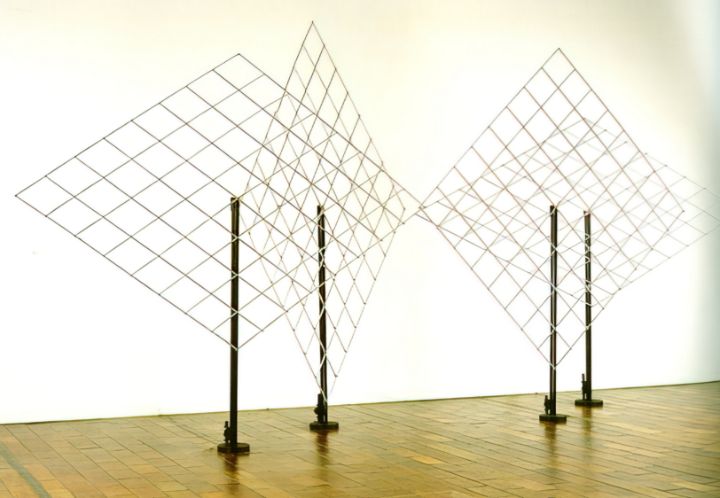
François Morellet(1926-2016) is one of the most rational and experimental artists in French geometric abstraction. With rules, systems, and mathematical logic at the core of his creation, he continuously dismantled the position of “artist's subjectivity” in art-making throughout his practice of over half a century. Triangles in his works are not symbolic shapes but key geometric units capable of triggering structural changes, directional shifts, and systemic imbalances. Through the introduction of triangles, Morellet pushed geometric abstraction from a static order towards an open system driven by rules yet continually generating unexpected outcomes.
Born in Cholet, France, Morelet did not receive systematic training in art academies during his youth; instead, he worked early on in commercial and technical environments. This non-academic background kept him at a distance from the Expressionist tradition in art history. In the early 1950s, he encountered the theories of Concrete Art, Constructivism, and Neo-Plasticism, and quickly realized that the true potential of geometric abstraction lay not in formal beauty, but inHow do rules themselves generate form?This realization became the starting point for his lifelong creative work.
In the late 1950s, Morele gradually abandoned any personal touch and intuitive composition, instead adopting strictly preset system rules for his creations. He used mathematical proportions, random numbers, repetitive algorithms, and simple geometric modules to allow his works to “generate themselves.” In this process, the triangle became an extremely important structural element. Compared to the stability of squares and the order of rectangles, the triangle, by its nature, carries directionality, inclination, and instability, capable of introducing tension and deviation into rule-based systems.
Morele's creative process typically begins with a simple rule, such as a fixed rotation of angles, equidistant shifts of lines, or the incremental arrangement of triangular units in a grid. Once the rule is established, the artist's role recedes, and the work is no longer “designed” but executed. This approach thoroughly undermines the author's aesthetic judgment, allowing the artwork to become the result of the interaction between rules, space, and materials. In this system, triangles serve as both the smallest structural units and catalysts for overall transformation.
In his early paintings and wall works, triangles often appeared as intersecting lines, forming a tilted grid system. These structures, while seemingly calm, created a strong sense of visual vibration, forcing viewers to realize that space is not a static plane but a dynamic relationship composed of direction, angle, and rhythm. In the 1960s, Morellet began to extensively use neon lights, stainless steel, and industrial materials, extending the triangular structure into real space, transforming geometric abstraction from canvases into environmental experiences.
In his representative works, many installations break the original orthogonal order of architecture through triangular or diagonal structures. Neon light triangles, often embedded in walls or ceilings at slight deviations from right angles, cause viewers to constantly perceive the imbalance and re-balance of space as they move. This approach is not decorative but a form of irony towards “rational order”: even the most rigorous systems reveal their instability through changes in angles.
In the history of geometric abstract art, Morerelle's unique contribution lies in advancing abstraction from “formal choice” to a “methodological level.” The triangle ceases to be a shape favored by the artist and instead becomes an indispensable variable within a system of rules. Through the tilting, rotating, and repetition of triangles, he demonstrated that geometric abstraction is not about pursuing eternal order, but rather about revealing how order can emerge, deviate, or even disintegrate within rules.
His artistic stance has a distinct anti-romantic flavor. He repeatedly emphasizes the importance of randomness and humor, believing that systems are not meant to establish authority but to expose its limitations. The triangle in his works often plays a role in “disrupting stability,” making the audience aware that any seemingly absolute geometric order actually relies on artificially established rules and premises.
From a historical perspective, Morellet is one of the key figures who successfully introduced geometric abstraction into the context of contemporary art. His practice forms a clear conceptual continuum with Systemic Art, Conceptual Art, Minimalism, and later Generative Art. Especially today, when algorithms and rule-based generation have become important methods of artistic creation, Morellet's systematic experiments using triangles appear exceptionally forward-looking.
Within the overall lineage of geometric abstract art, François Morellet is not a “purist” pursuing the ultimate form, but an experimenter constantly testing the boundaries of geometric rules. He allows triangles to emerge from stable compositions as a form of critical inquiry: when rationality is thoroughly implemented, how will art confront imbalance, deviation, and unpredictability? It is precisely in this sense that his contribution belongs not only to the history of geometric abstraction but also to the ongoing reflection in contemporary art on the relationship between rules, systems, and freedom.
 简体中文
简体中文  English
  日本語
日本語  Español
  Français
  हिन्दी
  العربية
  বাংলা
বাংলা  Português do Brasil
  Русский
  اردو
اردو  Bahasa Indonesia
  Deutsch
  Kiswahili
  मराठी
मराठी  తెలుగు
  Tiếng Việt
  Türkçe
  Italiano
  தமிழ்
தமிழ்  한국어
한국어