
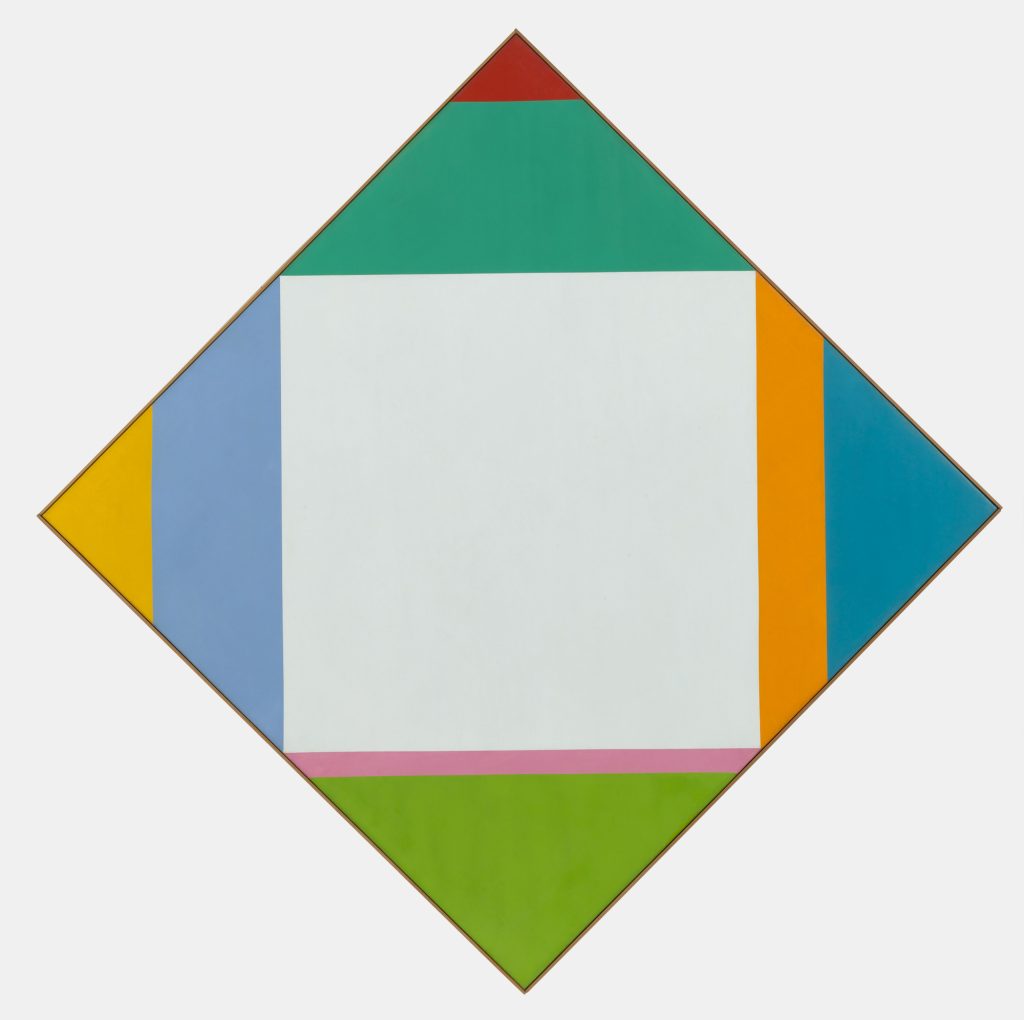
Max Bill was one of the most important proponents of Concrete Art. He was a painter, sculptor, architect, and design educator. TheArtStory and the European Patent Office's art collection page both emphasize that he consistently adhered to an abstract approach centered on geometry, proportion, mathematical relationships, and rational order, understanding art as a precise construction of formal relationships. If we were to discuss him within the "block-based modularity" framework, one of the most suitable representative works would be *Expansion in Four Directions* (1961–62), now in the collection of the Museum of Modern Art, New York. Painted with synthetic polymer pigments on canvas, it measures approximately 186.7 × 186.7 cm.
If we understand this work within the context of "block mosaic modules," its key lies not in the number of blocks drawn, but in how these blocks, through boundaries, corners, advancements, and interlocking, form a complete structural system. Max Bill's abstraction is never decorative collage, but rather a highly rational formal organization. TheArtStory's summary is accurate: his advocacy of concrete art emphasizes establishing a non-representational visual order using "precisely defined shapes and lines"; and the EPO page also points out that he always believed that harmony in art depends not only on color, but also on the "perfect geometric and mathematical interplay" between form and color. Therefore, in Max Bill's work, block mosaic is not about randomly juxtaposing fragments, but rather, like mathematical deduction, ensuring that each part occupies a necessary place within the whole.
The title "Expansion in Four Directions" itself points to the structural logic: expansion is not a single-direction advancement, but rather a simultaneous unfolding in four directions. In other words, the image is not composed of a central image and background, but rather resembles a series of geometric blocks continuously extending outwards around a central relationship. This "block-to-block assembly" thus possesses a clear growth characteristic: each block is like an extension unit derived from the previous one, with edges and corners constantly connecting to form a four-directionally expanding whole. MoMA's inclusion of it in the Painting and Sculpture department, rather than the Design or Pattern category, is also telling: although this work is built upon clear geometric modules, it is not a flat decoration, but an abstract painting that actively generates a sense of space and objectivity through the relationships between the modules.
From the perspective of "block splicing modules," Max Bill's brilliance lies in treating splicing as a continuous order, rather than a fragmented assembly. Many block splicing works emphasize difference, clash, and breakage, but Bill values progression within unity. He doesn't pursue intense visual conflict, but rather allows the blocks to harmonize with each other in terms of proportion, direction, and boundary relationships. TheArtStory, citing his artistic philosophy, mentions that he defines art as "significant patterns"—that is, a meaningful order established by the constantly changing relationships, rhythms, and proportions between abstract forms. This statement can almost directly explain block splicing modules: the blocks themselves are not important; what truly matters is how the blocks create rhythm and how they maintain wholeness after being spliced together.
This is precisely why Max Bill's paneling often possesses a quality that lies between painting and architecture. The EPO page, in introducing him, emphasizes that Bill was deeply influenced by the Bauhaus and consistently pursued the goal of "developing objects for both spiritual and material purposes"; his art is not arbitrary lyricism, but rather connects environment, structure, proportion, and human perception. Looking at *Expansion in Four Directions*, one can understand why such works are particularly suitable for translation into architectural skins, floor assemblies, modular wall systems, and exhibition structures: it offers not an accidental pattern, but a reproducible, scalable, and precisely constructible logic of paneling. The relationships between panels precede the image, the system precedes the part—this is precisely what distinguishes Max Bill from many artists who merely remain at the level of planar composition.
From today's perspective, Max Bill's value in the "block splicing module" lies in his elevation of splicing from a visual surface to a structural principle. Splicing no longer signifies fragmentation, but order; no longer local accumulation, but holistic deduction; no longer merely a two-dimensional pattern, but something that can be integrated into architecture, design, and spatial organization. *Expansion in Four Directions* is suitable as a representative case study because it condenses the issues of "block—boundary—expansion—whole" with remarkable clarity. It reminds us that truly advanced block splicing is not about increasing the number of blocks, but about each block functioning like a word in structural language, working together with other blocks to form a rigorous, clear, and sustainably growing overall system.

Lessons F2-24: Analysis of Max Bill's Works (Click to view and listen to the reading)
Max Bill was one of the most important proponents of Concrete Art. He was a painter, sculptor, architect, and design educator. TheArtStory and the European Patent Office's art collection page both emphasize his long-standing adherence to an abstract approach centered on geometry, proportion, mathematical relationships, and rational order, understanding art as a precise construction of formal relationships. One of the most representative works in the context of "block-based collage" is *Expansion in Four Directions* (1961–62), now in the Museum of Modern Art, New York. Painted with synthetic polymer pigments on canvas, it measures approximately 186.7 × 186.7 cm. Understanding this work within the "block-based collage" framework reveals that its key lies not in the number of blocks painted, but in how these blocks, through boundaries, corners, advancements, and interlocking, form a complete structural system. Max Bill's abstraction was never decorative collage, but rather a highly rational formal organization. TheArtStory's summary of him is accurate: his advocacy of Concrete Art emphasizes establishing a non-representational visual order using "precisely defined shapes and lines"; and the EPO page also points out that he always believed that harmony in art depends not only on color, but also on the "perfect geometric and mathematical interplay" between form and color. Therefore, in Max Bill's works, the patchwork is not about randomly juxtaposing fragments, but rather, like mathematical deduction, allowing each part to occupy a necessary position in the whole. The title "Expansion in Four Directions" itself points out the structural logic: expansion is not a single-direction advancement, but a simultaneous unfolding in four directions. That is to say, the image is not composed of a central image plus a background, but rather like several geometric blocks continuously extending outward around a central relationship. The "patchwork" here therefore has a clear growth nature: each block is like an extension unit derived from the previous block, with edges and corners continuously connecting, ultimately forming a four-way expanding whole. MoMA's inclusion of it in the Painting and Sculpture section, rather than the Design or Pattern category, is quite telling: while the work is built upon clear geometric modules, it is not a flat decoration, but an abstract painting that actively generates a sense of space and objectivity through the relationships between the modules. From the perspective of "block-based modularity," Max Bill's brilliance lies in treating the assembly as a continuous order, rather than a fragmented patchwork. Many block-based works emphasize difference, clash, and rupture, but Bill values progression within unity. He does not pursue intense visual conflict, but rather allows the blocks to harmonize with each other in terms of proportion, direction, and boundary relationships. TheArtStory, citing his artistic views, mentions that he defines art as "significant patterns"—that is, a meaningful order established by the constantly changing relationships, rhythms, and proportions between abstract forms. This statement can almost directly explain block-based modularity: the blocks themselves are not important; what truly matters is how the blocks form a rhythm and how they maintain wholeness after being assembled. It is precisely for this reason that Max Bill's block-based assemblies often possess a quality that lies between painting and architecture. The EPO page, in introducing him, specifically emphasizes that Bill was deeply influenced by the Bauhaus and consistently pursued the goal of "developing objects for spiritual and material purposes." His art is not arbitrary lyricism, but rather connects environment, structure, proportion, and human perception. Looking at *Expansion in Four Directions*, one can understand why such works are particularly suitable for translation into architectural skins, floor assemblies, modular wall systems, and exhibition structures: it offers not accidental patterns, but a reproducible, scalable, and precisely constructible logic of assembly. The relationship between blocks precedes the image, the system precedes the part—this is precisely what distinguishes Max Bill from many artists who remain only at the level of planar composition. From today's perspective, Max Bill's value in "block assembly modules" lies in his elevation of assembly from a visual surface to a structural principle. Assembly no longer means fragmentation, but order; no longer means local accumulation, but overall deduction; no longer just two-dimensional patterns, but can enter into architecture, design, and spatial organization. The reason why "Expansion in Four Directions" is suitable as his representative analytical case is precisely because it compresses the issues of "block-boundary-expansion-whole" very clearly. It reminds us that truly advanced block assembly does not lie in increasing the number of blocks, but in the fact that each block can, like a word in a structural language, work together with other blocks to form a rigorous, clear, and sustainably growing overall system.
 简体中文
简体中文  English
  日本語
日本語  Español
  Français
  हिन्दी
  العربية
  বাংলা
বাংলা  Português do Brasil
  Русский
  اردو
اردو  Bahasa Indonesia
  Deutsch
  Kiswahili
  मराठी
मराठी  తెలుగు
  Tiếng Việt
  Türkçe
  Italiano
  தமிழ்
தமிழ்  한국어
한국어