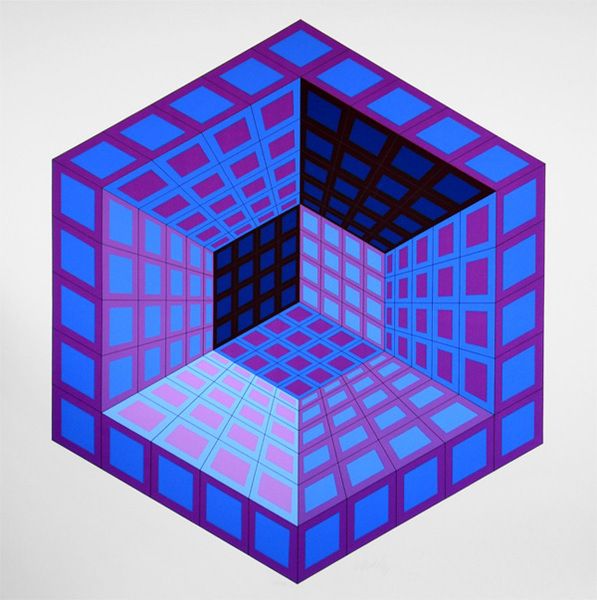
Victor Vasarely is a pivotal artist in the "spatial compositional module" movement. While he is most often categorized within the historical context of Op Art and geometric abstraction, his importance, analyzed from a formal structural perspective, lies not only in creating visually deceptive games but also in his transformation of planar geometric order into a tangible spatial composition. The Britannica, Tate, and Vasarely Foundations all acknowledge him as a Hungarian-French artist and one of the most important founders of Op Art; his art, starting from planar graphics, continuously develops a sense of volume, expansion, concavity, and a cosmic spatial illusion.
Vasarely's spatial composition does not rely on perspective, chiaroscuro, or the depiction of real objects in traditional realistic painting, but is built upon the systematic deformation of geometric units. Squares, circles, rhombuses, ellipses, wavebands, and repeating modules are not statically arranged in his paintings, but are organized into visual fields that bulge forward, sink backward, expand left and right, or vibrate continuously through variations in density, direction, scale, and color difference. Therefore, his "space" is not a representation of natural space, but a structural space actively generated by geometric relationships. Op Art emphasizes strong contrast between foreground and background and "virtual movement" within static images; Vasarely takes this to an extremely high level.
If the core task of spatial composition artists is to transform geometry from planar order into a structural system with depth and direction, then Vasarely's most typical contribution is that he accomplished this transformation in his "Vega" series. Guggenheim and related research have pointed out that this series, through spherical distortion of the grid, makes the surface of the canvas appear as if it is being lifted by internal forces or sucked into the depths by unknown gravity. In other words, although the canvas remains flat, the viewer strongly feels that a three-dimensional block is forming. This sense of bulging, collapse, and floating generated by grid deformation is one of the most typical advanced forms of spatial composition geometric abstraction.
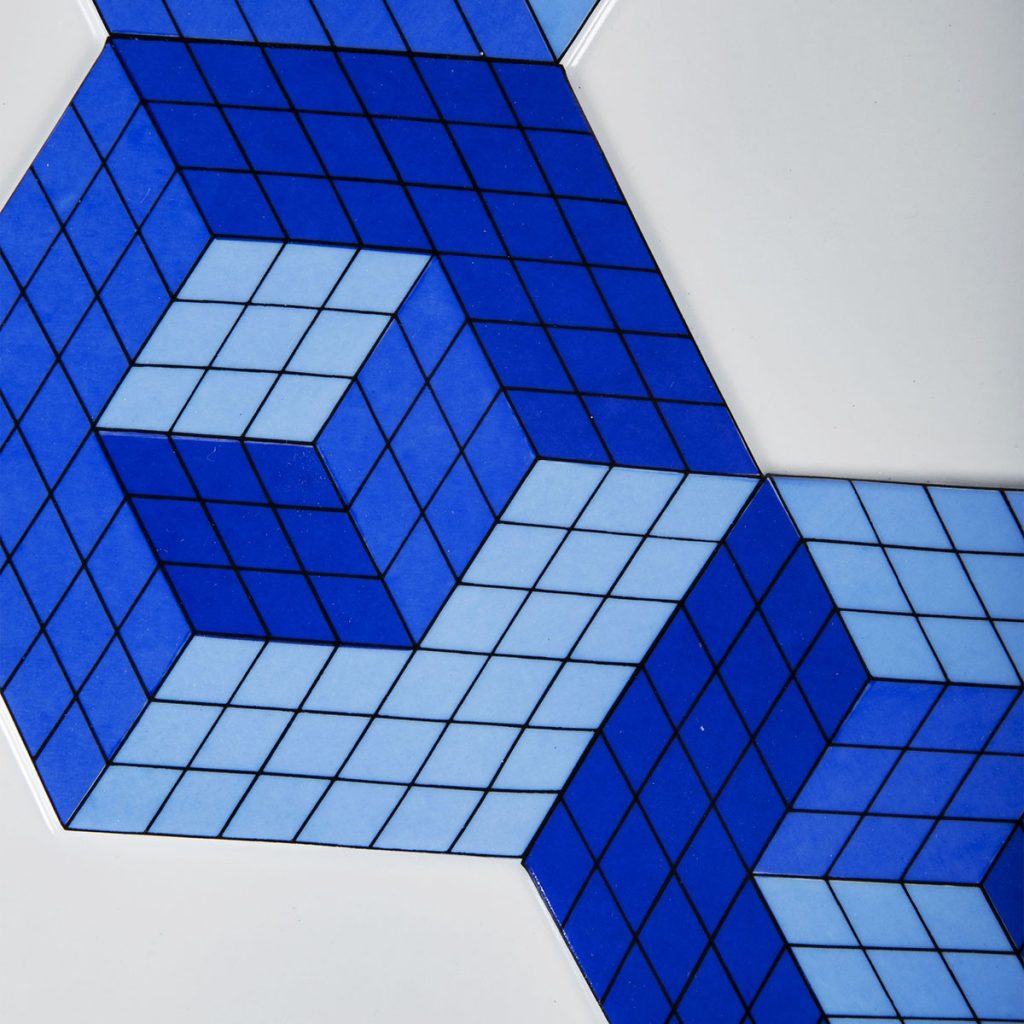
Another significant contribution of Vasarely is his systematization of spatial composition methods. He proposed the "plastic alphabet," a "formal alphabet" composed of basic geometric shapes and color units. According to the foundation's documentation, this system combines, transforms, and encodes different geometric shapes and colors, thereby generating an illusion and structure of infinite variation; this makes his work not merely individual compositions, but rather a continuously evolving spatial language system. This is particularly important for "spatial compositional modules," as it implies that space is not a random effect, but a result that can be designed, arranged, and programmatically generated.
Visually, Vasarely's works often possess both a sense of order and instability. The order stems from grids, repetition, and strict modular relationships; the instability arises from the spatial oscillations created by stretching, compressing, bending, and misaligning these modules. Viewers perceive the images as expanding, rotating, undulating, or even moving as if a building surface, a cosmic field, or a mechanical interface is in motion. Therefore, his spatial composition is not equivalent to architectural perspective, nor is it a block-based, three-dimensional composition; rather, it is an "optical spatial composition"—space is not built by piling up objects, but rather activated by the relationships between geometric units.
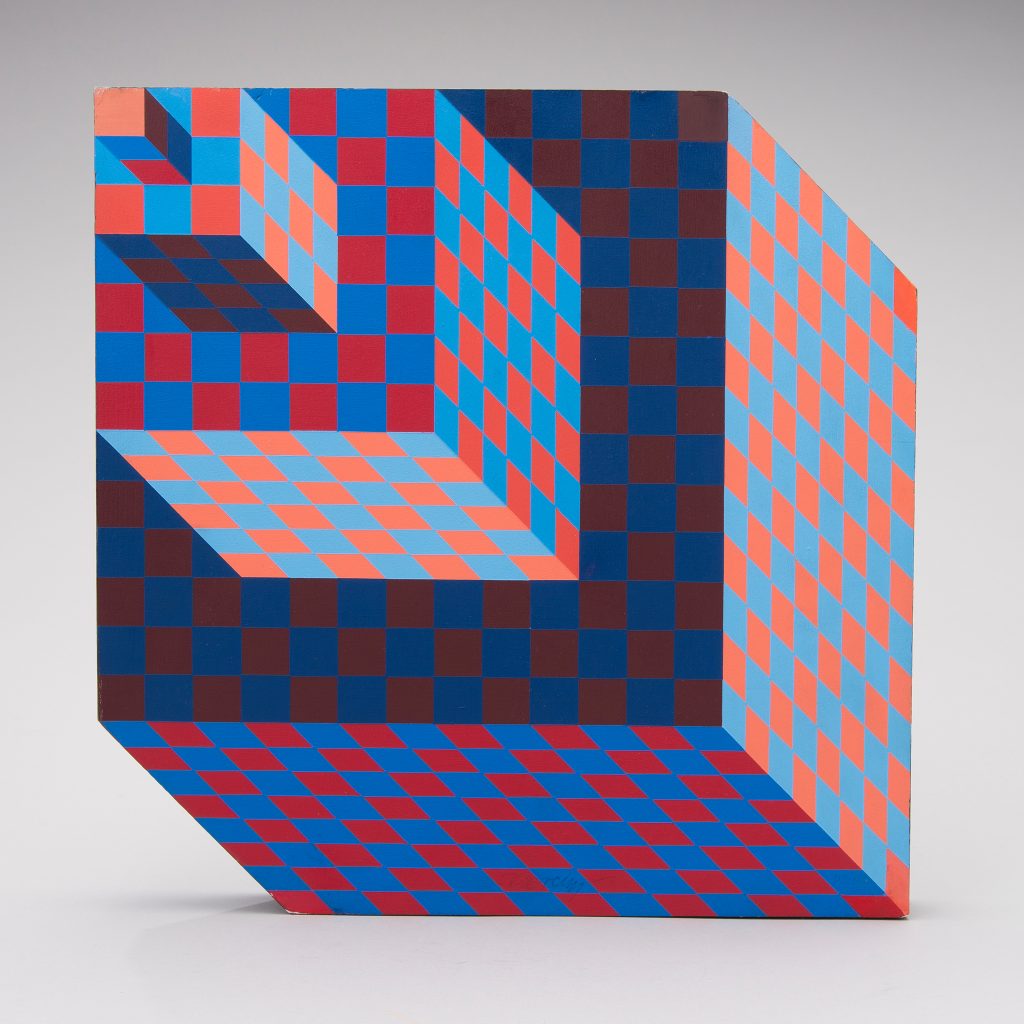
Therefore, when analyzing Victor Vasarely in the context of "spatial compositional modules," the key is not merely to view him as an Op artist, but rather to see how he advanced geometric abstraction into a spatial art form with the ability to create illusions of depth, suggest volumes, and generate systems. He proved that space does not necessarily originate from real three-dimensional objects, but can also arise from the precise organization of planar geometry; a canvas, through grid deformation, color arrangement, and modular repetition, can produce a near-architectural, cosmic spatial experience. It is in this sense that Vasarely is not only a master of "visual illusions," but also a representative artist in geometric abstraction who transforms the plane into spatial structures.
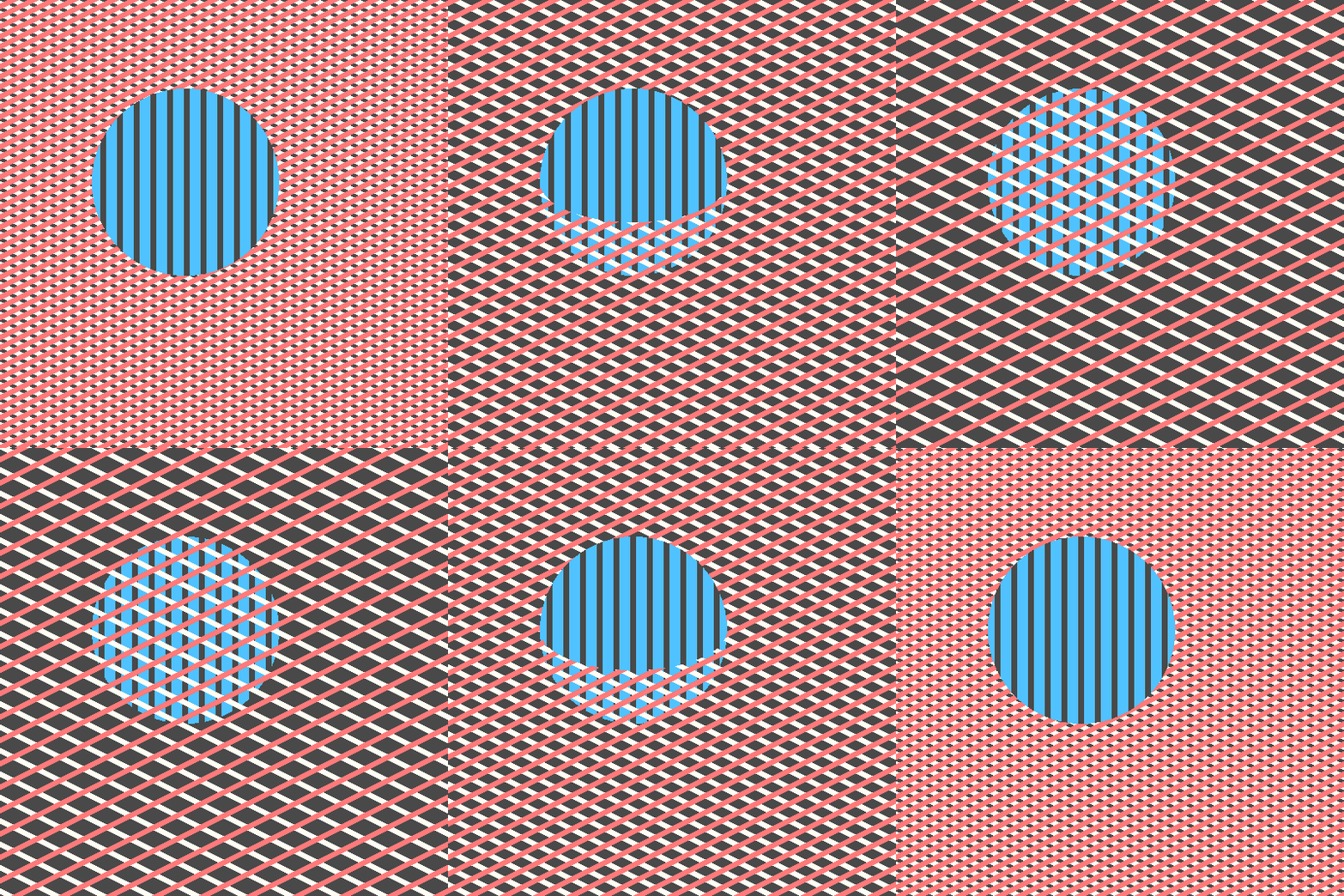
Lessons F2-12: Analysis of Victor Vasarely's Works (Click to view and listen to the reading)
Victor Vasarely is a pivotal artist in the "spatial compositional module" movement. While he is most often categorized within the historical context of Op Art and geometric abstraction, his importance, analyzed from a formal structural perspective, lies not only in creating visually deceptive games but also in his transformation of planar geometric order into a tangible spatial composition. Britannica, Tate, and the Vasarely Foundation all acknowledge him as a Hungarian-French artist and one of the most important founders of Op Art; his art, starting from planar graphics, continuously develops a sense of volume, expansion, concavity, and a cosmic spatial illusion. Vasarely's spatial composition does not rely on perspective, chiaroscuro, or realistic depiction of objects in traditional realistic painting but is built upon a systematic deformation of geometric units. Squares, circles, rhombuses, ellipses, wavebands, and repeating modules are not statically arranged in his paintings but are organized through variations in density, direction, scale, and color difference into visual fields that bulge forward, sink backward, expand laterally, or vibrate continuously. Therefore, his "space" is not a reproduced natural space, but a structural space actively generated by geometric relationships. Op Art emphasizes strong contrast between foreground and background and "virtual movement" in a static image, and Vasarely takes this to an extremely high level. If the core task of spatial composition artists is to transform geometry from planar order into a structural system with depth and direction, then Vasarely's most typical contribution is that he accomplished this transformation in his "Vega" series. Guggenheim and related research have pointed out that this series, through spherical distortion of the grid, makes the surface of the image appear as if it is being lifted by internal forces or sucked into the depths by unknown gravity. That is to say, although the canvas is still flat, the viewer will strongly feel that a three-dimensional block is forming. This sense of bulging, collapse, and floating generated by grid deformation is one of the most typical advanced forms of spatial composition geometric abstraction. Another important value of Vasarely is that he systematized the method of spatial composition. He proposed the "plastic alphabet," which is a "formal alphabet" composed of basic geometric shapes and color units. According to the foundation's information, this system combines, transforms, and encodes different geometric shapes and colors to create an illusion and structure of infinite variation; this makes his work not just individual compositions, but a spatial language system that can be continuously deduced. This is particularly important for "spatial compositional modules" because it means that space is not an accidental effect, but a result that can be designed, arranged, and programmatically generated. Visually, Vasarely's work often possesses both a sense of order and instability. The order comes from grids, repetition, and strict modular relationships; the instability comes from the spatial oscillations created by stretching, compressing, bending, and misplacing these modules. Viewers feel that the image is expanding, rotating, undulating, or even moving like some kind of architectural surface, cosmic field, or mechanical interface. Because of this, his spatial composition is not equivalent to architectural perspective, nor is it the same as block-interlaced three-dimensional composition, but rather an "optical spatial composition"—space is not built by piling up objects, but activated by the relationships between geometric units. Therefore, when analyzing Victor Vasarely in the context of "spatial compositional modules," the key is not merely to view him as an Op artist, but rather to see how he advanced geometric abstraction into a spatial art form with the ability to create illusions of depth, suggest volumes, and generate systems. He proved that space does not necessarily originate from real three-dimensional objects, but can also arise from the precise organization of planar geometry; a canvas, through grid deformation, color arrangement, and modular repetition, can produce a near-architectural, cosmic spatial experience. It is in this sense that Vasarely is not only a master of "visual illusions," but also a representative artist in geometric abstraction who transforms the plane into spatial structures.
 简体中文
简体中文  English
  日本語
日本語  Español
  Français
  हिन्दी
  العربية
  বাংলা
বাংলা  Português do Brasil
  Русский
  اردو
اردو  Bahasa Indonesia
  Deutsch
  Kiswahili
  मराठी
मराठी  తెలుగు
  Tiếng Việt
  Türkçe
  Italiano
  தமிழ்
தமிழ்  한국어
한국어