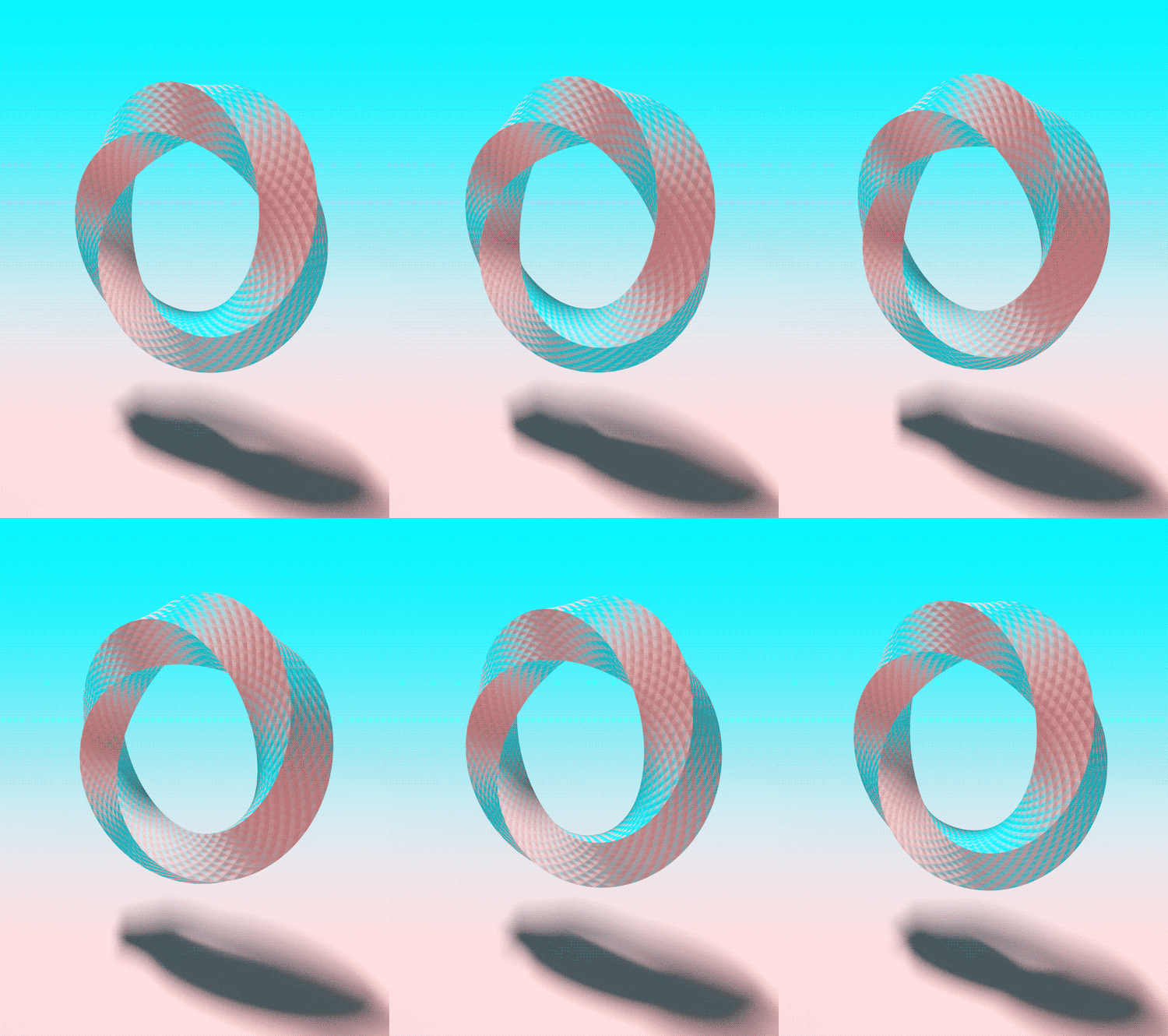
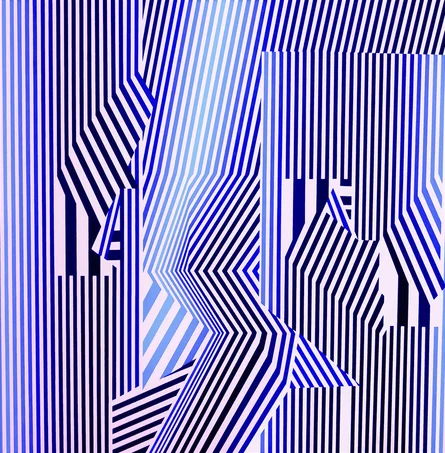
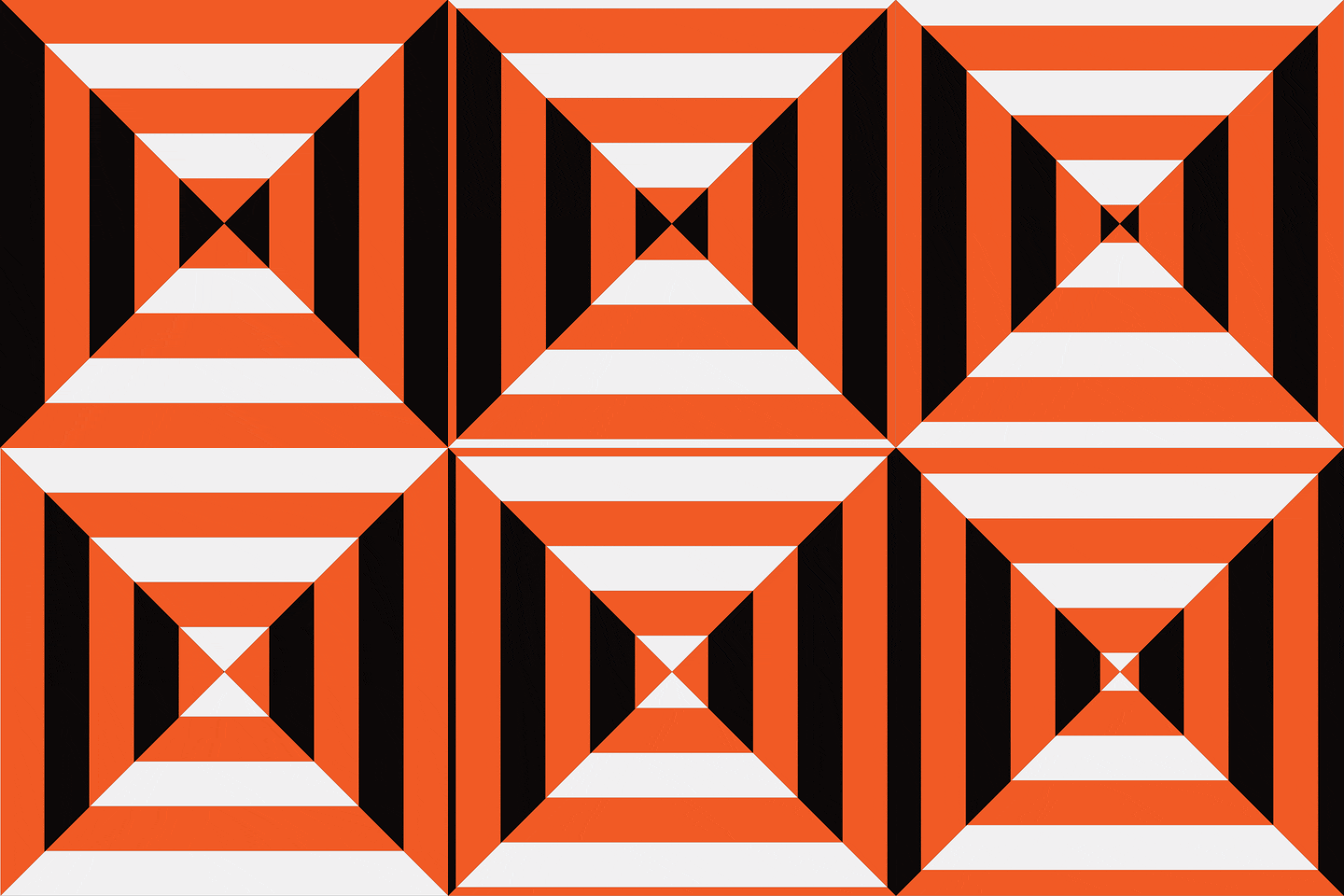
Cristina Ghetti fits perfectly into the "striped segmentation" category. Born in Argentina and now residing in Valencia, Spain, she has long centered her work on geometric abstraction, practicing across painting, installation, and new media, and further extending her research into "post-media geometry." Her work is not merely decorative stripes in the conventional sense, but rather transforms lines, bands, ripples, repetitive sequences, and visual rhythms into a structural language of perception.
If the core of "strip-based segmentation" is to divide the image, organize order, and create visual movement through continuous, parallel, twisting, or undulating strips, then Ghetti's work provides a very typical example. She herself has explicitly stated that her creation is built upon a re-contextualization of fundamental geometric abstract concepts, actively absorbing the languages of Concrete Art, Constructivism, Kinetic Art, and Op Art; she is particularly concerned with "the boundary between perception and reality," and uses digital tools to generate works in different formats, creating new connections between geometry, color, movement, and sound. In other words, her strip-like structures are not intended to arrange the image neatly, but rather to induce a sense of movement, shift, and uncertainty in the viewing experience itself.
Looking at her series of works, the recurring titles such as *Mareas*, *Double Wave*, *Gradient*, and *Colour Thinking* already hint at her formal direction: not a composition of closed cubes, nor a simple grid division, but a visual organization closer to "ribbon flow," "waveform progression," and "gradual transitions." She also held a solo exhibition in 2016 titled "stripe-generators," indicating that "stripes" are not merely accidental localized patterns, but rather one of her core vocabulary elements cultivated over a long period. For her, stripes act as a generator: they can both divide space and generate rhythm; they can both stabilize the image and make it constantly vibrate.
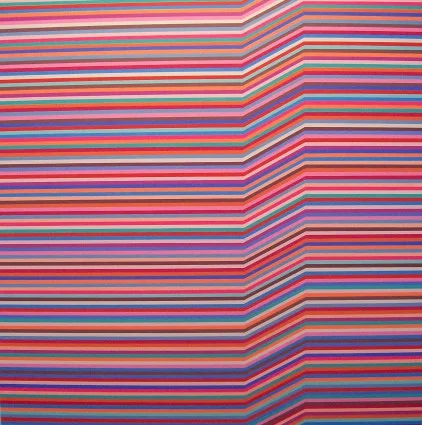
Ghetti's significance lies in her transformation of "striped division" from a static composition into a perceptual mechanism. Spanish media, commenting on her 2019 exhibition, pointed out that she creates optical illusions of space and depth through distorted lines and colors. The viewer's gaze and movement alter their understanding of the work, as different movements activate different shapes, patterns, and repetitive relationships. This is crucial: in her work, stripes are not background filler, but rather structures that "activate" with viewing. The viewer is not passively receiving an image in front of the painting, but rather constantly experiencing forward movement, backward movement, rotation, flickering, and drifting within the frequency, density, direction, and repetition of the stripes.
Therefore, from a formal analysis perspective, Christina Getty's "strip division" has at least three layers of value. First, it is a way of establishing order. The stripes divide the image into controllable, repeatable, and extensible units, giving geometric abstraction a clear framework. Second, it is a way of generating motion. Due to the variations in spacing, thickness, curvature, and color gradation between the stripes, a static image is perceived as a flowing field. Third, it is a way of creating space. She frequently uses wavy stripes, curved boundaries, and gradient colors to make the two-dimensional plane appear undulating, undulating, and deep, as if a constantly rotating space is hidden within the plane. These are the most typical advanced forms of the "strip division" style.
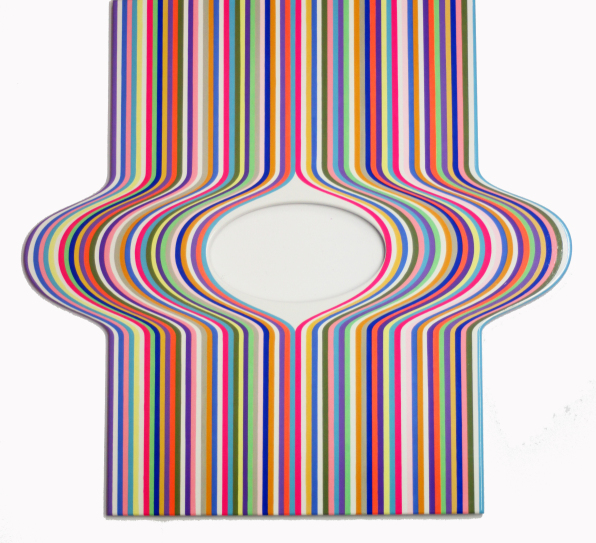
Compared to many geometric artists who emphasize cool rationality, Ghetti's striped language has a distinct characteristic: it is not rigid. Her stripes often possess a sense of undulation, breath, and rhythm, like sound waves, water ripples, electricity, or digital signals. Therefore, although her work is built upon the tradition of geometric abstraction, it is not merely a repetition of modernist rules. She is more like reintroducing 20th-century Op Art and Kinetic Art into a contemporary context, using digital generation, pictorial translation, and cross-media methods to make stripes a visual system that is both rational and emotional. Her research background and creative statements demonstrate that she is not merely at the level of style, but actively pushing geometric abstraction towards new media and new perceptual experiences.
Therefore, placing Christina Getty within the "striped division module" is highly accurate. Her representativeness lies not only in her use of stripes, but also in her demonstration that stripes can be a method of dividing an image, as well as a method of creating a sense of time, movement, depth, and viewer engagement. In her work, striped division is no longer merely a formal technique, but a core structure connecting geometric abstraction, optical experience, and contemporary perceptual issues. This is precisely her true value in this module.
Lessons F2-5: Analysis of Cristina Ghetti's Works (Click to listen to the reading)
Cristina Ghetti perfectly fits the "striped segmentation" category. Born in Argentina and now residing in Valencia, Spain, she has long centered her work on geometric abstraction, practicing across painting, installation, and new media, and further extending her research into "post-media geometry." Her work is not merely decorative stripes in the conventional sense, but rather transforms lines, bands, ripples, repetitive sequences, and visual rhythms into a structural language of perception. If the core of "striped segmentation" is to divide the image, organize order, and create visual movement through continuous, parallel, twisting, or undulating strips, then Ghetti's work provides a very typical example. She herself has explicitly stated that her work is built upon a recontextualization of the fundamental concepts of geometric abstraction, actively absorbing the languages of Concrete Art, Constructivism, Kinetic Art, and Op Art; she is particularly concerned with "the boundary between perception and reality," using digital tools to generate works in different formats, creating new connections between geometry, color, movement, and sound. In other words, her striped structures are not intended to arrange the image neatly, but to make the viewing itself sway, shift, and become uncertain. Looking at her series of works, the recurring titles such as *Mareas*, *Double Wave*, *Gradient*, and *Colour Thinking* already hint at her formal direction: not closed cubes, nor simple grid divisions, but a visual organization closer to "ribbon flow," "waveform progression," and "gradual transitions." She also held a solo exhibition in 2016 titled "stripe-generators," indicating that "stripes" are not merely accidental localized patterns, but one of her core vocabulary elements cultivated over a long period. For her, stripes act as a generator: they can both divide space and generate rhythm; they can both stabilize the image and make it constantly vibrate. Ghetti's importance lies in her transformation of "striped division" from static composition into a perceptual mechanism. Spanish media, commenting on her 2019 exhibition, pointed out that she creates optical illusions of space and depth through distorted lines and colors; the viewer's gaze and movement alter the understanding of the work, as different movements activate different shapes, patterns, and repetitive relationships. This is crucial: in her work, stripes are not background filler, but rather structures that "activate" as the viewer observes. The viewer doesn't passively receive an image in front of the painting, but rather experiences a continuous flow of movement—forward, backward, rotation, flickering, and drifting—through the frequency, density, direction, and repetition of the stripes. Therefore, from a formal analysis perspective, Christina Getty's "striped division" has at least three layers of value. First, it's a way of establishing order. The stripes divide the image into controllable, repeatable, and extensible units, giving geometric abstraction a clear framework. Second, it's a way of generating movement. Due to the variations in spacing, thickness, curvature, and color gradation between the stripes, a static image is perceived as a flowing field. Third, it's a way of creating space. She frequently uses wavy stripes, curved boundaries, and gradient colors to make the two-dimensional plane appear undulating, rolling, and deep, as if a constantly rotating space is hidden within the plane. These are the most typical advanced forms of the "striped division" style. Compared to many geometric artists who emphasize cool rationality, Ghetti's striped language has a distinct characteristic: it is not rigid. Her stripes often possess a sense of undulation, breath, and rhythm, like sound waves, water ripples, electricity, or digital signals. Therefore, although her work is built upon the tradition of geometric abstraction, it is not merely a repetition of modernist rules. She is more like reintroducing 20th-century Op Art and Kinetic Art into a contemporary context, using digital generation, pictorial translation, and cross-media methods to make stripes a visual system that is both rational and emotional. Her research background and creative statements demonstrate that she is not merely at the level of style, but actively pushing geometric abstraction towards new media and new perceptual experiences. Therefore, placing Christina Getty within the "striped segmentation module" is very accurate. Her representativeness lies not only in her use of stripes, but also in her demonstration that stripes can be a method of dividing the image, as well as a method of creating a sense of time, movement, depth, and viewer participation. In her work, striped segmentation is no longer just a formal technique, but a core structure connecting geometric abstraction, optical experience, and contemporary perceptual issues. This is precisely her true value in this module.
 简体中文
简体中文  English
  日本語
日本語  Español
  Français
  हिन्दी
  العربية
  বাংলা
বাংলা  Português do Brasil
  Русский
  اردو
اردو  Bahasa Indonesia
  Deutsch
  Kiswahili
  मराठी
मराठी  తెలుగు
  Tiếng Việt
  Türkçe
  Italiano
  தமிழ்
தமிழ்  한국어
한국어