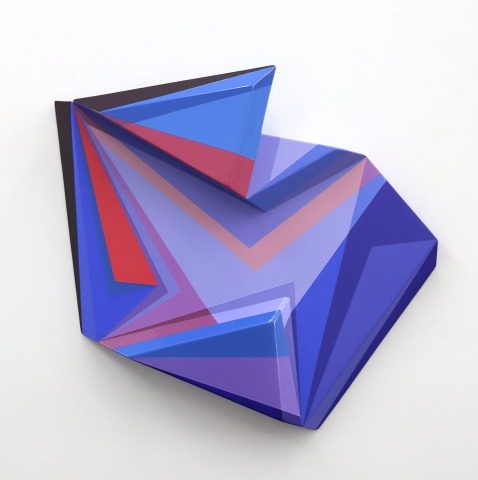
Rachel Hellmann is a representative artist of contemporary geometric abstraction, perfectly suited to being placed in "diagonally embedded modules." Her work spans painting, sculpture, and installation, and has long developed a distinct path: instead of simply laying geometric shapes flat on the canvas, she transforms folded, bent, tilted, and cut-in geometric structures into a kind of "form painting" that is both real and possesses optical illusions. She is particularly known for her wooden shaped paintings, which are both paintings and objects with thickness; they have clear boundaries, yet constantly create spatial ambiguity for the viewer.
If we understand Rachel Hellmann through the lens of "diagonal embedding," her key lies not in simply using diagonal lines, but in transforming the "diagonal direction" into a structural event. Traditional geometric composition often relies on vertical and horizontal lines to establish stable order, while Hellmann frequently inserts folded surfaces, beveled edges, sharp corners, and beam-like units from the side, creating a sense of deflection, cantilevering, overturning, inward folding, and traversal in the image. For her, diagonals are not auxiliary lines, but rather the main axis that alters the center of gravity and spatial judgment. Because of this, her works often evoke a viewing experience of "disrupted gravity": the viewer feels one surface pressing forward while another seems to recede backward, thus activating the plane into an unstable yet highly precise spatial system. Galleri Urbane's summary of her work emphasizes this "distorted sense of gravity" and perceptual dislocation created by geometry, light, and color.
Hellmann's work is well-suited to this module because she treats "embedding" with remarkable concreteness. Many of her forms are not completely closed geometric blocks, but rather parts cut out, folded, pushed in, or inserted from a larger structure. In this way, geometry is no longer a static pattern, but a deformed extension of architectural components, kite frames, origami layers, or ceiling beams. Elizabeth Houston Gallery, in introducing her exhibition *Boats on the Ceiling*, notes that she transforms architectural experience into a geometric system with a magical and heterogeneous feel, establishing complex visual-spatial relationships through the simplest shaping methods: folding, bending, and crease. This is crucial because the essence of "diagonal embedding" is not merely repetition of rules, but rather breaking the balance with oblique intervention and then rebuilding a new order.
In terms of material language, Rachel Hellmann is also distinctly different from artists who only deal with diagonal relationships on two-dimensional canvases. She often uses wood panels, especially poplar wood, as a base, and then uses cutting, splicing, sanding, and painting to truly create the folds. The Zillman Art Museum's description points out that her forms undergo processes such as planing, cutting, assembling, gluing, clamping, and sanding, before being combined with color ribbons and linear organization to complete the picture. This means that her "diagonals" are not merely painted illusions, but often have real thickness and edges. Thus, the diagonal embedding in her works has two layers of meaning: one is that the structure realistically extends into space; the other is that the painting further amplifies this sense of extension, causing the viewer to constantly swing back and forth between "the object is real" and "the space is an illusion."
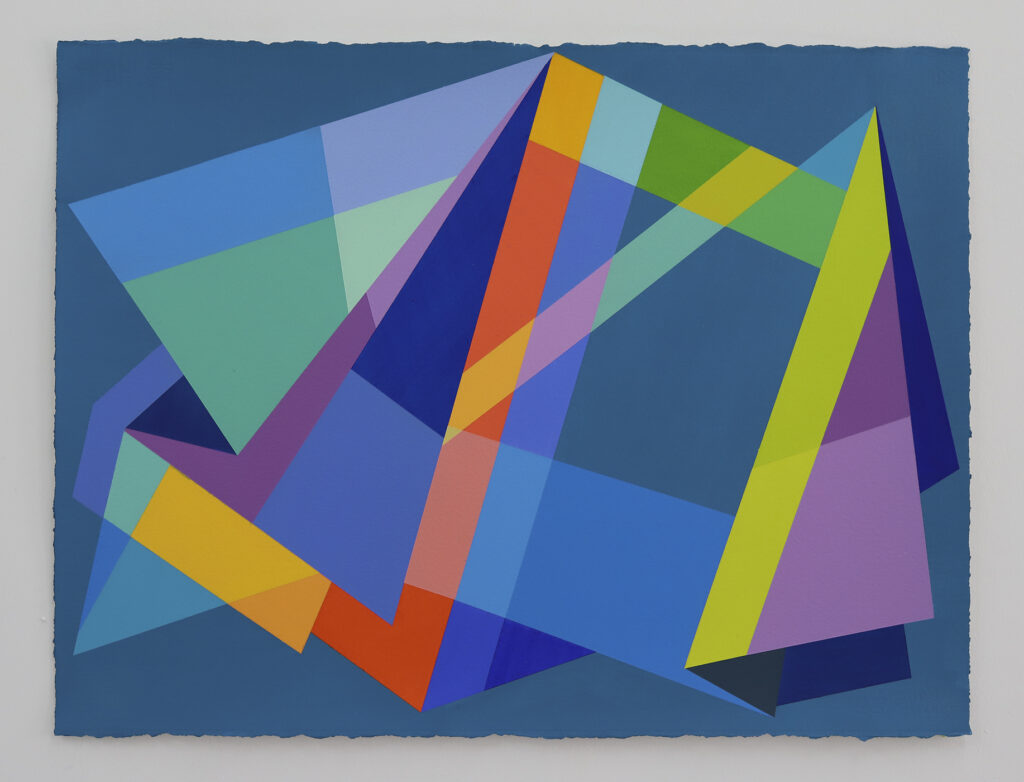
Her use of color and line also serves this diagonally embedded spatial construction. Hellmann frequently uses clear colored stripes, edges, and transitions between surfaces to further emphasize the angular relationships between different planes. For her, color is not a lyrical application, but rather a structural developer: which surface is lighter, which is heavier, which angle is sharper, which part seems to be penetrated by light, are often enhanced through the distribution of color stripes. In her recent works and exhibition texts, she repeatedly revolves around light, perception, transparent layers, and abstract space. The 2024 "Interweave" series further combines transparent materials, fabric, lines, mylar, and painting, making the layers both obscure and reveal each other, further expanding the concept of "embedding": not only are forms embedded in forms, but also light, texture, and a sense of memory are embedded in the picture.
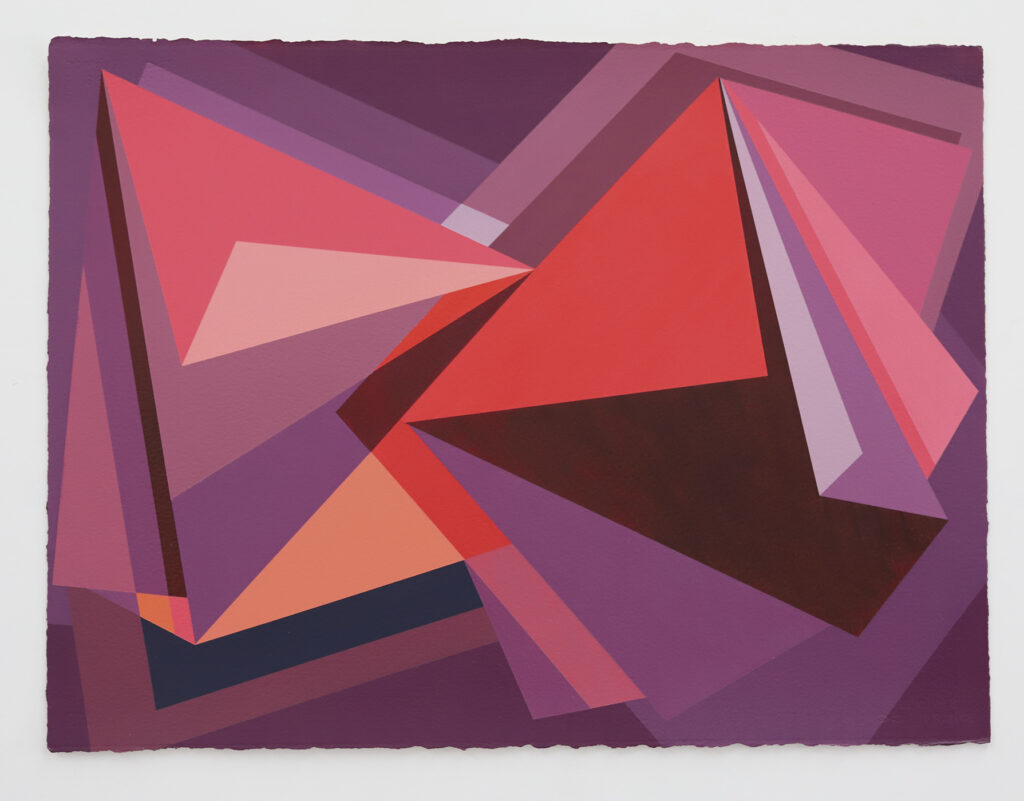
The most brilliant aspect of Rachel Hellmann's work lies in her avoidance of presenting geometric abstraction as a closed, cold, rigid system focused solely on order. Instead, she often creates a subtle surrealism within a minimalist language. The description in the Elizabeth Houston Gallery notes that her work lies between "geometric rigor" and "surreal illusion," simultaneously incorporating both actual and illusory spaces into the viewer's experience. This is particularly crucial for "diagonally embedded modules," as oblique structures naturally introduce instability: unlike vertical-horizontal systems, they are less prone to stillness, more easily triggering sensations of floating, tilting, shifting, penetration, and suspension. Hellmann transforms this instability into an elegant and restrained geometric poetics.
In terms of formal structure, Rachel Hellmann's typical approach can be summarized as: replacing flat surfaces with folds, replacing upright placement with oblique cuts, replacing juxtaposition with interlacing, and replacing single-point viewing with moving views. The exhibition description also clearly points out that the back and sides of her three-dimensional paintings are treated in their entirety, therefore viewers must move their bodies to truly understand the works. This indicates that her geometry is not a "frontal image," but a spatial object that needs to be viewed from different angles and re-evaluated. In such works, diagonals are no longer merely directions on the drawing, but become part of the viewer's bodily experience: the more you move, the more you feel a certain oblique surface being embedded from another structure, or being reabsorbed by another structure.
Therefore, placing Rachel Hellmann within the "diagonal embedding module" is highly accurate. Her value lies not only in the beauty of her work, nor merely in combining origami, architecture, and painting, but in her demonstration that geometric abstraction can gain new life through "oblique intervention": stable structures are thus broken, the boundaries of the plane are pushed aside, and geometry transforms from a figure into an event, from order into a process of spatial occurrence. Her work shows us that diagonal embedding is not simply a compositional technique, but a sophisticated method of transforming geometric forms into perceptual tension, spatial illusion, and bodily experience. This is precisely Rachel Hellmann's unique significance in geometric abstract art.
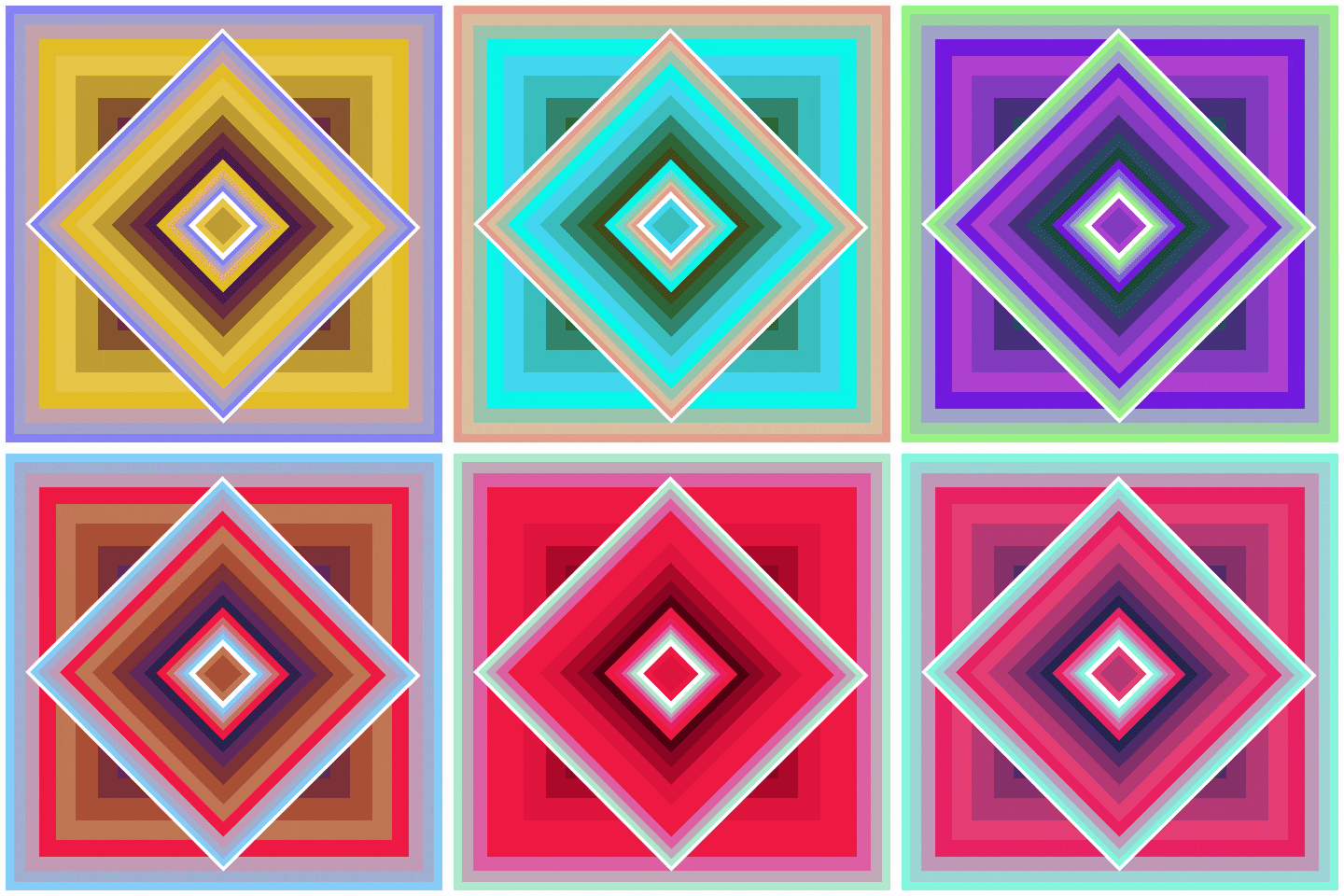
Lessons F2-17: Analysis of Rachel Hellmann's Works (Click to listen to the reading)
Rachel Hellmann is a representative artist in contemporary geometric abstraction who is perfectly suited to the "diagonal embedded module." Her work spans painting, sculpture, and installation, and has long developed a distinct path: instead of simply laying geometric shapes flat on the canvas, she transforms folded, bent, tilted, and cut-in geometric structures into a kind of "form painting" that is both real and possesses an optical illusion. She is particularly known for her wooden shaped paintings, which are both paintings and objects with thickness; they have clear boundaries, yet constantly create spatial ambiguity for the viewer. If we understand Rachel Hellmann in terms of "diagonal embeddedness," her key lies not in simply using diagonal lines, but in turning the "diagonal direction" into a structural event. Traditional geometric composition often relies on vertical and horizontal lines to establish a stable order, but Hellmann often inserts folded surfaces, beveled edges, sharp corners, and beam-like units from the side, giving the picture a sense of deflection, cantilever, overturning, inward folding, and traversal. For her, the diagonal is not an auxiliary line, but a main axis that changes the center of gravity and spatial judgment. This is precisely why her works often evoke a viewing experience of "disrupted gravity": the viewer feels one surface pressing forward while another seems to recede, activating the plane into an unstable yet highly precise spatial system. Galleri Urbane's summary of her work emphasizes this "distorted sense of gravity" and perceptual dislocation created by geometry, light, and color. Hellmann's work is also well-suited to this module because she handles "embedding" very concretely. Many of her forms are not completely closed geometric blocks, but rather parts cut out, folded, pushed forward, or inserted from a larger structure. In this way, geometry is no longer a static pattern, but a deformed extension like architectural components, kite frames, origami layers, or ceiling beams. In introducing her exhibition "Boats on the Ceiling," Elizabeth Houston Gallery mentions that she transforms architectural experience into a geometric system with a magical and heterogeneous feel, establishing complex visual-spatial relationships through the simplest shaping methods such as folding, bending, and crease. This is crucial because the essence of "diagonal embedding" is not merely the repetition of rules, but rather the disruption of balance through diagonal intervention, followed by the reconstruction of a new order. In terms of material language, Rachel Hellmann is also distinctly different from artists who only work with diagonal relationships on two-dimensional canvases. She frequently uses wood panels, especially poplar wood, as a base, then uses cutting, splicing, sanding, and painting to truly create the folds. The Zillman Art Museum's description points out that her forms undergo processes such as planing, cutting, assembling, gluing, clamping, and sanding, before being combined with color bands and linear organization to complete the image. This means that her "diagonals" are not merely painted illusions, but often possess real thickness and edges. Thus, diagonal embedding in her work has two layers of meaning: one is the structure realistically extending into space; the other is that the painting further amplifies this sense of extension, causing the viewer to constantly oscillate between "the object is real" and "the space is an illusion." Her use of color and line also serves this spatial construction of diagonal embedding. Hellmann frequently employs clear colored stripes, edges, and transitions between surfaces to further emphasize the angular relationships between different planes. Color in her work is not a lyrical application, but rather a structural developer: which surface is lighter, which is heavier, which angle is sharper, which part seems to be penetrated by light—these are often reinforced through the distribution of color stripes. In her recent works and exhibition texts, she repeatedly explores light, perception, transparent layers, and abstract space. Her 2024 "Interweave" series further combines transparent materials, fabric, lines, mylar, and painting, creating layers that both obscure and reveal, further expanding the concept of "embedding": not only forms are embedded within forms, but also light, texture, and a sense of memory are embedded in the picture. The most brilliant aspect of Rachel Hellmann's work lies in the fact that she doesn't create a closed, cold, rigid system of purely ordered geometric abstraction. Instead, she often creates a subtle surrealism within a minimalist language. The description in the Elizabeth Houston Gallery states that her work lies between "geometric rigor" and "surreal illusion," simultaneously incorporating both actual and illusory spaces into the viewer's experience. This is particularly crucial for "diagonally embedded modules," as oblique structures naturally introduce instability: unlike vertical-horizontal systems, they are not easily static, but rather more prone to triggering sensations of floating, tilting, shifting, penetrating, and suspended. Hellmann transforms this instability into an elegant and restrained geometric poetics. In terms of formal structure, Rachel Hellmann's typical approach can be summarized as: replacing planes with folds, replacing upright positions with oblique cuts, replacing juxtaposition with interlacing, and replacing single-point viewing with moving views. The exhibition description also explicitly points out that the back and sides of her three-dimensional paintings are treated fully, thus requiring viewers to move their bodies to truly understand the work. This indicates that her geometry is not a "frontal image," but a spatial object that needs to be viewed from different angles and re-evaluated. In such works, diagonals are no longer merely directions on a drawing, but become part of the viewer's bodily experience: the more you move, the more you feel a slope emerging from or being reabsorbed by another structure. Therefore, placing Rachel Hellmann within the "diagonally embedded module" is highly accurate. Her value lies not only in the beauty of her work, nor merely in combining origami, architecture, and painting, but in her demonstration that geometric abstraction can gain new life through "diagonal intervention": stable structures are thus broken, the boundaries of the plane are pushed aside, and geometry transforms from a figure into an event, from order into a process of spatial occurrence. Her work shows us that diagonal embedding is not simply a compositional technique, but a sophisticated method of transforming geometric forms into perceptual tension, spatial illusion, and bodily experience. This is precisely Rachel Hellmann's unique significance in geometric abstract art.
 简体中文
简体中文  English
  日本語
日本語  Español
  Français
  हिन्दी
  العربية
  বাংলা
বাংলা  Português do Brasil
  Русский
  اردو
اردو  Bahasa Indonesia
  Deutsch
  Kiswahili
  मराठी
मराठी  తెలుగు
  Tiếng Việt
  Türkçe
  Italiano
  தமிழ்
தமிழ்  한국어
한국어