
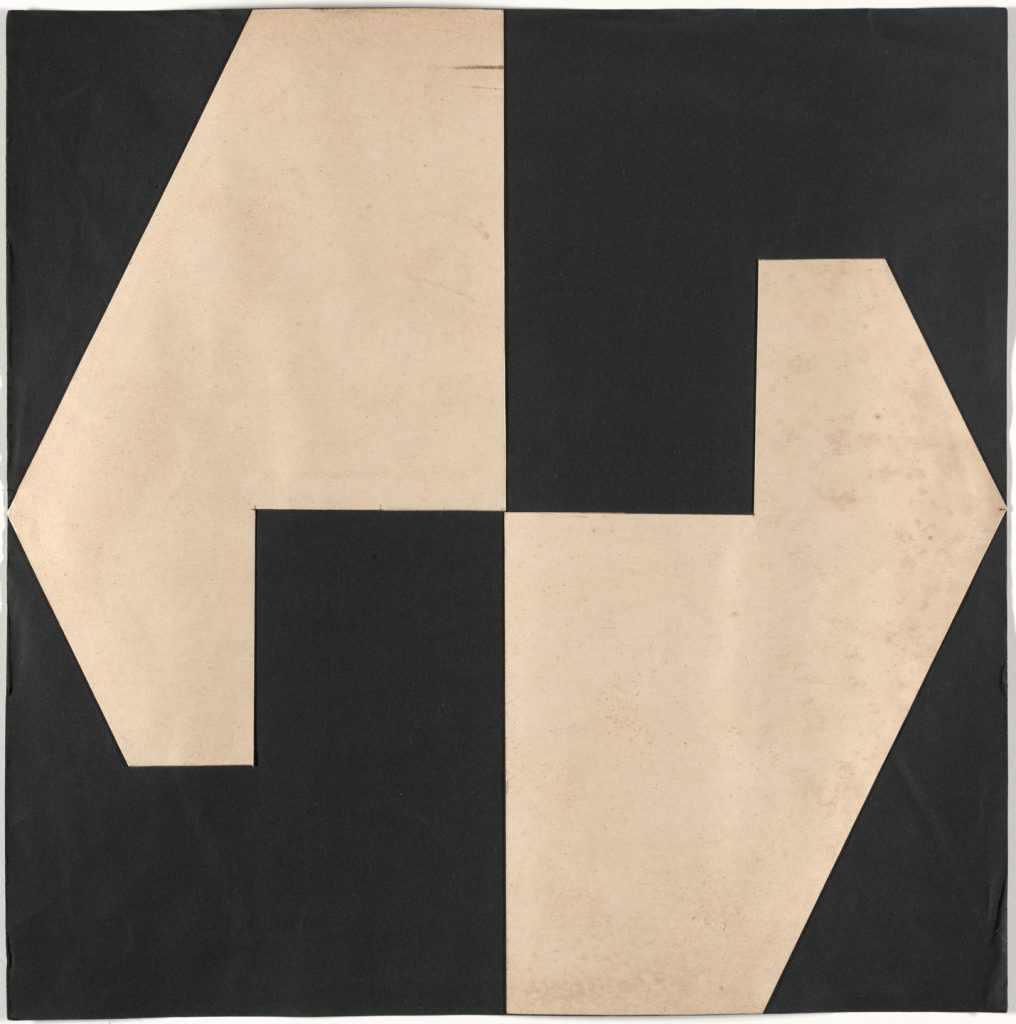
Ygia Clark's *Planes in Modulated Surface 4*, created in 1957 and now housed at the Museum of Modern Art (MoMA) in New York, is a work of Formica and industrial varnish on a wooden panel, measuring approximately 99.7 × 99.7 cm. It belongs to Clark's "Planes in Modulated Surface" series, which she developed intensively in 1957. MoMA's audio guide explains that this series of works represents the result of her rapid exploration of issues such as "movement, transformation, reflection, and the binary relationship between black and white"; in other words, this work is not an isolated geometric drawing, but rather a key point formed after she continuously refined structural changes within a short period.
If we analyze this work within the context of the "misaligned layering module," its representativeness becomes very clear. Clark doesn't create depth through heavy perspective, but rather through the offset, folding, interlocking, and adjacency of black and white planes, allowing different planes to form a relationship that is both close and staggered within the same image. The MoMA guided tour specifically mentions that she used the idea of "rotating around a central axis or pivot point" to initiate the sense of movement in this work; this indicates that the key to the work is not the individual geometric shapes themselves, but how the planes are relatively displaced as if driven by an axis. In other words, the "layering" here is not a static stacking, but a structural superposition with twists and turns.
The most important aspect of this work lies in its transformation of "layers" from a visual illusion into a method of composition. A MoMA research article, discussing Clark's works from 1957-1959, points out that the "modulated surfaces" of this period were not simply the removal of the background, but rather more like "planes added on top of planes," generating a sense of density and cohesion through the displacement and layering of adjacent color blocks. This assessment perfectly reveals the essence of *Planes in Modulated Surface 4*: Clark did not paint a three-dimensional object on a plane, but rather established a continuous relationship of "displacement—layering—re-displacement" between planes. Thus, the boundaries are no longer merely outlines, but become a transitional zone with a sense of thickness.
Formally, the brilliance of this work lies in its ability to create a complex spatial effect from the binary relationship between black and white. The MoMA audio mentions that Clark repeatedly considered the initiation methods of black and white, binaryity, reflection, and geometric composition; in this work, black and white are not simply opposites, but rather transformed into a continuously moving relationship through compression, folding, and displacement at their boundaries. What the viewer sees is not a quiet, flat expanse of black and white, but rather a series of planes interlocking, rotating, and shifting. Because the image is almost compressed to only black, white, and boundaries, all visual energy is concentrated on questions such as "where the displacement occurred," "which layer seems to flip forward," and "which line appears to be created by the compression of two layers."
Therefore, the inspiration for "misaligned layered modules" in *Planes in Modulated Surface 4* is not merely a formal geometric assembly, but rather it proposes a deeper structural perspective: the relationship between layers can generate enormous tension through minute displacements. A research article at MoMA summarizes Clark's achievements at this stage as follows: the work is not formed by subtracting materials, but by modulating and accumulating layers to reveal a "line like space." This description is very suitable for understanding this work—the most crucial element is often not the black or white surface itself, but the "functional boundary" that appears where the two meet. That line is not simply an outline, but a spatial trace left after the planes are misaligned.
From the perspective of Clark's personal development, this work also represents a turning point. The MoMA audio guide mentions that it's almost impossible to accurately distinguish the chronological order of the related research drafts because she was pushing these ideas forward very rapidly at the time; at the same time, the guide also points out that we can almost sense her growing dissatisfaction with the "limitations of the painted surface and geometric framework." In other words, while *Planes in Modulated Surface 4* is still a painting, it is already approaching the boundaries of painting: the plane seems to be folding out of space, the boundaries seem to be detaching from the surface, and the structure seems to be transforming from the painting into an object. This explains why Clark later continued to develop works with greater mobility and spatiality, such as "Counter Reliefs" and "Bichos."
From today's perspective, this work remains highly inspiring for "misaligned layered modules." It demonstrates that layering doesn't necessarily rely on transparent materials or increased thickness; it can also be achieved through extremely precise misalignment between planes, axial organization, and control of black and white boundaries. It is particularly suitable for translation into the design of wooden panel assemblies, acrylic sheets, architectural facade angles, paper art folding, interface layering, and interactive modules because it offers not some random pattern, but a clear methodology: first establish the plane, then create displacement; first maintain overall order, then let the boundaries generate space. Lygia Clark's work in *Planes in Modulated Surface 4* elevates "misaligned layering" from a visual effect to a structural principle, allowing geometric abstraction to reveal its impulse towards real space for the first time.
Lessons F2-21: Analysis of Ygia Clark's Works (Click to view and listen to the reading)
Ygia Clark's *Planes in Modulated Surface 4*, created in 1957 and now housed in the Museum of Modern Art (MoMA) in New York, is a work of Formica and industrial varnish on a wooden panel, measuring approximately 99.7 × 99.7 cm. It belongs to Clark's "Planes in Modulated Surface" series, which she developed intensively in 1957. MoMA's audio guide indicates that this series was the result of her rapid exploration of issues such as "movement, transformation, reflection, and the binary relationship between black and white"; that is, this work is not an isolated geometric drawing, but rather a key node formed after she continuously refined structural changes within a short period. If this work is analyzed within the context of "misaligned, layered modules," its representativeness becomes very clear. Clark does not create depth through heavy perspective, but rather through the offset, folding, interlocking, and adjacency of black and white planes, allowing different planes to form a relationship that is both fitting and staggered within the same picture. The MoMA tour specifically mentions that she used the idea of "rotating around a central axis or pivot point" to initiate the sense of movement in this work; this indicates that the key to the work is not the individual geometric shapes themselves, but how the planes are relatively displaced as if driven by an axis. In other words, the "layering" here is not static stacking, but a structural superposition with transitions and shifts. The most important aspect of this work is that it transforms "layers" from a visual illusion into a method of composition. MoMA's research article, when discussing Clark's related works from 1957 to 1959, points out that the "modulated surfaces" of this period are not simply the removal of the background, but more like "planes added on top of planes," generating a sense of density and cohesion through the displacement and layering of adjacent color blocks. This judgment precisely reveals the essence of *Planes in Modulated Surface 4*: Clark did not draw a three-dimensional object on a plane, but established a continuous relationship of "displacement-layering-displacement" between planes. Thus, the boundary is no longer just an outline, but becomes a transitional zone with a sense of thickness. Formally, the brilliance of this work lies in its ability to create a complex spatial effect from the binary relationship between black and white. The MoMA audio mentions that Clark repeatedly considered the initiation methods of black and white, binaryity, reflection, and geometric composition; in this work, black and white are not simply opposites, but are transformed into a continuously moving relationship through compression, folding, and misalignment at the boundaries. What the viewer sees is not a quiet, flat black and white surface, but rather a set of planes interlocking, rotating, and shifting. Because the image is almost compressed to only black, white, and boundaries, all visual energy is concentrated on questions such as "where the displacement occurs," "which layer seems to flip forward," and "which line seems to be created by the compression of two layers." Therefore, the inspiration for "misaligned layered modules" in *Planes in Modulated Surface 4* is not merely a formal geometric patchwork, but rather it proposes a deeper structural perspective: the relationship between layers can generate enormous tension through minute displacements. MoMA's research article summarizes Clark's achievements at this stage as follows: the work is not formed by subtracting materials, but by layering and accumulating them to make a "line like space" emerge. This description is very suitable for understanding this work—the most crucial element in the work is often not the black or white surface itself, but the "functional boundary" that appears when the two meet. That line is not a simple outline, but a spatial trace left after the plane is misaligned. From the perspective of Clark's personal development, this work is also at a turning point. The MoMA audio guide mentions that it is almost impossible to accurately distinguish the order of the relevant research drafts because she was pushing these ideas very quickly at the time; at the same time, the guide also points out that we can almost feel her growing dissatisfaction with the "limitations of the painted surface and geometric framework". In other words, although *Planes in Modulated Surface 4* is still a painting, it is already approaching the boundaries of painting: the plane seems to be folding out of space, the boundary seems to be detaching from the surface, and the structure seems to be transforming from the painting into an object. This explains why Clark later developed works like "Counter Reliefs" and "Bichos," which are more dynamic and spatial. From today's perspective, this work remains highly inspiring for "misaligned layered modules." It demonstrates that layering doesn't necessarily rely on transparent materials or increased thickness; it can also be achieved through precise misalignment between planes, axial organization, and control of black and white boundaries. It is particularly suitable for translation into wood paneling, acrylic stacking, architectural facade folding, paper art layering, interface layering, and interactive module design because it offers not some random pattern, but a clear methodology: first establish the plane, then create displacement; first maintain overall order, then let the boundaries generate space. Lygia Clark's work in *Planes in Modulated Surface 4* elevates "misaligned layering" from a visual effect to a structural principle, allowing geometric abstraction to reveal its impulse towards real space for the first time.
 简体中文
简体中文  English
  日本語
日本語  Español
  Français
  हिन्दी
  العربية
  বাংলা
বাংলা  Português do Brasil
  Русский
  اردو
اردو  Bahasa Indonesia
  Deutsch
  Kiswahili
  मराठी
मराठी  తెలుగు
  Tiếng Việt
  Türkçe
  Italiano
  தமிழ்
தமிழ்  한국어
한국어