
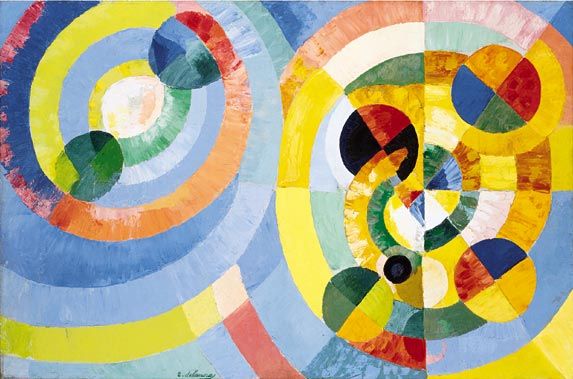
František Kupka's *Study for “Disks of Newton”*, painted around 1911–1912, with an inscription dated 1912, is now in the Guggenheim Museum, New York. Painted on paper, it measures approximately 24.8 × 27.9 cm. Although a study on paper, it is not a marginal sketch, but rather a crucial formal experiment in Kupka's journey towards pure abstraction. The Guggenheim included this work in its Orffian collection, and the formal title *Disks of Newton (Study for “Fugue in Two Colors”)* further indicates that Kupka was already attempting to combine color, optics, and musical organization into a new abstract language.
If this work is understood within the framework of the "concentric expansion module," its typicality becomes very strong. The image is not composed of horizontal and vertical grids, but rather uses a basic order of centers, discs, arcs, and ring-shaped color bands, continuously expanding outward from the center. Here, "concentricity" is not a mechanical interlocking of rings, but a rhythmic expansion structure: some discs are complete and clear, some are only arc segments, some color rings overlap each other, and some seem to be spreading towards the edge of the image. In other words, Kupka is not depicting static circular objects, but rather using circumferential relationships to organize a continuously overflowing visual energy field.
The most noteworthy aspect of this work is its elevation of the "circle" from a mere geometric form to a structural principle. Britannica's description of the formal work, *Disks of Newton (Study for “Fugue in Two Colors”)*, points out that the title directly relates to Newton's research on the spectrum, specifically the idea that sunlight can be broken down into a continuous color spectrum. In this study, the bands of red, orange, yellow, green, and blue are not attached to the surface of an object, but rather organized into a rotating, overlapping, and advancing circular system. Color here is no longer a filler, but part of the structure itself: the further outward the colors expand, the stronger the circular order, thus giving the entire composition a pulsating rhythm emanating from the center.
Visually, the charm of this work lies not in symmetry, but in "order within movement." Concentric expanding modules often fall into rigid repetition, but Kupka maintains the vitality of the image through differences in size, discontinuous curves, overlapping color layers, and changes in direction. What the viewer sees is not a rigid, locked circular system, but rather a series of constantly vibrating discs, sound waves, or tracks. Therefore, although this work is a two-dimensional abstraction, it possesses a strong sense of time and music. Britannica explicitly mentions that the "Fugue" in the title refers to the fugue in music, and Kupka is attempting to make the visual structure repeat, vary, and progress like a musical theme.
This also explains why *Study for “Disks of Newton”* is so important in the history of geometric abstraction. It demonstrates that “concentric expanding modules” are not simply nested circles, but can develop into a more complex perceptual system: the center focuses, the outer rings diffuse, overlapping areas create rhythm and depth, and the composite color bands make the image seem to vibrate. In other words, Kupka advanced geometric abstraction from static segmentation to dynamic generation. He didn't use circles to decorate the image, but rather to establish order, organize the spectrum, simulate music, and allow the viewer to experience a continuous rotation and expansion.
From a contemporary creative perspective, this work still offers direct inspiration for the concentric expansion module. It is particularly well-suited for translation into light installations, glass interlayers, sound visualizations, interactive projections, interface animations, and spatial wayfinding systems because it offers not a fixed pattern, but a set of enlargeable, parameterized, and dynamic circular structural logics. Center, radius, color spectrum, layering, and diffusion—these elements can all continue to grow within contemporary materials and digital media. Therefore, *Study for “Disks of Newton”* is not only a key exercise in Kupka's abstract explorations but also an important prototype for the development of the "concentric expansion module" from geometric form into a visual system.
Lessons F2-13: Analysis of František Kupka's Works (Click to view and listen to the reading)
František Kupka's *Study for “Disks of Newton”*, painted around 1911–1912, with an inscription dated 1912, is now in the Guggenheim Museum, New York. Painted on paper, it measures approximately 24.8 × 27.9 cm. Although a study on paper, it is not a marginal sketch, but rather a crucial formal experiment in Kupka's journey towards pure abstraction. The Guggenheim included this work in its Orffian collection, and the formal title *Disks of Newton (Study for “Fugue in Two Colors”)* further indicates that Kupka was already attempting to combine color, optics, and musical organization into a new abstract language. Its typicality is striking when understood within the context of "concentric expansion modules." The composition is not based on a horizontal or vertical grid, but rather on a fundamental order of centers, discs, arcs, and circular color bands, expanding outwards from the center. The "concentricity" here is not a mechanical ringing, but a rhythmic expansion structure: some discs are complete and clear, some are only arcs, some color rings overlap each other, and some seem to be spreading towards the edge of the picture. In other words, Kupka is not depicting static circular objects, but organizing a continuously overflowing visual energy field using circumferential relationships. The most noteworthy aspect of this work is that it elevates the "circle" from an ordinary geometric form to a structural principle. Britannica's description of the formal work "Disks of Newton (Study for "Fugue in Two Colors")" points out that the title directly relates to Newton's research on the spectrum, namely the idea that sunlight can be decomposed into a continuous spectrum. In this study, the bands of red, orange, yellow, green, and blue are not attached to the surface of an object, but are organized into a rotating, overlapping, and advancing circular system. Color here is no longer a filler, but part of the structure itself: the further the colors expand outward, the stronger the circumferential order, and the entire picture thus acquires a rhythmic pulsation from the center outward. Visually, the charm of this work lies not in symmetry, but in "order within movement." Concentric expanding modules often fall into rigid repetition, but Kupka maintains the vitality of the image through differences in size, discontinuous curves, overlapping color layers, and changes in direction. What the viewer sees is not a rigid, locked circular system, but rather a series of constantly vibrating discs, sound waves, or tracks. Therefore, although this work is a planar abstraction, it possesses a strong sense of time and music. Britannica explicitly mentions that the "Fugue" in the title refers to the fugue in music, and Kupka is attempting to make the visual structure repeat, vary, and advance like a musical theme. This also explains why *Study for “Disks of Newton”* is so important in the history of geometric abstraction. It demonstrates that "concentric expanding modules" are not simply nested circles, but can develop into a more complex perceptual system: the center focuses, the outer rings diffuse, the overlapping parts create rhythm and depth, and the composite color bands make the image appear to vibrate. In other words, Kupka advanced geometric abstraction from static division to dynamic generation. He didn't use circles to decorate the image, but rather to establish order, organize the spectrum, simulate music, and allow the viewer to experience a continuous rotation and expansion. From today's creative perspective, this work still directly inspires the concentric expansion module. It is particularly suitable for translation into light installations, glass interlayers, sound visualizations, interactive projections, interface animations, and spatial wayfinding systems because it offers not a fixed pattern, but a set of circular structural logic that can be magnified, parameterized, and dynamic. Center, radius, spectrum, layering, diffusion—these elements can continue to grow within contemporary materials and digital media. Therefore, *Study for “Disks of Newton”* is not only a key study in Kupka's abstract exploration but also an important prototype for the development of the "concentric expansion module" from geometric form into a visual system.
 简体中文
简体中文  English
  日本語
日本語  Español
  Français
  हिन्दी
  العربية
  বাংলা
বাংলা  Português do Brasil
  Русский
  اردو
اردو  Bahasa Indonesia
  Deutsch
  Kiswahili
  मराठी
मराठी  తెలుగు
  Tiếng Việt
  Türkçe
  Italiano
  தமிழ்
தமிழ்  한국어
한국어